Joint BioEnergy Institute, Emeryville, CA, USA.
Mol Syst Biol. 2011 May 10;7:487. doi: 10.1038/msb.2011.21.
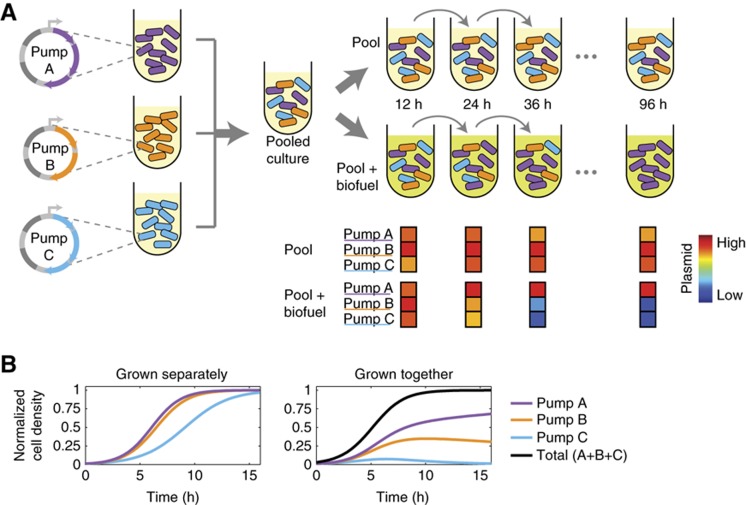
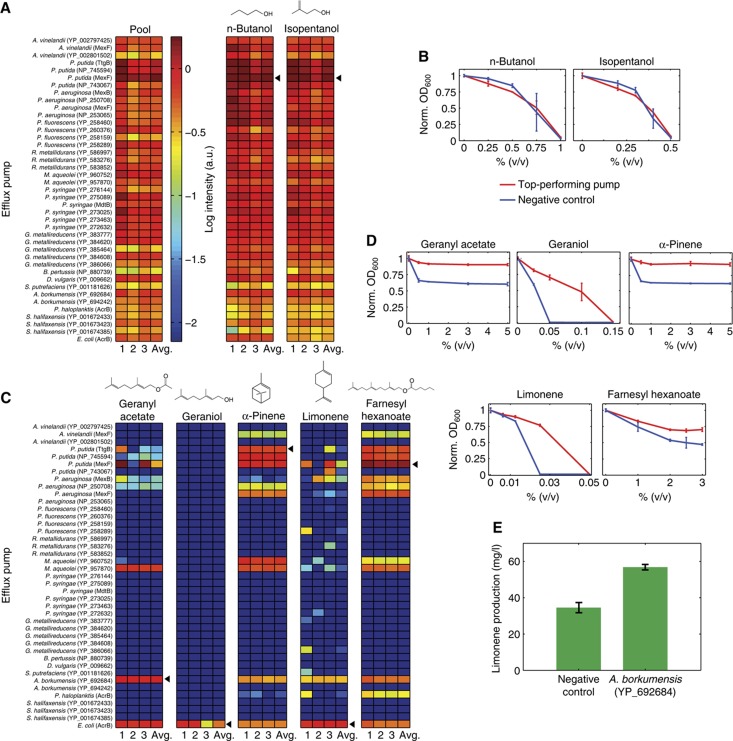
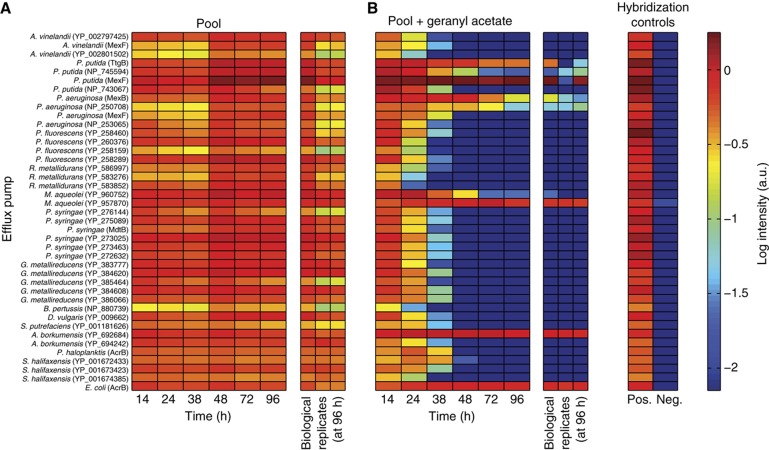
Many compounds being considered as candidates for advanced biofuels are toxic to microorganisms. This introduces an undesirable trade-off when engineering metabolic pathways for biofuel production because the engineered microbes must balance production against survival. Cellular export systems, such as efflux pumps, provide a direct mechanism for reducing biofuel toxicity. To identify novel biofuel pumps, we used bioinformatics to generate a list of all efflux pumps from sequenced bacterial genomes and prioritized a subset of targets for cloning. The resulting library of 43 pumps was heterologously expressed in Escherichia coli, where we tested it against seven representative biofuels. By using a competitive growth assay, we efficiently distinguished pumps that improved survival. For two of the fuels (n-butanol and isopentanol), none of the pumps improved tolerance. For all other fuels, we identified pumps that restored growth in the presence of biofuel. We then tested a beneficial pump directly in a production strain and demonstrated that it improved biofuel yields. Our findings introduce new tools for engineering production strains and utilize the increasingly large database of sequenced genomes.
许多被认为是先进生物燃料候选物的化合物对微生物有毒。这在为生物燃料生产工程代谢途径时引入了一个不理想的权衡,因为工程微生物必须在生产和生存之间取得平衡。细胞外排系统,如外排泵,为降低生物燃料毒性提供了直接的机制。为了鉴定新型生物燃料泵,我们使用生物信息学从测序细菌基因组中生成了所有外排泵的列表,并为克隆确定了一组目标。由此产生的 43 个泵的文库在大肠杆菌中异源表达,我们用七种代表性生物燃料对其进行了测试。通过使用竞争生长测定法,我们有效地区分了提高生存能力的泵。对于两种燃料(正丁醇和异戊醇),没有一种泵能提高耐受性。对于所有其他燃料,我们都鉴定出了在存在生物燃料时能恢复生长的泵。然后,我们在生产菌株中直接测试了一种有益的泵,并证明它提高了生物燃料的产量。我们的发现为工程生产菌株引入了新的工具,并利用了不断增加的测序基因组数据库。