EM-unit, CODA-CERVA, Groeselenberg 99, Brussels, Belgium.
J Nanobiotechnology. 2011 May 11;9:17. doi: 10.1186/1477-3155-9-17.
Transmission electron microscopy (TEM) remains an important technique to investigate the size, shape and surface characteristics of particles at the nanometer scale. Resulting micrographs are two dimensional projections of objects and their interpretation can be difficult. Recently, electron tomography (ET) is increasingly used to reveal the morphology of nanomaterials (NM) in 3D. In this study, we examined the feasibility to visualize and measure silica and gold NM in suspension using conventional bright field electron tomography.
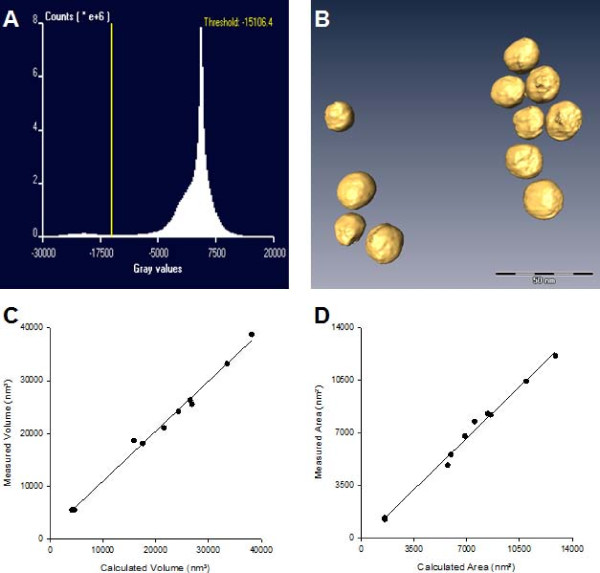
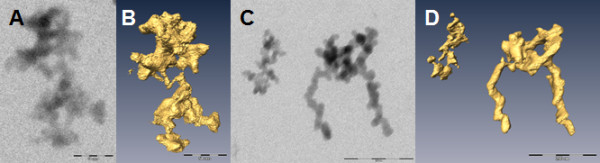
The general morphology of gold and silica NM was visualized in 3D by conventional TEM in bright field mode. In orthoslices of the examined NM the surface features of a NM could be seen and measured without interference of higher or lower lying structures inherent to conventional TEM. Segmentation by isosurface rendering allowed visualizing the 3D information of an electron tomographic reconstruction in greater detail than digital slicing. From the 3D reconstructions, the surface area and the volume of the examined NM could be estimated directly and the volume-specific surface area (VSSA) was calculated. The mean VSSA of all examined NM was significantly larger than the threshold of 60 m(2)/cm(3). The high correlation between the measured values of area and volume gold nanoparticles with a known spherical morphology and the areas and volumes calculated from the equivalent circle diameter (ECD) of projected nanoparticles (NP) indicates that the values measured from electron tomographic reconstructions are valid for these gold particles.
The characterization and definition of the examined gold and silica NM can benefit from application of conventional bright field electron tomography: the NM can be visualized in 3D, while surface features and the VSSA can be measured.
透射电子显微镜(TEM)仍然是一种研究纳米尺度颗粒尺寸、形状和表面特征的重要技术。得到的显微照片是物体的二维投影,其解释可能很困难。最近,电子断层扫描(ET)越来越多地用于揭示纳米材料(NM)的 3D 形态。在这项研究中,我们考察了使用常规明场电子断层扫描可视化和测量悬浮液中二氧化硅和金 NM 的可行性。
通过常规 TEM 明场模式在 3D 中可视化了金和二氧化硅 NM 的一般形态。在检查 NM 的正交切片中,可以看到 NM 的表面特征,并且可以进行测量,而不会受到常规 TEM 中固有更高或更低层结构的干扰。通过等表面渲染进行分割,可以比数字切片更详细地可视化电子断层重建的 3D 信息。从 3D 重建中,可以直接估计检查 NM 的表面积和体积,并计算体积比表面积(VSSA)。所有检查 NM 的平均 VSSA 明显大于 60 m²/cm³的阈值。具有已知球形形态的测量值与投影纳米粒子(NP)的等效圆直径(ECD)计算出的面积和体积之间的高度相关性表明,从电子断层重建中测量的值对这些金粒子有效。
常规明场电子断层扫描的应用可以使所检查的金和二氧化硅 NM 的特征和定义受益:可以在 3D 中可视化 NM,同时可以测量表面特征和 VSSA。