NanoScience Technology Center and Department of Chemistry, University of Central Florida, Orlando, FL 32826, USA.
J Nanobiotechnology. 2011 May 23;9:20. doi: 10.1186/1477-3155-9-20.
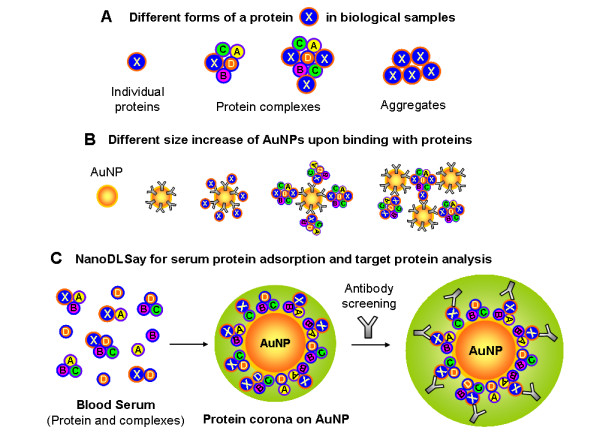
Gold nanoparticles (AuNPs) scatter light intensely at or near their surface plasmon wavelength region. Using AuNPs coupled with dynamic light scattering (DLS) detection, we developed a facile nanoparticle immunoassay for serum protein biomarker detection and analysis. A serum sample was first mixed with a citrate-protected AuNP solution. Proteins from the serum were adsorbed to the AuNPs to form a protein corona on the nanoparticle surface. An antibody solution was then added to the assay solution to analyze the target proteins of interest that are present in the protein corona. The protein corona formation and the subsequent binding of antibody to the target proteins in the protein corona were detected by DLS.
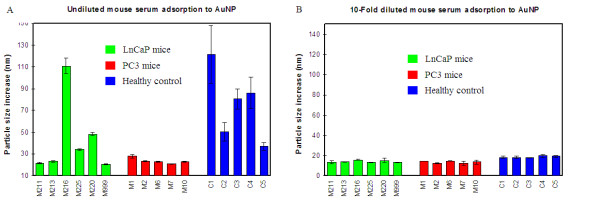
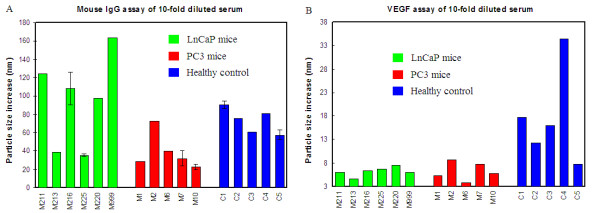
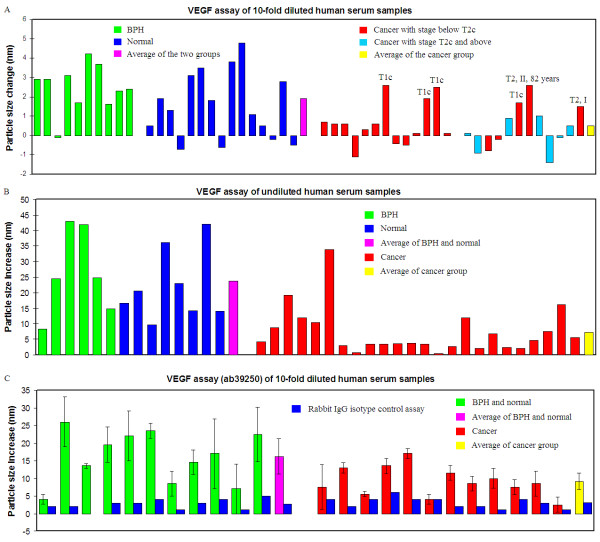
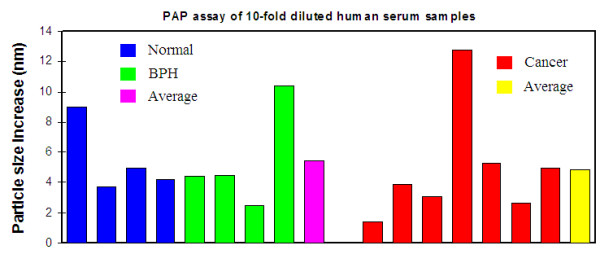
Using this simple assay, we discovered multiple molecular aberrations associated with prostate cancer from both mice and human blood serum samples. From the mice serum study, we observed difference in the size of the protein corona and mouse IgG level between different mice groups (i.e., mice with aggressive or less aggressive prostate cancer, and normal healthy controls). Furthermore, it was found from both the mice model and the human serum sample study that the level of vascular endothelial growth factor (VEGF, a protein that is associated with tumor angiogenesis) adsorbed to the AuNPs is decreased in cancer samples compared to non-cancerous or less malignant cancer samples.
The molecular aberrations observed from this study may become new biomarkers for prostate cancer detection. The nanoparticle immunoassay reported here can be used as a convenient and general tool to screen and analyze serum proteins and to discover new biomarkers associated with cancer and other human diseases.
金纳米粒子(AuNPs)在其表面等离子体波长区域或附近强烈散射光。我们使用 AuNPs 与动态光散射(DLS)检测相结合,开发了一种用于血清蛋白生物标志物检测和分析的简便纳米粒子免疫测定法。首先将血清样品与柠檬酸保护的 AuNP 溶液混合。来自血清的蛋白质被吸附到 AuNPs 上,在纳米粒子表面形成蛋白质冠。然后向测定溶液中加入抗体溶液,以分析存在于蛋白质冠中的感兴趣的靶蛋白。通过 DLS 检测蛋白质冠的形成以及随后抗体与蛋白质冠中的靶蛋白的结合。
使用这种简单的测定法,我们从人和小鼠血清样本中发现了与前列腺癌相关的多种分子异常。从小鼠血清研究中,我们观察到不同小鼠组(即具有侵袭性或侵袭性较小的前列腺癌以及正常健康对照小鼠)之间的蛋白质冠大小和小鼠 IgG 水平存在差异。此外,从小鼠模型和人血清样本研究中发现,与非癌性或恶性较小的癌症样本相比,吸附到 AuNPs 上的血管内皮生长因子(VEGF,与肿瘤血管生成相关的蛋白质)水平在癌症样本中降低。
本研究中观察到的分子异常可能成为前列腺癌检测的新生物标志物。这里报道的纳米粒子免疫测定法可以用作筛选和分析血清蛋白并发现与癌症和其他人类疾病相关的新生物标志物的简便而通用的工具。