Key Laboratory of Major Diseases in Children and National Key Discipline of Pediatrics (Capital Medical University), Ministry of Education, Beijing Pediatric Research Institute, Beijing Children's Hospital, Capital Medical University, Beijing, China.
Institute of Human Nutrition, College of Physicians and Surgeons, Columbia University, New York, USA.
Nutr Metab (Lond). 2011 May 24;8(1):31. doi: 10.1186/1743-7075-8-31.
The expression of leptin is increased in obesity and inhibited by n-3 polyunsaturated fatty acids (n-3 PUFAs), but the underlying molecular mechanisms have not been firmly established.
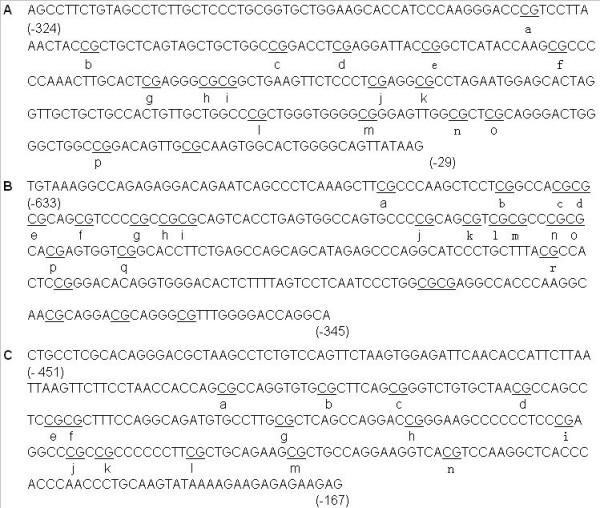
In this study, we investigated the effects of dietary n-3 PUFAs on the methylation of CpG islands in the promoter regions of the leptin, leptin-R and POMC genes, as well as the effects of n-3 PUFA status in early life on the modification of the promoters of these three genes. Male C57 BL/6J mice were fed a high-fat diet with one of four different fat types: sunflower oil (n-3 PUFA deficient), soy oil, fish oil, or a mixture of soy and fish oil (soy:fish oil = 1:1). Two low-fat diets with sunflower oil or soy oil served as controls. Female mice were fed two breeding diets, sunflower oil or a mixture of soy and fish oil (soy:fish oil = 1:1), during pregnancy and lactation to breed new pups.
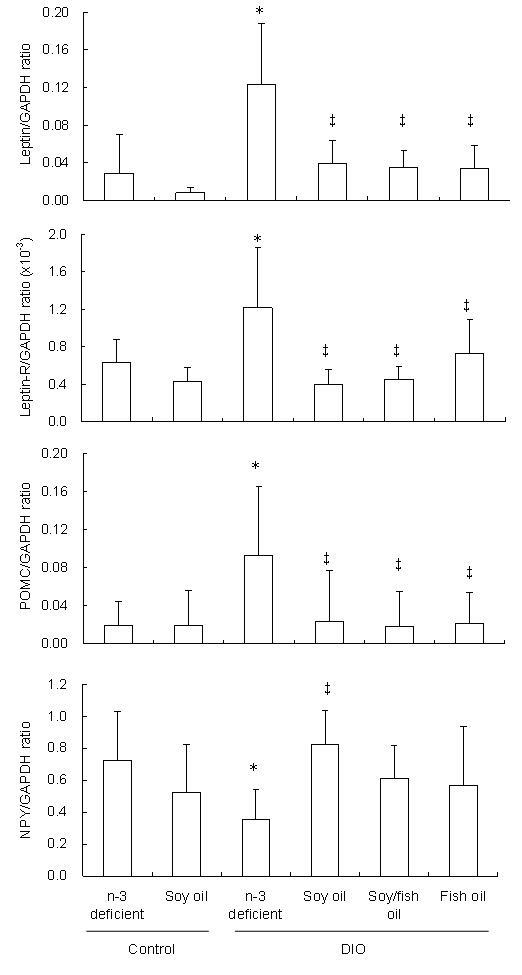
Compared to mice fed the control diets, the expression of leptin in fat tissue and leptin-R and POMC in the hypothalamus was higher in the diet-induced obesity (DIO) mice, and the n-3 PUFAs in the diets reversed these elevated expression levels. The mean methylation levels of CpG sites in the promoter regions of the leptin and POMC genes showed no difference between the DIO and the control diet groups nor between the n-3 PUFA-containing and -deficient diet groups. For the CpG sites in the promoter regions of leptin-R, no methylation was found in any of the DIO or control groups. Feeding mice with the n-3 PUFA diet during pregnancy and lactation did not affect CpG methylation in the leptin or POMC promoters.
Our findings indicate that promoter DNA methylation may not be related to the expression of leptin, leptin-R or its related hypothalamic satiety regulator POMC.
瘦素的表达在肥胖中增加,并受到 n-3 多不饱和脂肪酸(n-3 PUFAs)的抑制,但潜在的分子机制尚未得到明确证实。
在这项研究中,我们研究了饮食中 n-3 PUFAs 对瘦素、瘦素受体和 POMC 基因启动子区 CpG 岛甲基化的影响,以及早期生活中 n-3 PUFA 状态对这三个基因启动子修饰的影响。雄性 C57BL/6J 小鼠用四种不同脂肪类型之一喂养高脂肪饮食:葵花籽油(n-3 PUFA 缺乏)、大豆油、鱼油或大豆和鱼油的混合物(大豆:鱼油= 1:1)。两种含有葵花籽油或大豆油的低脂饮食作为对照。雌性小鼠在怀孕期间和哺乳期分别用葵花籽油或大豆和鱼油的混合物(大豆:鱼油= 1:1)喂养两种繁殖饮食,以繁殖新的幼崽。
与喂食对照饮食的小鼠相比,饮食诱导肥胖(DIO)小鼠的脂肪组织中瘦素的表达以及下丘脑的瘦素受体和 POMC 表达较高,饮食中的 n-3 PUFAs 逆转了这些升高的表达水平。瘦素和 POMC 基因启动子区 CpG 位点的平均甲基化水平在 DIO 组和对照组之间以及在含有和缺乏 n-3 PUFAs 的饮食组之间没有差异。对于瘦素受体启动子区的 CpG 位点,在任何 DIO 或对照饮食组中都未发现甲基化。在怀孕期间和哺乳期给小鼠喂食 n-3 PUFA 饮食不会影响瘦素或 POMC 启动子的 CpG 甲基化。
我们的研究结果表明,启动子 DNA 甲基化可能与瘦素、瘦素受体或其相关的下丘脑饱腹感调节剂 POMC 的表达无关。