Department of Electrical and Computer Engineering, University of Miami, Coral Gables, FL 33146, USA.
BMC Bioinformatics. 2011 May 26;12:211. doi: 10.1186/1471-2105-12-211.
The Bayesian shrinkage technique has been applied to multiple quantitative trait loci (QTLs) mapping to estimate the genetic effects of QTLs on quantitative traits from a very large set of possible effects including the main and epistatic effects of QTLs. Although the recently developed empirical Bayes (EB) method significantly reduced computation comparing with the fully Bayesian approach, its speed and accuracy are limited by the fact that numerical optimization is required to estimate the variance components in the QTL model.
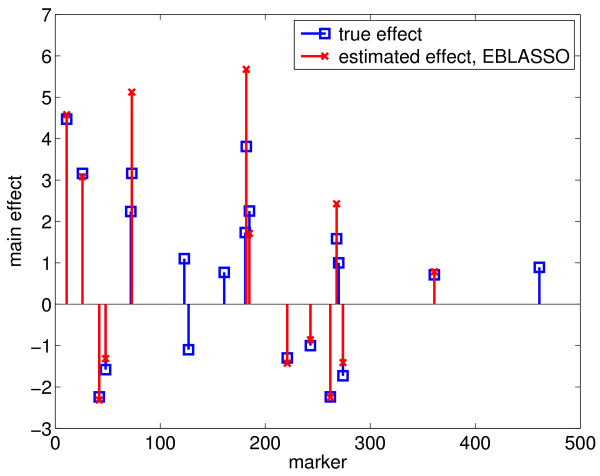
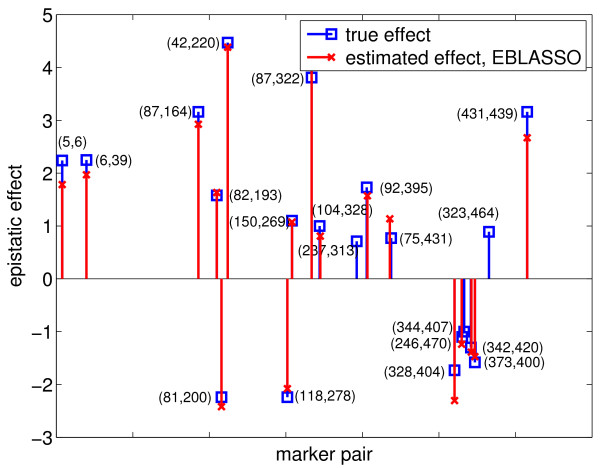
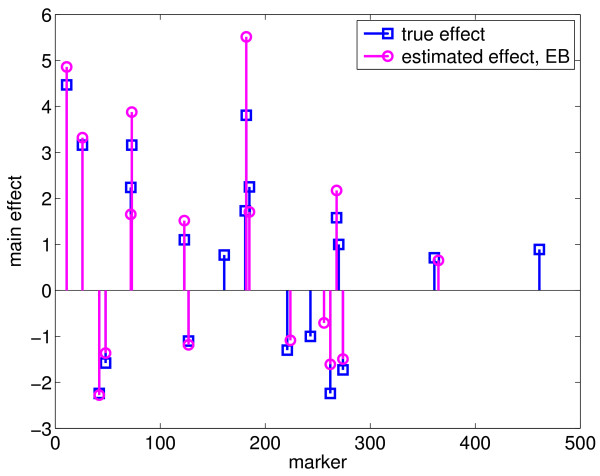
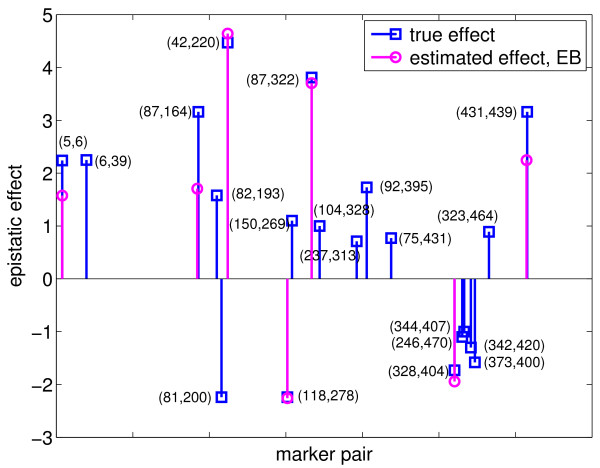
We developed a fast empirical Bayesian LASSO (EBLASSO) method for multiple QTL mapping. The fact that the EBLASSO can estimate the variance components in a closed form along with other algorithmic techniques render the EBLASSO method more efficient and accurate. Comparing with the EB method, our simulation study demonstrated that the EBLASSO method could substantially improve the computational speed and detect more QTL effects without increasing the false positive rate. Particularly, the EBLASSO algorithm running on a personal computer could easily handle a linear QTL model with more than 100,000 variables in our simulation study. Real data analysis also demonstrated that the EBLASSO method detected more reasonable effects than the EB method. Comparing with the LASSO, our simulation showed that the current version of the EBLASSO implemented in Matlab had similar speed as the LASSO implemented in Fortran, and that the EBLASSO detected the same number of true effects as the LASSO but a much smaller number of false positive effects.
The EBLASSO method can handle a large number of effects possibly including both the main and epistatic QTL effects, environmental effects and the effects of gene-environment interactions. It will be a very useful tool for multiple QTL mapping.
贝叶斯收缩技术已被应用于多个数量性状基因座 (QTL) 作图中,以从非常多的可能效应中估计 QTL 对数量性状的遗传效应,包括 QTL 的主效和上位性效应。尽管最近开发的经验贝叶斯 (EB) 方法与完全贝叶斯方法相比大大减少了计算量,但由于需要数值优化来估计 QTL 模型中的方差分量,因此其速度和准确性受到限制。
我们开发了一种用于多个 QTL 作图的快速经验贝叶斯 LASSO (EBLASSO) 方法。EBLASSO 可以在封闭形式中估计方差分量的事实,以及其他算法技术,使 EBLASSO 方法更加高效和准确。与 EB 方法相比,我们的模拟研究表明,EBLASSO 方法可以显著提高计算速度,并在不增加假阳性率的情况下检测到更多的 QTL 效应。特别是,EBLASSO 算法在个人计算机上运行,可以轻松处理我们模拟研究中具有超过 100,000 个变量的线性 QTL 模型。实际数据分析也表明,EBLASSO 方法检测到的效应比 EB 方法更合理。与 LASSO 相比,我们的模拟表明,当前版本的 EBLASSO 在 Matlab 中实现的速度与在 Fortran 中实现的 LASSO 相似,并且 EBLASSO 检测到的真实效应数量与 LASSO 相同,但假阳性效应数量要小得多。
EBLASSO 方法可以处理大量的效应,可能包括主效和上位性 QTL 效应、环境效应以及基因-环境相互作用的效应。它将成为多个 QTL 作图的非常有用的工具。