Department of Physiology and Biophysics, SUNY at Stony Brook, NY 11794, USA.
J Gen Physiol. 2011 Jun;137(6):507-20. doi: 10.1085/jgp.201010538.
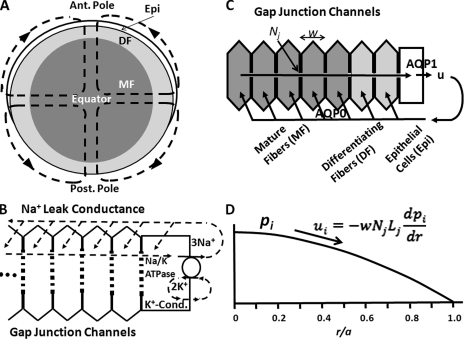
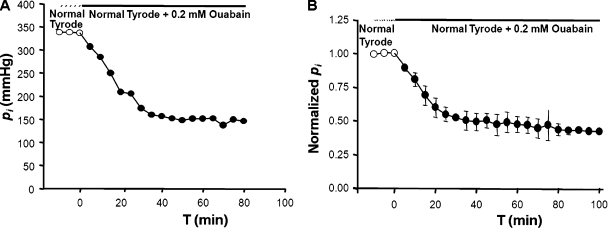
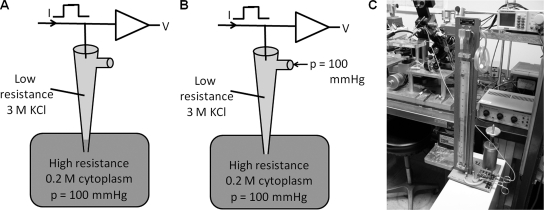
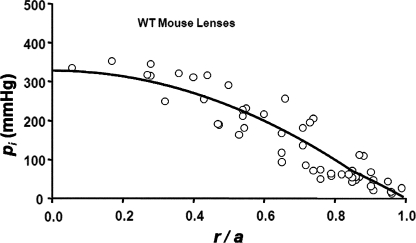
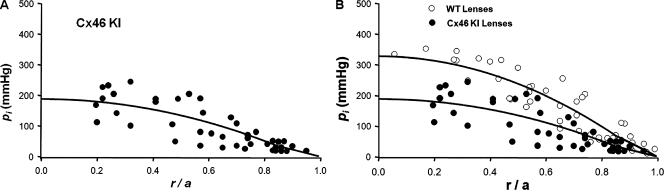
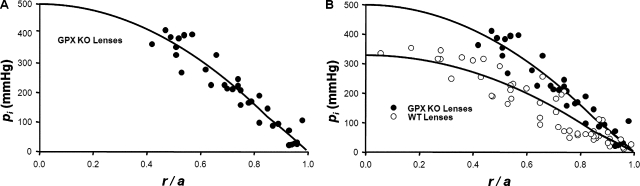
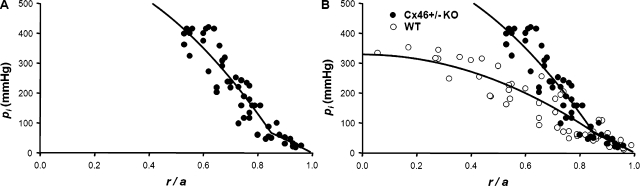
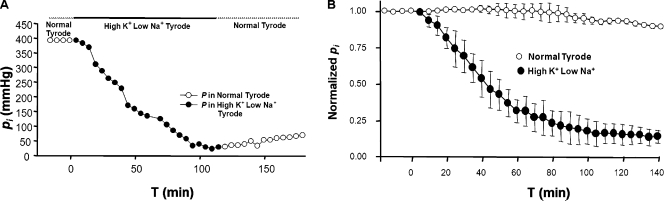
We recently modeled fluid flow through gap junction channels coupling the pigmented and nonpigmented layers of the ciliary body. The model suggested the channels could transport the secretion of aqueous humor, but flow would be driven by hydrostatic pressure rather than osmosis. The pressure required to drive fluid through a single layer of gap junctions might be just a few mmHg and difficult to measure. In the lens, however, there is a circulation of Na(+) that may be coupled to intracellular fluid flow. Based on this hypothesis, the fluid would cross hundreds of layers of gap junctions, and this might require a large hydrostatic gradient. Therefore, we measured hydrostatic pressure as a function of distance from the center of the lens using an intracellular microelectrode-based pressure-sensing system. In wild-type mouse lenses, intracellular pressure varied from ∼330 mmHg at the center to zero at the surface. We have several knockout/knock-in mouse models with differing levels of expression of gap junction channels coupling lens fiber cells. Intracellular hydrostatic pressure in lenses from these mouse models varied inversely with the number of channels. When the lens' circulation of Na(+) was either blocked or reduced, intracellular hydrostatic pressure in central fiber cells was either eliminated or reduced proportionally. These data are consistent with our hypotheses: fluid circulates through the lens; the intracellular leg of fluid circulation is through gap junction channels and is driven by hydrostatic pressure; and the fluid flow is generated by membrane transport of sodium.
我们最近对连接睫状体色素层和非色素层的缝隙连接通道中的液体流动进行了建模。该模型表明,这些通道可以运输房水的分泌,但流动是由静水压力驱动的,而不是渗透。驱动单层缝隙连接通道中的液体流动所需的压力可能只有几个毫米汞柱,而且很难测量。然而,在晶状体中,存在一种可能与细胞内液流动相耦合的钠离子循环。基于这一假设,液体将穿过数百层的缝隙连接通道,这可能需要一个很大的静水压力梯度。因此,我们使用基于细胞内微电极的压力感应系统,测量了从晶状体中心到不同距离处的静水压力。在野生型小鼠晶状体中,细胞内压力从中心的约 330 毫米汞柱变化到表面的零。我们有几个具有不同程度缝隙连接通道表达的基因敲除/敲入小鼠模型,这些通道连接着晶状体纤维细胞。这些小鼠模型晶状体中的细胞内静水压力与通道数量呈反比。当晶状体中的钠离子循环被阻断或减少时,中央纤维细胞内的细胞内静水压力要么被消除,要么相应减少。这些数据与我们的假设一致:液体在晶状体中循环;液体循环的细胞内部分是通过缝隙连接通道进行的,由静水压力驱动;而流体流动是由钠离子的膜转运产生的。