Department of Molecular Genetics and Microbiology, Stony Brook University, Stony Brook, New York, United States of America.
PLoS One. 2011;6(5):e20188. doi: 10.1371/journal.pone.0020188. Epub 2011 May 19.
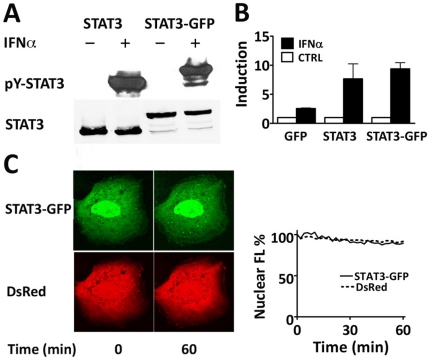
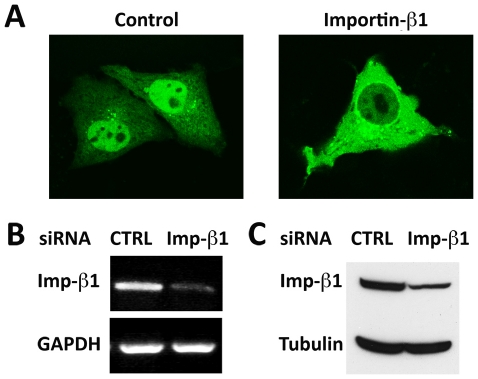
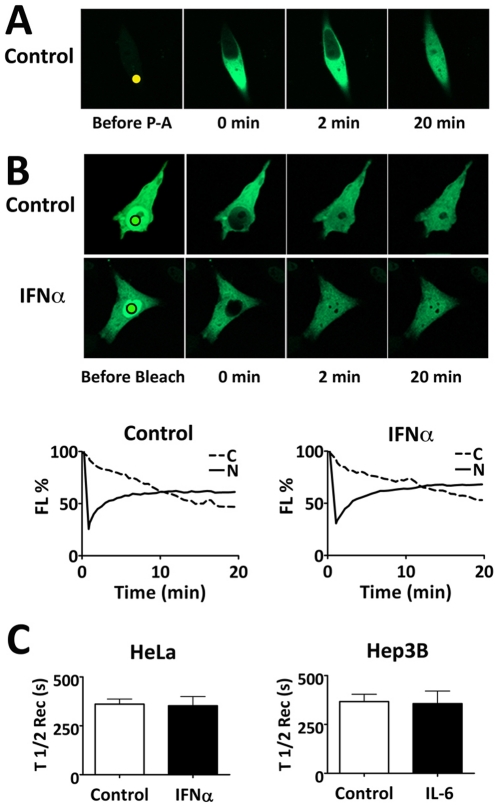
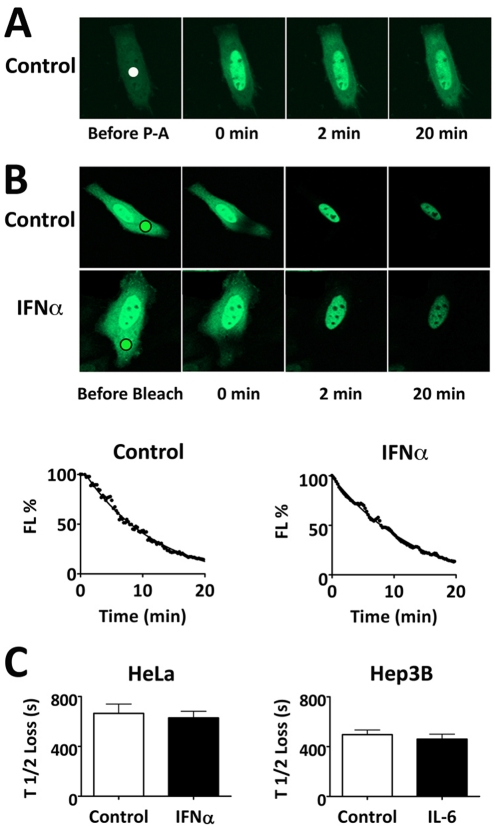
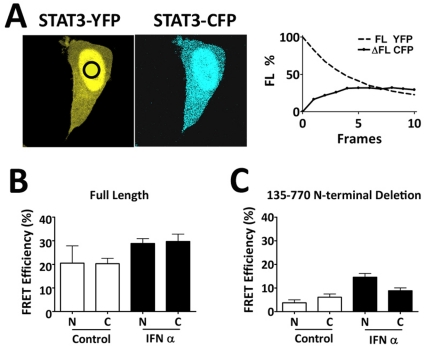
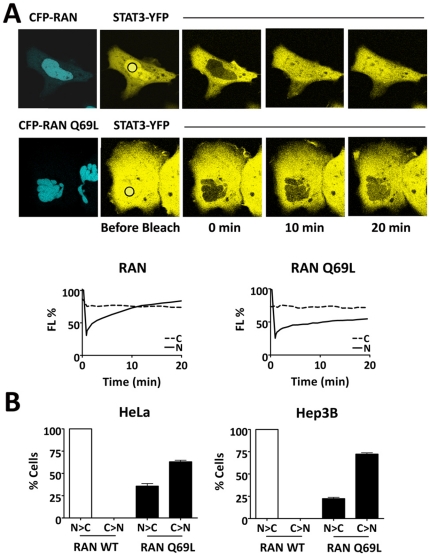
The signal transducer and activator of transcription-3 (STAT3) induces transcription of genes that control differentiation, inflammation, proliferation, and tumor cell invasion. Cytokines such as interleukin-6 and interferon stimulate the specific tyrosine phosphorylation of STAT3, which confers its ability to bind consensus DNA targets. In addition, unphosphorylated STAT3 has been demonstrated to induce specific gene expression. STAT3 must gain entrance to the nucleus to impact transcription, however access to the nucleus is a tightly regulated process. Because nuclear trafficking is critical to the function of STAT3, we investigated the molecular mechanisms by which STAT3 is imported to the nucleus. Live cell imaging techniques were used with STAT3 tagged with green fluorescence protein (GFP) or photoactivatable GFP to follow the cellular dynamics of both unphosphorylated and tyrosine phosphorylated forms. Cytokine activation did not alter the rate of STAT3 nuclear import or nuclear export. In addition, Förster resonance energy transfer experiments revealed homomeric interaction of unphosphorylated STAT3 dependent on its amino terminus, but this dimerization is not necessary for its nuclear import. Previous work demonstrated the adapter importin-α3 binds to STAT3 and is required for nuclear import. To determine whether STAT3 nuclear import is mediated by the importin-α/importin-β1 heterodimer, the effects of siRNA to importin-β1 were evaluated. Results indicate STAT3 nuclear import is dependent on the function of importin-β1. Since the Ran GTPase is necessary to bind importin-β1 in the nucleus for release of importin-α-cargo, the effect of a GTPase deficient mutant of Ran was tested. Expression of the Ran interfering mutant inhibited STAT3 nuclear import. This study defines importin-α/importin-β1/Ran as the molecular mechanism by which STAT3 traffics to the nucleus.
信号转导子和转录激活子 3(STAT3)诱导控制分化、炎症、增殖和肿瘤细胞侵袭的基因转录。细胞因子,如白细胞介素 6 和干扰素,刺激 STAT3 的特定酪氨酸磷酸化,从而使其能够结合共识 DNA 靶标。此外,未磷酸化的 STAT3 已被证明能诱导特定基因的表达。STAT3 必须进入细胞核才能影响转录,但进入细胞核是一个受到严格调控的过程。由于核转运对 STAT3 的功能至关重要,我们研究了 STAT3 进入细胞核的分子机制。使用与绿色荧光蛋白(GFP)或光活化 GFP 标记的 STAT3 的活细胞成像技术来跟踪未磷酸化和酪氨酸磷酸化形式的细胞内动力学。细胞因子激活不会改变 STAT3 核内输入或核内输出的速率。此外,Förster 共振能量转移实验揭示了未磷酸化的 STAT3 的同源相互作用依赖于其氨基末端,但这种二聚化对于其核内输入不是必需的。先前的工作表明衔接蛋白 importin-α3 与 STAT3 结合,是核内输入所必需的。为了确定 STAT3 的核内输入是否由 importin-α/importin-β1 异源二聚体介导,评估了 siRNA 对 importin-β1 的影响。结果表明,STAT3 的核内输入依赖于 importin-β1 的功能。由于 Ran GTPase 对于 importin-β1 在核内与 importin-α-货物结合释放是必需的,因此测试了 Ran 缺陷突变体的影响。Ran 干扰突变体的表达抑制了 STAT3 的核内输入。本研究定义了 importin-α/importin-β1/Ran 作为 STAT3 向核内运输的分子机制。