The Scientific and Technological Research Council of Turkey, Marmara Research Center, Genetic Engineering and Biotechnology Institute, Gebze-Kocaeli Turkey.
Genet Mol Biol. 2010 Oct;33(4):719-30. doi: 10.1590/S1415-47572010005000094. Epub 2010 Dec 1.
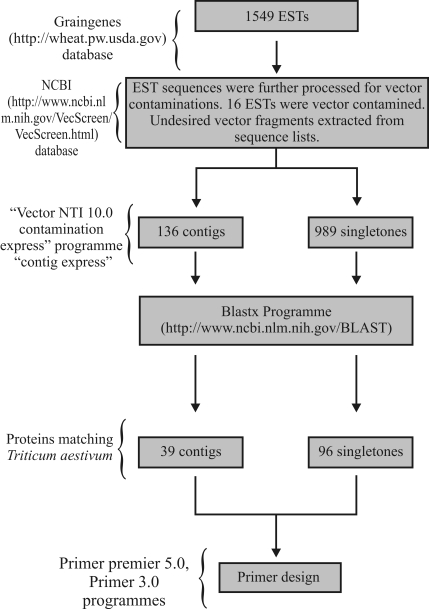
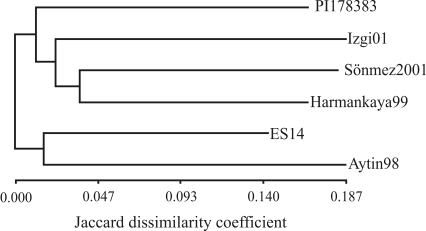
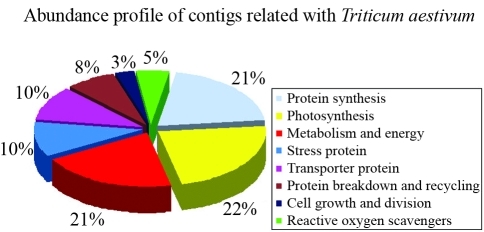
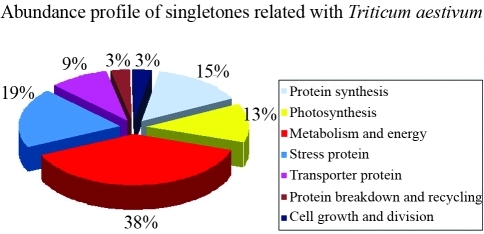
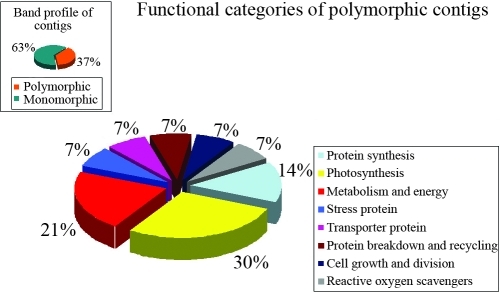
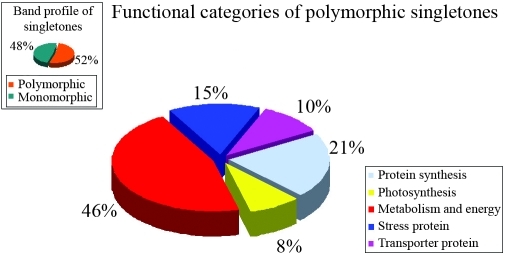
Expressed sequence tag (EST) markers have been used to assess variety and genetic diversity in wheat (Triticum aestivum). In this study, 1549 ESTs from wheat infested with yellow rust were used to examine the genetic diversity of six susceptible and resistant wheat cultivars. The aim of using these cultivars was to improve the competitiveness of public wheat breeding programs through the intensive use of modern, particularly marker-assisted, selection technologies. The F(2) individuals derived from cultivar crosses were screened for resistance to yellow rust at the seedling stage in greenhouses and adult stage in the field to identify DNA markers genetically linked to resistance. Five hundred and sixty ESTs were assembled into 136 contigs and 989 singletons. BlastX search results showed that 39 (29%) contigs and 96 (10%) singletons were homologous to wheat genes. The database-matched contigs and singletons were assigned to eight functional groups related to protein synthesis, photosynthesis, metabolism and energy, stress proteins, transporter proteins, protein breakdown and recycling, cell growth and division and reactive oxygen scavengers. PCR analyses with primers based on the contigs and singletons showed that the most polymorphic functional categories were photosynthesis (contigs) and metabolism and energy (singletons). EST analysis revealed considerable genetic variability among the Turkish wheat cultivars resistant and susceptible to yellow rust disease and allowed calculation of the mean genetic distance between cultivars, with the greatest similarity (0.725) being between Harmankaya99 and Sönmez2001, and the lowest (0.622) between Aytin98 and Izgi01.
表达序列标签 (EST) 标记已被用于评估小麦 (Triticum aestivum) 的多样性和遗传多样性。在本研究中,使用了 1549 个受黄锈病侵袭的小麦 EST,以检测六个感病和抗病小麦品种的遗传多样性。使用这些品种的目的是通过密集使用现代,特别是标记辅助的选择技术,提高公共小麦育种计划的竞争力。从品种杂交中衍生的 F2 个体在温室中进行幼苗期和田间成株期的黄锈病抗性筛选,以鉴定与抗性相关的遗传标记。将 560 个 EST 组装成 136 个 contigs 和 989 个 singletons。BlastX 搜索结果表明,39 个 contigs (29%) 和 96 个 singletons (10%) 与小麦基因同源。与数据库匹配的 contigs 和 singletons被分配到与蛋白质合成、光合作用、代谢和能量、应激蛋白、转运蛋白、蛋白质降解和回收、细胞生长和分裂以及活性氧清除剂相关的八个功能组。基于 contigs 和 singletons 的引物的 PCR 分析表明,最具多态性的功能类别是光合作用 (contigs) 和代谢和能量 (singletons)。EST 分析揭示了对黄锈病具有抗性和敏感性的土耳其小麦品种之间存在相当大的遗传变异性,并允许计算品种之间的平均遗传距离,其中 Harmankaya99 和 Sönmez2001 之间的相似度最高 (0.725),Aytin98 和 Izgi01 之间的相似度最低 (0.622)。