Wunderlich Arthur P, Klug Roland, Stuber Gregor, Landwehrmeyer Bernhard, Weber Frank, Freund Wolfgang
Department of Diagnostic and Interventional Radiology, University Hospital, Ulm, Germany.
Open Neuroimag J. 2011;5:1-8. doi: 10.2174/1874440001105010001. Epub 2011 Jan 18.
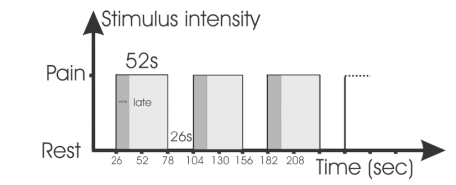
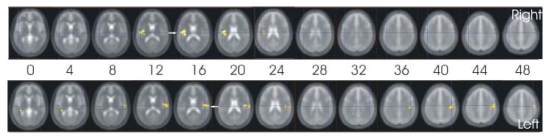
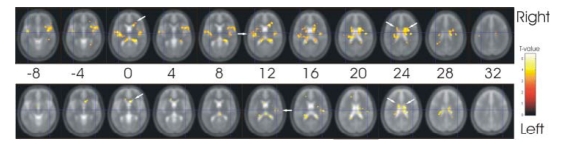
Pain modulation is an integral function of the nervous system. It is needed to adapt to chronic stimuli. To gain insights into pain suppression mechanisms, two studies concerning the suppression of the feeling of pain with different stimulation modalities (heat vs. electrical stimuli) but using the same stimulation paradigms were compared: 15 subjects each had been stimulated on both hands under the instruction to suppress the feeling of pain. Anterior insula and DLPFC activation was seen in both single modality studies and seems to be a common feature of pain suppression, as it is absent in the interaction analyses presented here. During the task to suppress the feeling of pain, there were no consistent activations stronger under thermostimulation. But during electrostimulation, there was significantly stronger activation than during thermal stimulation in the caudate nucleus bilaterally and in the contralateral posterior insula. This may be attributed to the higher sensory-discriminative content and more demand on subjective rating and suppression of the painful electrical stimulus, compared to thermostimulation. The caudate nucleus seems to play an important role not only in the motor system but also in the modulation of the pain experience.
疼痛调制是神经系统的一项重要功能。它对于适应慢性刺激是必要的。为了深入了解疼痛抑制机制,我们比较了两项研究,这两项研究采用不同的刺激方式(热刺激与电刺激)但相同的刺激范式来抑制疼痛感觉:每项研究有15名受试者,他们的双手都接受了刺激,并被要求抑制疼痛感觉。在单模态研究中均观察到前脑岛和背外侧前额叶皮层的激活,这似乎是疼痛抑制的一个共同特征,因为在本文所呈现的交互分析中并未出现这种情况。在抑制疼痛感觉的任务中,热刺激下没有持续更强的激活。但在电刺激期间,双侧尾状核和对侧后脑岛的激活明显强于热刺激期间。这可能是由于与热刺激相比,电刺激具有更高的感觉辨别成分,并且对疼痛电刺激的主观评分和抑制要求更高。尾状核似乎不仅在运动系统中发挥重要作用,而且在疼痛体验的调制中也发挥重要作用。