Shenoy Pradeep, Yu Angela J
Department of Cognitive Science, University of California San Diego, La Jolla, CA, USA.
Front Hum Neurosci. 2011 May 27;5:48. doi: 10.3389/fnhum.2011.00048. eCollection 2011.
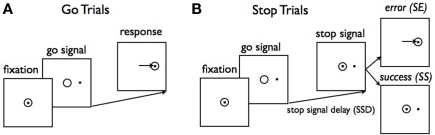
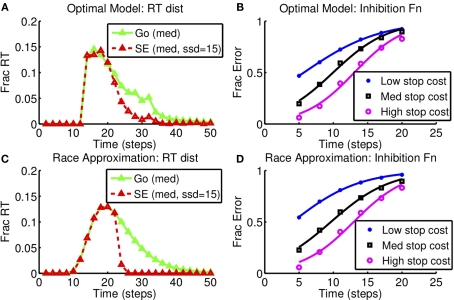
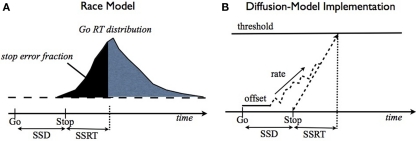
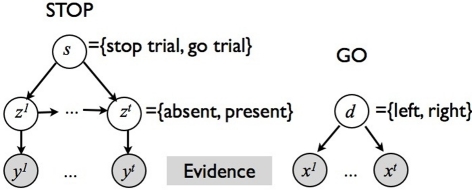
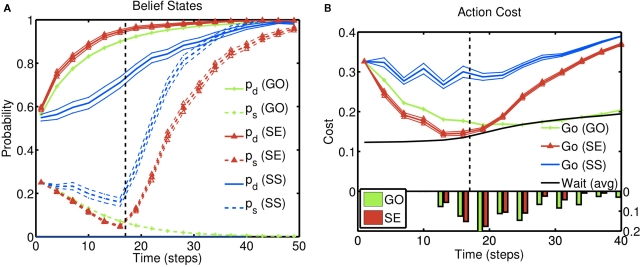
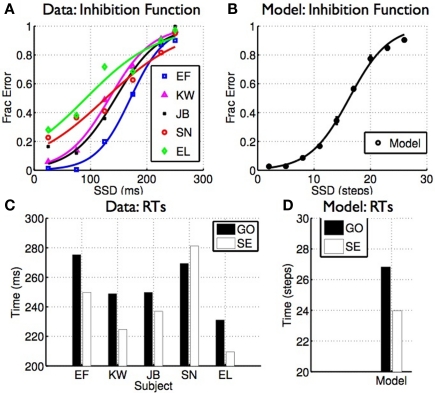
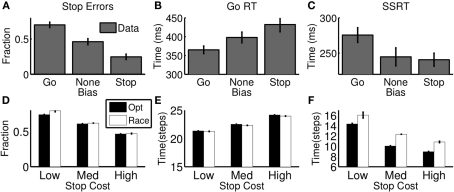
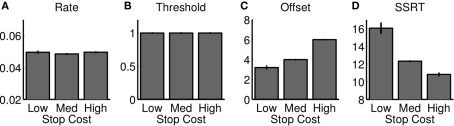
An important aspect of cognitive flexibility is inhibitory control, the ability to dynamically modify or cancel planned actions in response to changes in the sensory environment or task demands. We formulate a probabilistic, rational decision-making framework for inhibitory control in the stop signal paradigm. Our model posits that subjects maintain a Bayes-optimal, continually updated representation of sensory inputs, and repeatedly assess the relative value of stopping and going on a fine temporal scale, in order to make an optimal decision on when and whether to go on each trial. We further posit that they implement this continual evaluation with respect to a global objective function capturing the various reward and penalties associated with different behavioral outcomes, such as speed and accuracy, or the relative costs of stop errors and go errors. We demonstrate that our rational decision-making model naturally gives rise to basic behavioral characteristics consistently observed for this paradigm, as well as more subtle effects due to contextual factors such as reward contingencies or motivational factors. Furthermore, we show that the classical race model can be seen as a computationally simpler, perhaps neurally plausible, approximation to optimal decision-making. This conceptual link allows us to predict how the parameters of the race model, such as the stopping latency, should change with task parameters and individual experiences/ability.
认知灵活性的一个重要方面是抑制控制,即根据感官环境或任务需求的变化动态修改或取消计划行动的能力。我们为停止信号范式中的抑制控制制定了一个概率性的、理性的决策框架。我们的模型假定,受试者会维持一个贝叶斯最优的、不断更新的感官输入表征,并在精细的时间尺度上反复评估停止和继续的相对价值,以便在每次试验中就是否继续以及何时继续做出最优决策。我们进一步假定,他们会根据一个全局目标函数来进行这种持续评估,该目标函数捕捉了与不同行为结果相关的各种奖励和惩罚,比如速度和准确性,或者停止错误和继续错误的相对成本。我们证明,我们的理性决策模型自然会产生该范式中一直观察到的基本行为特征,以及由于奖励偶然性或动机因素等情境因素导致的更微妙的影响。此外,我们表明经典的竞争模型可以被视为对最优决策的一种计算上更简单、可能在神经学上更合理的近似。这种概念上的联系使我们能够预测竞争模型的参数,比如停止潜伏期,应该如何随任务参数和个体经验/能力而变化。