Institute for Environmental Sciences, University of Koblenz-Landau, Landau, Germany.
PLoS One. 2011;6(5):e20112. doi: 10.1371/journal.pone.0020112. Epub 2011 May 27.
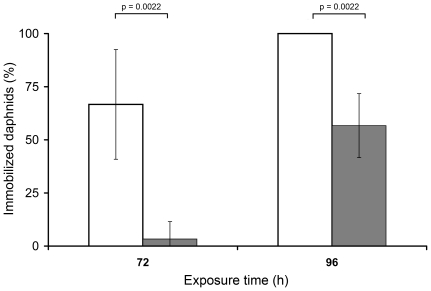
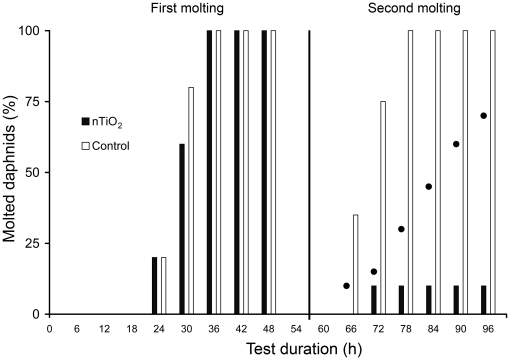
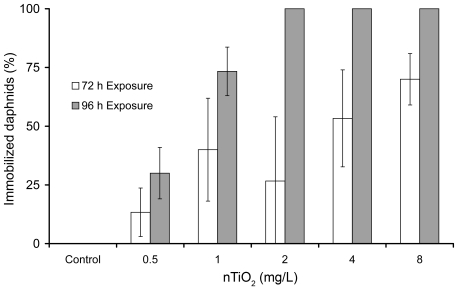
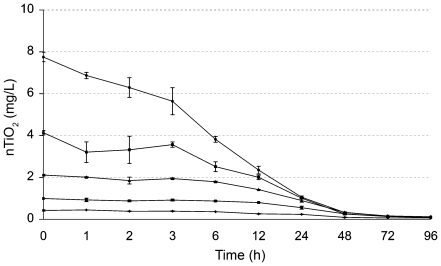
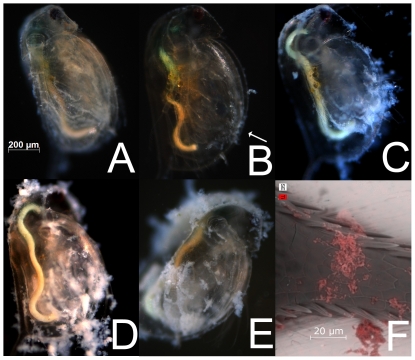
The production and use of nanoparticles (NP) has steadily increased within the last decade; however, knowledge about risks of NP to human health and ecosystems is still scarce. Common knowledge concerning NP effects on freshwater organisms is largely limited to standard short-term (≤48 h) toxicity tests, which lack both NP fate characterization and an understanding of the mechanisms underlying toxicity. Employing slightly longer exposure times (72 to 96 h), we found that suspensions of nanosized (∼100 nm initial mean diameter) titanium dioxide (nTiO(2)) led to toxicity in Daphnia magna at nominal concentrations of 3.8 (72-h EC(50)) and 0.73 mg/L (96-h EC(50)). However, nTiO(2) disappeared quickly from the ISO-medium water phase, resulting in toxicity levels as low as 0.24 mg/L (96-h EC(50)) based on measured concentrations. Moreover, we showed that nTiO(2) (∼100 nm) is significantly more toxic than non-nanosized TiO(2) (∼200 nm) prepared from the same stock suspension. Most importantly, we hypothesized a mechanistic chain of events for nTiO(2) toxicity in D. magna that involves the coating of the organism surface with nTiO(2) combined with a molting disruption. Neonate D. magna (≤6 h) exposed to 2 mg/L nTiO(2) exhibited a "biological surface coating" that disappeared within 36 h, during which the first molting was successfully managed by 100% of the exposed organisms. Continued exposure up to 96 h led to a renewed formation of the surface coating and significantly reduced the molting rate to 10%, resulting in 90% mortality. Because coating of aquatic organisms by manmade NP might be ubiquitous in nature, this form of physical NP toxicity might result in widespread negative impacts on environmental health.
在过去的十年中,纳米颗粒(NP)的生产和使用稳步增加;然而,关于 NP 对人类健康和生态系统的风险的知识仍然很少。关于 NP 对淡水生物的影响的常识在很大程度上仅限于标准的短期(≤48 小时)毒性测试,这些测试既缺乏 NP 命运特征描述,也缺乏对毒性背后机制的理解。采用稍长的暴露时间(72 至 96 小时),我们发现,在名义浓度为 3.8(72 小时 EC50)和 0.73mg/L(96 小时 EC50)时,纳米级(初始平均直径约为 100nm)二氧化钛(nTiO2)的悬浮液会导致大型溞(Daphnia magna)产生毒性。然而,nTiO2 很快从 ISO 介质水相中消失,导致毒性水平低至 0.24mg/L(96 小时 EC50),这是基于测量浓度得出的。此外,我们表明,nTiO2(约 100nm)比由同一 stock 悬浮液制备的非纳米级 TiO2(约 200nm)毒性更大。最重要的是,我们提出了一个关于 nTiO2 在大型溞体内毒性的机制链事件假设,该假设涉及 nTiO2 与生物体表面的涂层结合以及蜕皮破坏。暴露于 2mg/L nTiO2 的新生大型溞(≤6 小时)表现出“生物表面涂层”,该涂层在 36 小时内消失,在此期间,100%暴露的生物成功地完成了第一次蜕皮。持续暴露至 96 小时会导致表面涂层的重新形成,并使蜕皮率显著降低至 10%,导致 90%的死亡率。由于人为 NP 对水生生物的涂层可能在自然界中无处不在,这种形式的物理 NP 毒性可能会对环境健康产生广泛的负面影响。