Department of Psychiatry and Behavioral Neuroscience, University of Chicago, 5841 S. Maryland Ave., MC3077, Chicago, IL 60637, USA.
Psychopharmacology (Berl). 2012 Jan;219(1):15-24. doi: 10.1007/s00213-011-2374-5. Epub 2011 Jun 7.
Several psychoactive drugs are known to influence episodic memory. However, these drugs' effects on false memory, or the tendency to incorrectly remember nonstudied information, remain poorly understood.
Here, we examined the effects of two commonly used psychoactive drugs, one with memory-enhancing properties (dextroamphetamine; AMP), and another with memory-impairing properties (Δ(9)-tetrahydrocannabinol; THC), on false memory using the Deese/Roediger-McDermott (DRM) illusion.
Two parallel studies were conducted in which healthy volunteers received either AMP (0, 10, and 20 mg) or THC (0, 7.5, and 15 mg) in within-subjects, randomized, double-blind designs. Participants studied DRM word lists under the influence of the drugs, and their recognition memory for the studied words was tested 2 days later, under sober conditions.
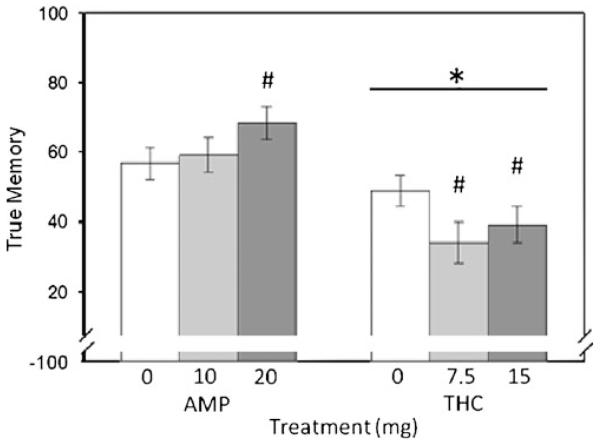
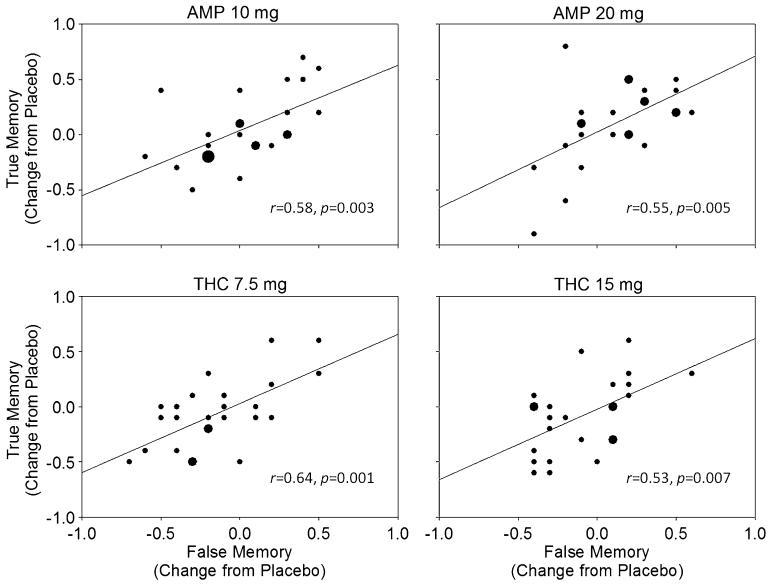
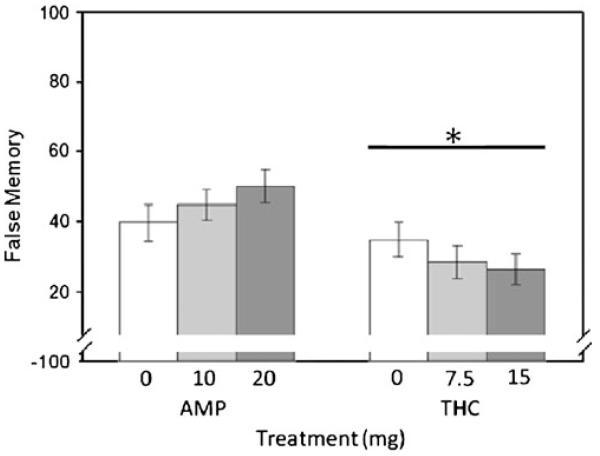
As expected, AMP increased memory of studied words relative to placebo, and THC reduced memory of studied words. Although neither drug significantly affected false memory relative to placebo, AMP increased false memory relative to THC. Across participants, both drugs' effects on true memory were positively correlated with their effects on false memory.
Our results indicate that AMP and THC have opposing effects on true memory, and these effects appear to correspond to similar, albeit more subtle, effects on false memory. These findings are consistent with previous research using the DRM illusion and provide further evidence that psychoactive drugs can affect the encoding processes that ultimately result in the creation of false memories.
几种已知具有影响情景记忆能力的精神活性药物。然而,这些药物对错误记忆的影响,即错误地记住未学习信息的倾向,仍未被充分理解。
在这里,我们使用 Deese/Roediger-McDermott(DRM)错觉研究了两种常用的精神活性药物(一种具有增强记忆的特性,即右旋苯丙胺;AMP,另一种具有损害记忆的特性,即 Δ(9)-四氢大麻酚;THC)对错误记忆的影响。
进行了两项平行研究,健康志愿者在这两项研究中分别接受了 AMP(0、10 和 20 mg)或 THC(0、7.5 和 15 mg)的影响,采用了在个体内、随机、双盲设计。参与者在药物的影响下学习 DRM 单词列表,然后在 2 天后,在清醒的状态下,对学习过的单词进行识别记忆测试。
正如预期的那样,AMP 相对于安慰剂增加了对学习过的单词的记忆,而 THC 则降低了对学习过的单词的记忆。尽管两种药物相对于安慰剂都没有显著影响错误记忆,但 AMP 增加了错误记忆相对于 THC 的数量。在参与者中,两种药物对真实记忆的影响与对错误记忆的影响呈正相关。
我们的结果表明,AMP 和 THC 对真实记忆有相反的影响,这些影响似乎与错误记忆存在类似的、尽管更为微妙的影响相对应。这些发现与使用 DRM 错觉的先前研究一致,并提供了进一步的证据,表明精神活性药物可以影响最终导致错误记忆产生的编码过程。