Human Genetics Center, School of Public Health, University of Texas Health Science Center at Houston, Houston, Texas, USA.
Am J Hypertens. 2011 Sep;24(9):1035-40. doi: 10.1038/ajh.2011.97. Epub 2011 Jun 9.
Blood pressure (BP) homeostasis involves complex interactions among genetic and nongenetic factors, providing major challenges to dissection of the genetic components that influence BP and hypertension. In this study, we examine the effects of interaction of genetic variants with physical activity on BP in a relatively genetically homogenous cohort of rural Chinese villagers.
Generalized estimating equations analysis was used to test for associations of systolic blood pressure (SBP) and diastolic blood pressure (DBP) with variants in 24 genes in BP pathways (196 single-nucleotide polymorphisms (SNPs)) among 3,142 Chinese participants divided according to physical activity (active vs. inactive groups).
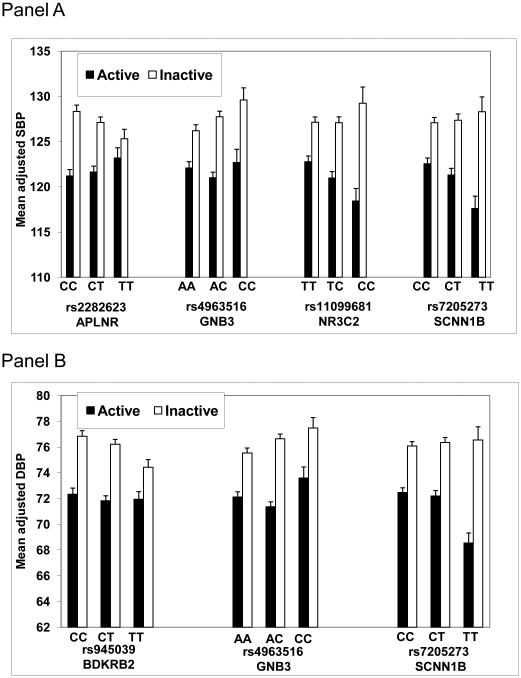
In the physically active group, two SNPs in NR3C2 were significantly associated with lower SBP, and a SNP in SCNN1B was significantly associated with lower SBP and DBP. In the physically inactive group, a SNP in APLNR was associated with lower SBP, a SNP in GNB3 (guanine nucleotide binding protein, β polypeptide 3) was associated with higher SBP and DBP, and a SNP in BDKRB2 (bradykinin receptor B2) was associated with lower DBP. Cumulative effects in carriers of minor alleles of these SNPs showed reductions of SBP and DBP as large as 8 and 5 mm Hg, respectively, in the active individuals compared to inactive individuals carrying the same number of minor alleles.
We found that physical activity modifies the effects of genetic variants on BP. However, our results also show that active individuals with specific genotypes always have lower BP than inactive individuals with the same genotypes, demonstrating the overall beneficial effects of physical activity on BP.
血压(BP)稳态涉及遗传和非遗传因素之间的复杂相互作用,这为剖析影响 BP 和高血压的遗传成分带来了重大挑战。在这项研究中,我们检查了遗传变异与体力活动之间相互作用对相对遗传同质性的中国农村村民群体中 BP 的影响。
使用广义估计方程分析来检验 24 个 BP 途径基因(196 个单核苷酸多态性(SNP))中变异与血压(收缩压(SBP)和舒张压(DBP))之间的关联,该研究中的 3142 名中国参与者根据体力活动(活跃组与不活跃组)进行了分组。
在体力活跃组中,NR3C2 中的两个 SNP 与 SBP 降低显著相关,SCNN1B 中的一个 SNP 与 SBP 和 DBP 降低显著相关。在体力不活跃组中,APLNR 中的一个 SNP 与 SBP 降低相关,GNB3(鸟嘌呤核苷酸结合蛋白,β多肽 3)中的一个 SNP 与 SBP 和 DBP 升高相关,BDKRB2(缓激肽受体 B2)中的一个 SNP 与 DBP 降低相关。与携带相同数量的次要等位基因的不活跃个体相比,这些 SNP 的少数等位基因携带者的累积效应显示,活跃个体的 SBP 和 DBP 分别降低了 8 和 5mmHg。
我们发现体力活动改变了遗传变异对 BP 的影响。然而,我们的结果还表明,具有特定基因型的活跃个体的 BP 总是低于具有相同基因型的不活跃个体,这表明体力活动对 BP 具有整体的有益影响。