Gulbenkian Ph.D. Program in Biomedicine Oeiras, Portugal.
Front Integr Neurosci. 2011 May 30;5:20. doi: 10.3389/fnint.2011.00020. eCollection 2011.
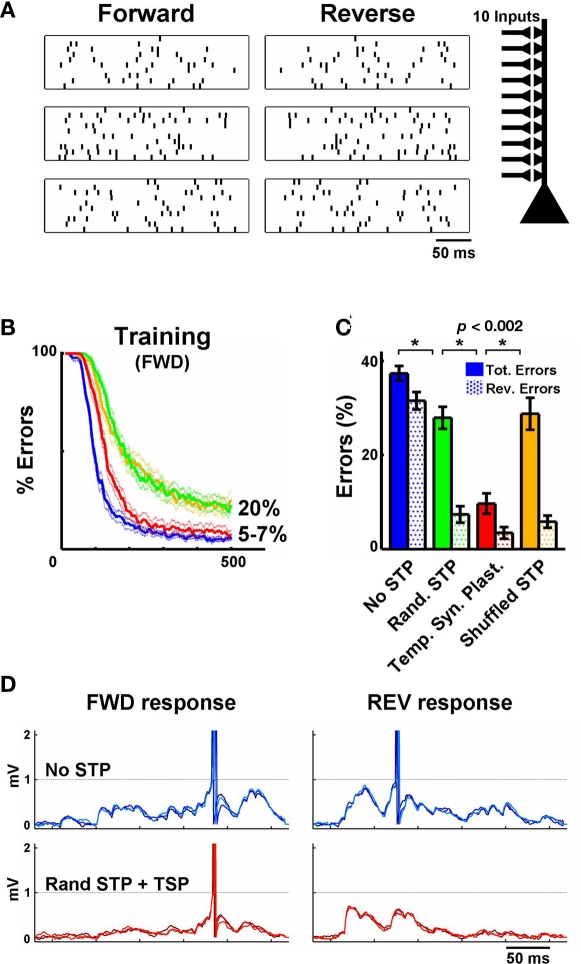
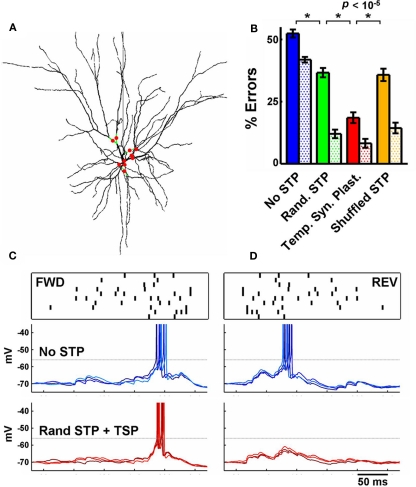
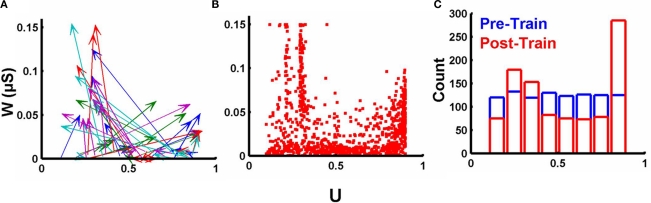
It is well established that short-term synaptic plasticity (STP) of neocortical synapses is itself plastic - e.g., the induction of LTP and LTD tend to shift STP towards short-term depression and facilitation, respectively. What has not been addressed theoretically or experimentally is whether STP is "learned"; that is, is STP regulated by specific learning rules that are in place to optimize the computations performed at synapses, or, are changes in STP essentially an epiphenomenon of long-term plasticity? Here we propose that STP is governed by specific learning rules that operate independently and in parallel of the associative learning rules governing baseline synaptic strength. We describe a learning rule for STP and, using simulations, demonstrate that it significantly enhances the discrimination of spatiotemporal stimuli. Additionally we generate a set of experimental predictions aimed at testing our hypothesis.
众所周知,新皮层突触的短期突触可塑性(STP)本身就是可塑的 - 例如,LTP 和 LTD 的诱导往往分别使 STP 向短期抑制和易化转移。从理论或实验上尚未解决的问题是 STP 是否“可学习”;也就是说,STP 是否受到特定学习规则的调节,这些规则是为了优化在突触上执行的计算而制定的,或者,STP 的变化本质上是长期可塑性的附带现象?在这里,我们提出 STP 受特定学习规则的控制,这些学习规则独立于调节基线突触强度的联想学习规则并行运作。我们描述了一种用于 STP 的学习规则,并通过模拟演示了它可以显著提高时空刺激的辨别能力。此外,我们还生成了一组旨在检验我们假设的实验预测。