Division of Respiratory and Critical Care Medicine, Department of Medicine, National University Hospital, National University Health System Tower Block, Level 10, 1E Kent Ridge Road, Singapore 119228.
BMJ. 2011 Jun 13;342:d3245. doi: 10.1136/bmj.d3245.
To assess the compliance of Asian intensive care units and hospitals to the Surviving Sepsis Campaign's resuscitation and management bundles. Secondary objectives were to evaluate the impact of compliance on mortality and the organisational characteristics of hospitals that were associated with higher compliance.
Prospective cohort study.
150 intensive care units in 16 Asian countries.
1285 adult patients with severe sepsis admitted to these intensive care units in July 2009. The organisational characteristics of participating centres, the patients' baseline characteristics, the achievement of targets within the resuscitation and management bundles, and outcome data were recorded.
Compliance with the Surviving Sepsis Campaign's resuscitation (six hours) and management (24 hours) bundles.
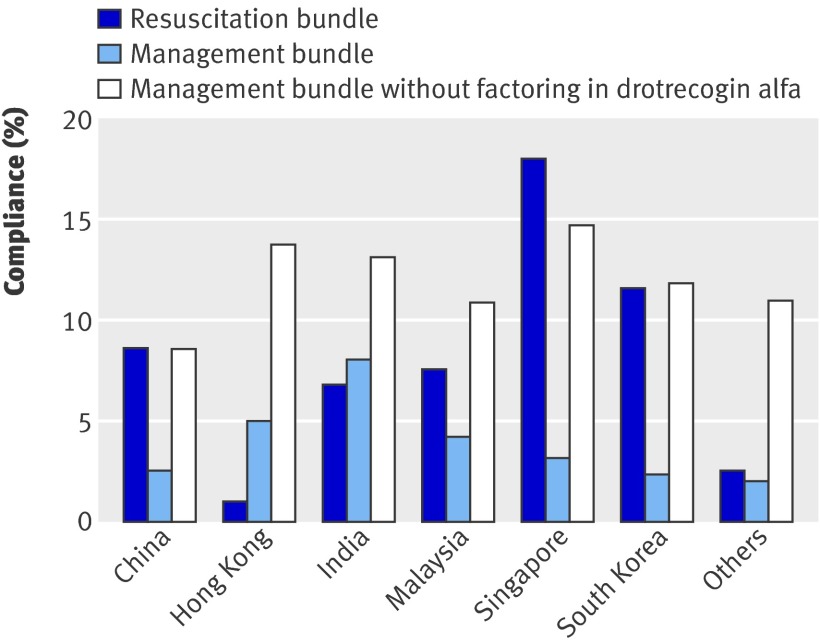
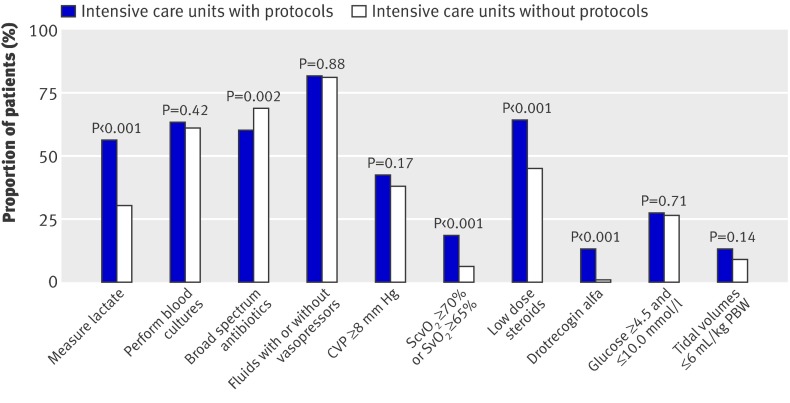
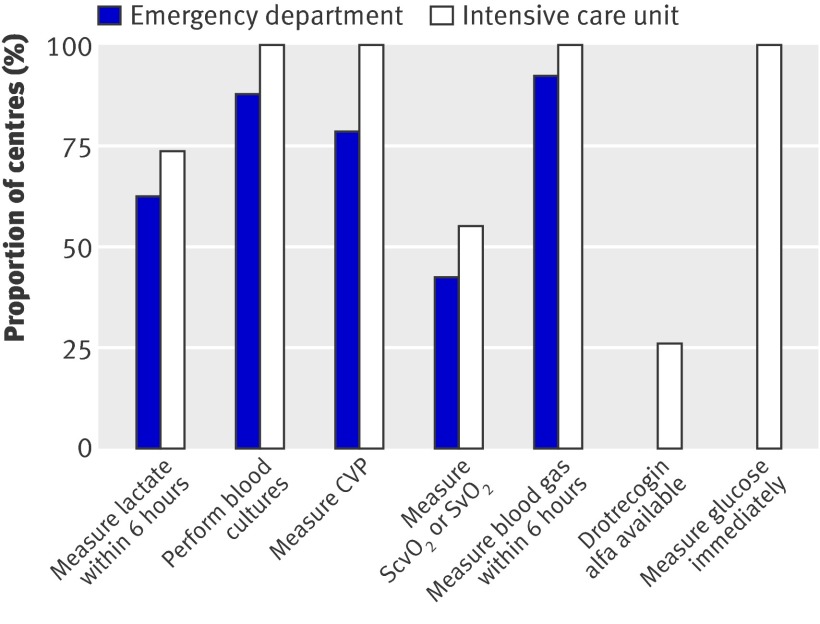
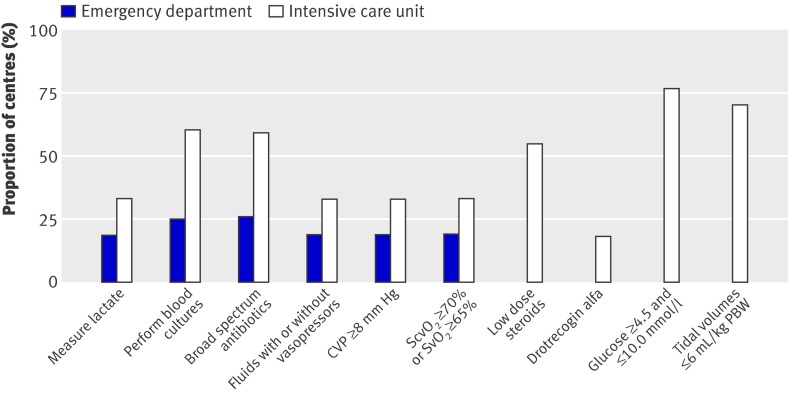
Hospital mortality was 44.5% (572/1285). Compliance rates for the resuscitation and management bundles were 7.6% (98/1285) and 3.5% (45/1285), respectively. On logistic regression analysis, compliance with the following bundle targets independently predicted decreased mortality: blood cultures (achieved in 803/1285; 62.5%, 95% confidence interval 59.8% to 65.1%), broad spectrum antibiotics (achieved in 821/1285; 63.9%, 61.3% to 66.5%), and central venous pressure (achieved in 345/870; 39.7%, 36.4% to 42.9%). High income countries, university hospitals, intensive care units with an accredited fellowship programme, and surgical intensive care units were more likely to be compliant with the resuscitation bundle.
While mortality from severe sepsis is high, compliance with resuscitation and management bundles is generally poor in much of Asia. As the centres included in this study might not be fully representative, achievement rates reported might overestimate the true degree of compliance with recommended care and should be interpreted with caution. Achievement of targets for blood cultures, antibiotics, and central venous pressure was independently associated with improved survival.
评估亚洲重症监护病房和医院对拯救脓毒症运动复苏和管理捆绑包的遵守情况。次要目标是评估遵守情况对死亡率的影响,以及与更高遵守率相关的医院组织特征。
前瞻性队列研究。
16 个亚洲国家的 150 个重症监护病房。
2009 年 7 月入住这些重症监护病房的 1285 名患有严重败血症的成年患者。记录了参与中心的组织特征、患者的基线特征、复苏和管理捆绑包内目标的实现情况以及结局数据。
对拯救脓毒症运动复苏(6 小时)和管理(24 小时)捆绑包的遵守情况。
医院死亡率为 44.5%(572/1285)。复苏和管理捆绑包的遵守率分别为 7.6%(98/1285)和 3.5%(45/1285)。在逻辑回归分析中,以下捆绑包目标的遵守情况独立预测死亡率降低:血培养(在 1285 例中实现 803 例;62.5%,95%置信区间 59.8%至 65.1%)、广谱抗生素(在 1285 例中实现 821 例;63.9%,61.3%至 66.5%)和中心静脉压(在 870 例中实现 345 例;39.7%,36.4%至 42.9%)。高收入国家、大学医院、有认证研究员计划的重症监护病房和外科重症监护病房更有可能遵守复苏捆绑包。
尽管严重败血症的死亡率很高,但亚洲大部分地区的复苏和管理捆绑包的遵守情况普遍较差。由于本研究纳入的中心可能不完全具有代表性,因此报告的达标率可能高估了推荐护理的实际遵守程度,应谨慎解读。血培养、抗生素和中心静脉压目标的实现与生存率的提高独立相关。