Princeton Neuroscience Institute, Princeton University, Princeton, New Jersey, United States of America.
PLoS One. 2011;6(6):e20262. doi: 10.1371/journal.pone.0020262. Epub 2011 Jun 1.
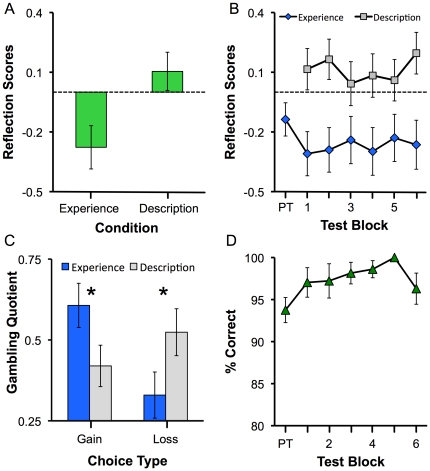
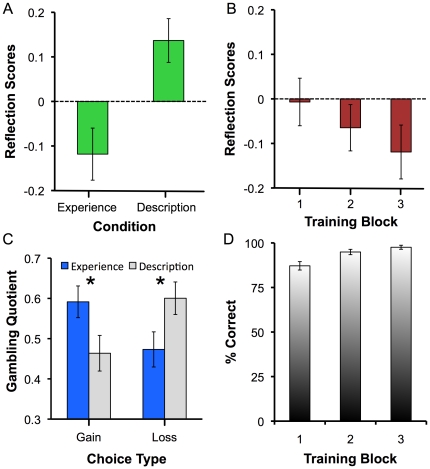
When faced with risky decisions, people tend to be risk averse for gains and risk seeking for losses (the reflection effect). Studies examining this risk-sensitive decision making, however, typically ask people directly what they would do in hypothetical choice scenarios. A recent flurry of studies has shown that when these risky decisions include rare outcomes, people make different choices for explicitly described probabilities than for experienced probabilistic outcomes. Specifically, rare outcomes are overweighted when described and underweighted when experienced. In two experiments, we examined risk-sensitive decision making when the risky option had two equally probable (50%) outcomes. For experience-based decisions, there was a reversal of the reflection effect with greater risk seeking for gains than for losses, as compared to description-based decisions. This fundamental difference in experienced and described choices cannot be explained by the weighting of rare events and suggests a separate subjective utility curve for experience.
当面对风险决策时,人们往往在获得时规避风险,在损失时寻求风险(反射效应)。然而,研究这种风险敏感型决策的研究通常直接询问人们在假设的选择情景中会怎么做。最近一系列研究表明,当这些风险决策包括罕见结果时,人们对明确描述的概率做出的选择与经验概率结果不同。具体来说,罕见结果在被描述时被高估,而在被体验时被低估。在两项实验中,我们研究了当风险选项有两个同等可能(50%)结果时的风险敏感型决策。对于基于经验的决策,与基于描述的决策相比,获得收益的风险寻求大于损失的风险寻求,从而出现了反射效应的逆转。这种经验和描述选择之间的根本差异不能用罕见事件的加权来解释,这表明经验有一个单独的主观效用曲线。