Department of Chemistry, University of Saskatchewan, 110 Science Place, Saskatoon, SK S7N 5C9, Canada.
Biochemistry Laboratory, ICAR Research Complex for North Eastern Hill Region, Umiam, Meghalaya 793103, India.
Mar Drugs. 2011;9(5):719-738. doi: 10.3390/md9050719. Epub 2011 Apr 28.
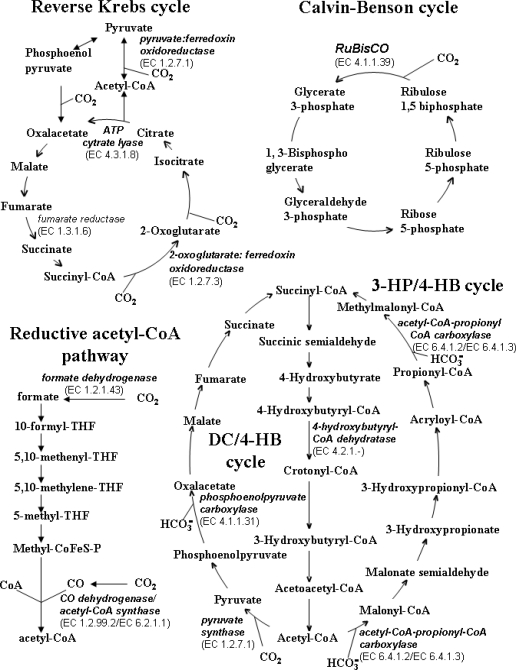
Deep sea hydrothermal vents are located along the mid-ocean ridge system, near volcanically active areas, where tectonic plates are moving away from each other. Sea water penetrates the fissures of the volcanic bed and is heated by magma. This heated sea water rises to the surface dissolving large amounts of minerals which provide a source of energy and nutrients to chemoautotrophic organisms. Although this environment is characterized by extreme conditions (high temperature, high pressure, chemical toxicity, acidic pH and absence of photosynthesis) a diversity of microorganisms and many animal species are specially adapted to this hostile environment. These organisms have developed a very efficient metabolism for the assimilation of inorganic CO₂ from the external environment. In order to develop technology for the capture of carbon dioxide to reduce greenhouse gases in the atmosphere, enzymes involved in CO₂ fixation and assimilation might be very useful. This review describes some current research concerning CO₂ fixation and assimilation in the deep sea environment and possible biotechnological application of enzymes for carbon dioxide capture.
深海热液喷口位于大洋中脊系统沿线,靠近火山活跃地区,那里的构造板块正在彼此远离。海水渗透到火山床的裂缝中,并被岩浆加热。这种加热的海水上升到表面,溶解了大量的矿物质,为化能自养生物提供了能源和营养物质的来源。尽管这种环境具有极端条件(高温、高压、化学毒性、酸性 pH 值和缺乏光合作用),但许多微生物和动物物种都专门适应了这种恶劣的环境。这些生物体已经发展出一种非常有效的新陈代谢机制,用于从外部环境中同化无机 CO₂。为了开发从大气中捕获二氧化碳以减少温室气体的技术,参与 CO₂固定和同化的酶可能非常有用。本综述描述了深海环境中 CO₂固定和同化的一些当前研究以及酶在二氧化碳捕集方面的潜在生物技术应用。