Biotechnology Unit, University of Buea, P.O. Box 63 Buea, South West Region, Cameroon.
Malar J. 2011 Jun 17;10:167. doi: 10.1186/1475-2875-10-167.
Malaria is a major public health threat in Africa, and traditional medicine continues to play a key role in its control especially in rural areas. A bioassay-guided fractionation was carried out in order to evaluate the anti-malarial potential and the safety of the methanol extract of the Hypericum lanceolatum stem bark.
The anti-plasmodial activity was assayed by the lactate dehydrogenase method (pLDH) against the multidrug-resistant W2mef laboratory strain, and a field isolate (SHF4) of Plasmodium falciparum. Cytotoxicity tests were carried out using the LLC-MK2 monkey kidney epithelial cells.
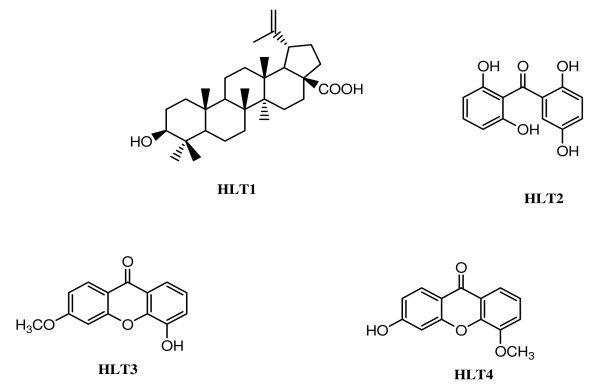
Five compounds were isolated from the most active and least cytotoxic ethylacetate sub-extract: betulinic acid (HLT1), 2,2',5,6'-tetrahydroxybenzophenone (HLT2), 5-hydroxy-3-methoxyxanthone (HLT3), 3-hydroxy-5-methoxyxanthone (HLT4) and HLT0 (yet to be identified). Three of the tested compounds presented significant anti-plasmodial activities (with 50% inhibitory concentration, IC₅₀ < 5 μM), with 5-hydroxy-3-methoxyxanthone exerting the highest activity, followed by HLT0 and betulinic acid. All the compounds with significant anti-plasmodial activity were non-cytotoxic, except betulinic acid which showed a 50% cytotoxic concentration, CC₅₀ of 25 μg/mL.
These findings justify the use of H. lanceolatum stem bark as anti-malarial by traditional healers of Western Cameroon, and could constitute a good basis for further studies towards development of new drug candidates or phytomedicines for malaria.
疟疾是非洲的主要公共卫生威胁,传统医学在控制疟疾方面继续发挥关键作用,尤其是在农村地区。进行了基于生物测定的分离,以评估 Hypericum lanceolatum 茎皮甲醇提取物的抗疟潜力和安全性。
采用乳酸脱氢酶法(pLDH)测定抗疟活性,针对多药耐药的 W2mef 实验室株和疟原虫的田间分离株(SHF4)。使用 LLC-MK2 猴肾上皮细胞进行细胞毒性试验。
从最活跃且细胞毒性最小的乙酸乙酯亚提取物中分离出 5 种化合物:白桦脂酸(HLT1)、2,2',5,6'-四羟基二苯甲酮(HLT2)、5-羟基-3-甲氧基黄烷酮(HLT3)、3-羟基-5-甲氧基黄烷酮(HLT4)和 HLT0(尚未鉴定)。测试的三种化合物具有显著的抗疟活性(半数抑制浓度,IC₅₀<5 μM),其中 5-羟基-3-甲氧基黄烷酮活性最高,其次是 HLT0 和白桦脂酸。除白桦脂酸外,具有显著抗疟活性的所有化合物均无细胞毒性,白桦脂酸的细胞毒性浓度(CC₅₀)为 25 μg/mL。
这些发现证明了喀麦隆西部传统医生使用 H. lanceolatum 茎皮作为抗疟药的合理性,并且可以为进一步研究开发新的药物候选物或抗疟植物药提供良好的基础。