Experimental NeuroTherapeutics Laboratory, Institute for Biological Sciences, National Research Council of Canada, Ottawa, Ontario, Canada.
PLoS One. 2011;6(6):e20808. doi: 10.1371/journal.pone.0020808. Epub 2011 Jun 8.
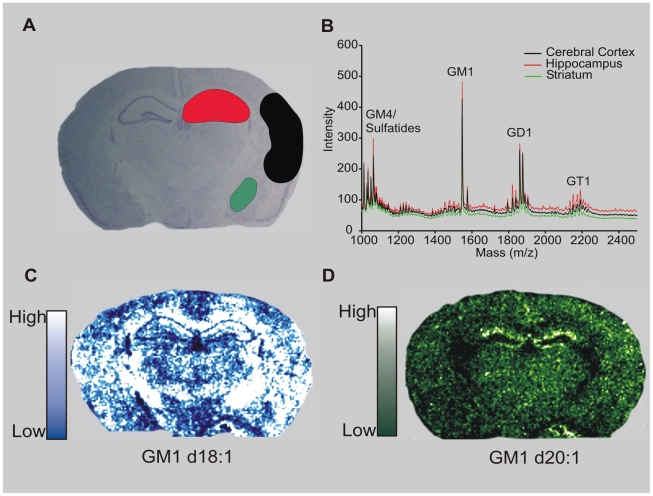
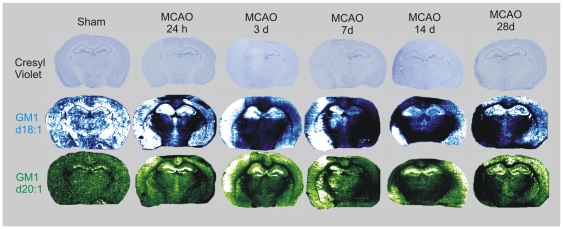
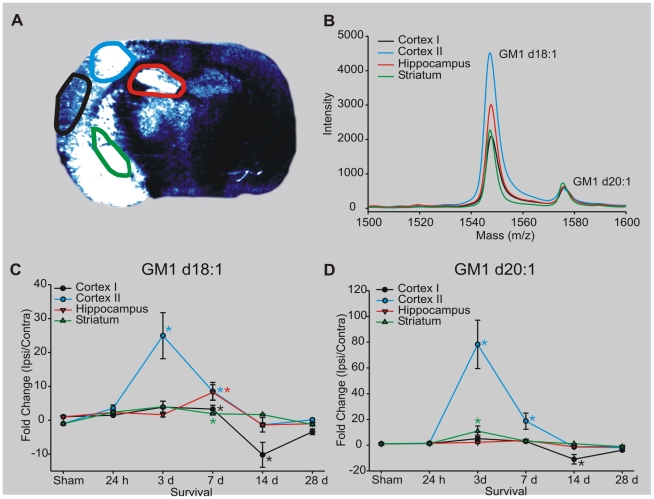
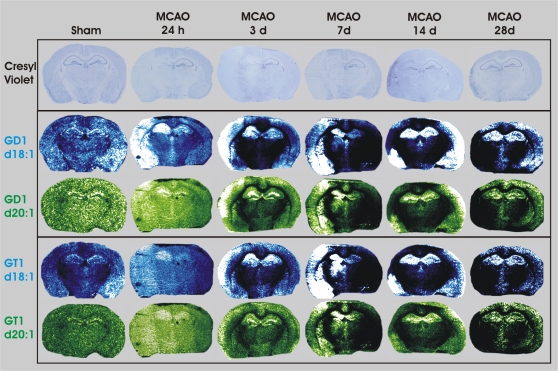
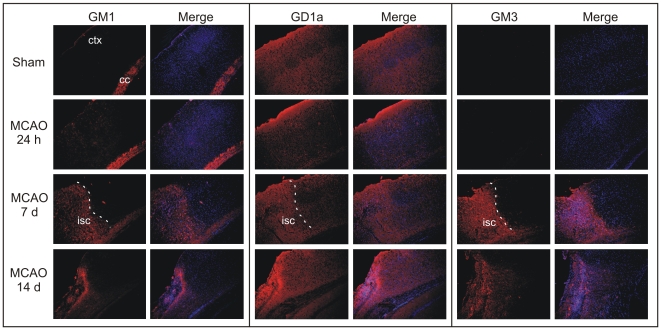
Gangliosides, a member of the glycosphingolipid family, are heterogeneously expressed in biological membranes and are particularly enriched within the central nervous system. Gangliosides consist of mono- or poly-sialylated oligosaccharide chains of variable lengths attached to a ceramide unit and are found to be intimately involved in brain disease development. The purpose of this study is to examine the spatial profile of ganglioside species using matrix-assisted laser desorption/ionization (MALDI) imaging (IMS) following middle cerebral artery occlusion (MCAO) reperfusion injury in the mouse. IMS is a powerful method to not only discriminate gangliosides by their oligosaccharide components, but also by their carbon length within their sphingosine base. Mice were subjected to a 30 min unilateral MCAO followed by long-term survival (up to 28 days of reperfusion). Brain sections were sprayed with the matrix 5-Chloro-2-mercaptobenzothiazole, scanned and analyzed for a series of ganglioside molecules using an Applied Biosystems 4800 MALDI TOF/TOF. Traditional histological and immunofluorescence techniques were performed to assess brain tissue damage and verification of the expression of gangliosides of interest. Results revealed a unique anatomical profile of GM1, GD1 and GT1b (d18:1, d20:1 as well as other members of the glycosphingolipid family). There was marked variability in the ratio of expression between ipsilateral and contralateral cortices for the various detected ganglioside species following MCAO-reperfusion injury. Most interestingly, MCAO resulted in the transient induction of both GM2 and GM3 signals within the ipsilateral hemisphere; at the border of the infarcted tissue. Taken together, the data suggest that brain region specific expression of gangliosides, particularly with respect to hydrocarbon length, may play a role in neuronal responses to injury.
神经节苷脂是糖鞘脂家族的成员,在生物膜中呈异质表达,尤其在中枢神经系统中丰富。神经节苷脂由单或多唾液酸化的长短不一的寡糖链与神经酰胺单元相连,被发现与脑疾病的发展密切相关。本研究旨在使用基质辅助激光解吸/电离(MALDI)成像(IMS)检测小鼠大脑中动脉闭塞(MCAO)再灌注损伤后神经节苷脂的空间分布。IMS 不仅可以通过其寡糖成分,还可以通过其神经酰胺碱基中的碳长来区分神经节苷脂,是一种强大的方法。将小鼠进行 30 分钟单侧 MCAO 后进行长期存活(最长 28 天再灌注)。用基质 5-氯-2-巯基苯并噻唑喷洒脑切片,用 Applied Biosystems 4800 MALDI TOF/TOF 扫描并分析一系列神经节苷脂分子。进行传统的组织学和免疫荧光技术以评估脑组织损伤和感兴趣的神经节苷脂的表达验证。结果显示 GM1、GD1 和 GT1b(d18:1、d20:1 以及糖鞘脂家族的其他成员)具有独特的解剖分布特征。MCAO 再灌注损伤后,各种检测到的神经节苷脂的同侧和对侧皮质之间的表达比率存在显著差异。最有趣的是,MCAO 导致同侧半球 GM2 和 GM3 信号短暂诱导;在梗死组织的边界处。总的来说,这些数据表明神经节苷脂的脑区特异性表达,特别是与烃链长度有关,可能在神经元对损伤的反应中发挥作用。