Department of Biostatistics and Computational Biology, Dana-Farber Cancer Institute & Harvard School of Public Health, Boston 02115 MA, USA.
BMC Bioinformatics. 2011 Jun 21;12:251. doi: 10.1186/1471-2105-12-251.
Target specific antibodies are pivotal for the design of vaccines, immunodiagnostic tests, studies on proteomics for cancer biomarker discovery, identification of protein-DNA and other interactions, and small and large biochemical assays. Therefore, it is important to understand the properties of protein sequences that are important for antigenicity and to identify small peptide epitopes and large regions in the linear sequence of the proteins whose utilization result in specific antibodies.
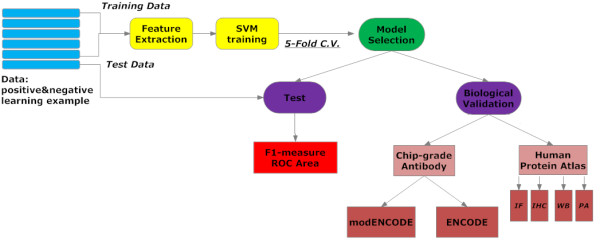
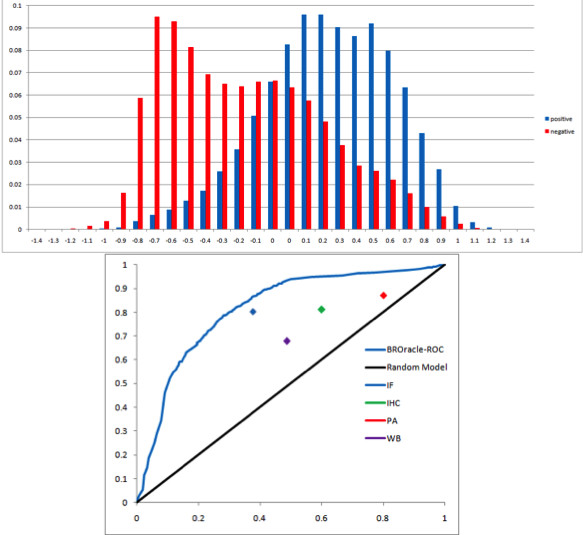
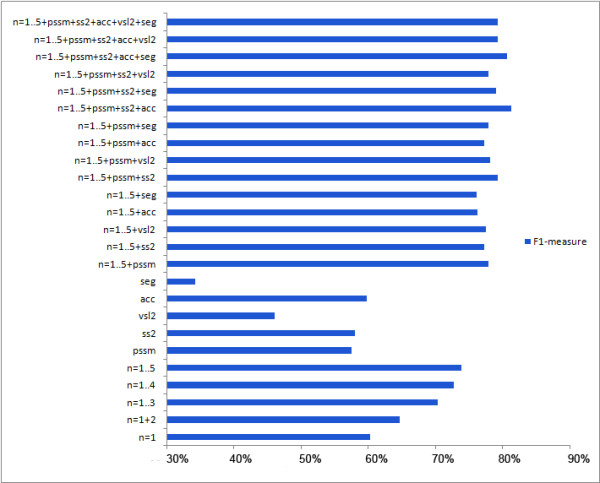
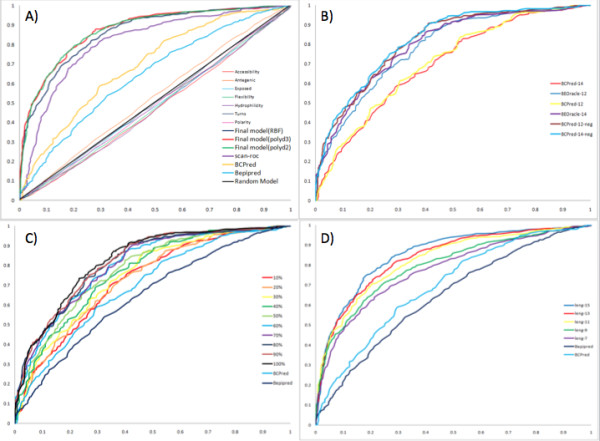
Our analysis using protein properties suggested that sequence composition combined with evolutionary information and predicted secondary structure, as well as solvent accessibility is sufficient to predict successful peptide epitopes. The antigenicity and the specificity in immune response were also found to depend on the epitope length. We trained the B-Cell Epitope Oracle (BEOracle), a support vector machine (SVM) classifier, for the identification of continuous B-Cell epitopes with these protein properties as learning features. The BEOracle achieved an F1-measure of 81.37% on a large validation set. The BEOracle classifier outperformed the classical methods based on propensity and sophisticated methods like BCPred and Bepipred for B-Cell epitope prediction. The BEOracle classifier also identified peptides for the ChIP-grade antibodies from the modENCODE/ENCODE projects with 96.88% accuracy. High BEOracle score for peptides showed some correlation with the antibody intensity on Immunofluorescence studies done on fly embryos. Finally, a second SVM classifier, the B-Cell Region Oracle (BROracle) was trained with the BEOracle scores as features to predict the performance of antibodies generated with large protein regions with high accuracy. The BROracle classifier achieved accuracies of 75.26-63.88% on a validation set with immunofluorescence, immunohistochemistry, protein arrays and western blot results from Protein Atlas database.
Together our results suggest that antigenicity is a local property of the protein sequences and that protein sequence properties of composition, secondary structure, solvent accessibility and evolutionary conservation are the determinants of antigenicity and specificity in immune response. Moreover, specificity in immune response could also be accurately predicted for large protein regions without the knowledge of the protein tertiary structure or the presence of discontinuous epitopes. The dataset prepared in this work and the classifier models are available for download at https://sites.google.com/site/oracleclassifiers/.
针对特定抗体是疫苗设计、免疫诊断测试、癌症生物标志物发现的蛋白质组学研究、蛋白质-DNA 和其他相互作用以及小生化和大生化分析的关键。因此,了解对抗原性很重要的蛋白质序列的特性,并识别蛋白质线性序列中的小肽表位和大区域,这些区域的利用会导致特异性抗体。
我们使用蛋白质特性的分析表明,序列组成与进化信息和预测的二级结构以及溶剂可及性相结合足以预测成功的肽表位。免疫反应的抗原性和特异性也发现取决于表位长度。我们使用这些蛋白质特性作为学习特征,训练了 B 细胞表位预测器(BEOracle),一种支持向量机(SVM)分类器,用于识别连续 B 细胞表位。BEOracle 在大型验证集上的 F1 测量值达到 81.37%。BEOracle 分类器优于基于倾向的经典方法和 BCPred 和 Bepipred 等复杂方法,用于 B 细胞表位预测。BEOracle 分类器还使用 modENCODE/ENCODE 项目的 ChIP 级抗体识别 96.88%的准确率。肽的高 BEOracle 评分与在蝇胚胎上进行免疫荧光研究的抗体强度有一定的相关性。最后,使用 BEOracle 评分作为特征训练了第二个 SVM 分类器,即 B 细胞区域预测器(BROracle),以高精度预测具有高准确性的大蛋白质区域产生的抗体的性能。BROracle 分类器在具有免疫荧光、免疫组织化学、蛋白质阵列和 Western blot 结果的验证集上的准确率为 75.26-63.88%,来自蛋白质图谱数据库。
总的来说,我们的结果表明抗原性是蛋白质序列的局部性质,并且蛋白质序列的组成、二级结构、溶剂可及性和进化保守性等特性是免疫反应中抗原性和特异性的决定因素。此外,即使不知道蛋白质三级结构或不存在不连续表位,也可以准确预测大蛋白质区域的特异性。本工作中准备的数据集和分类器模型可在 https://sites.google.com/site/oracleclassifiers/ 下载。