Department of Nutrition and Dietetics, Saint Louis University, 3437 Caroline St, Room 3076, Saint Louis, MO, 63104, USA.
J Int Soc Sports Nutr. 2011 Jun 21;8:9. doi: 10.1186/1550-2783-8-9.
Protein needs for athletes are likely higher than those for the general population. However, athletes may perceive their protein needs to be excessively high. The purpose of this research was to compare collegiate athletes' perceived protein needs and measured protein intake to the recommended protein intake (RDI) for healthy adults (i.e. 0.8 g/kg/d) and to the maximum beneficial level for strength-trained athletes (i.e. 2.0 g/kg/day).
Perceived protein needs were quantified in 42 strength-trained collegiate male athletes by using a survey that asked the athletes to provide their perception about protein needs in specific quantitative terms (i.e. g/kg/d). Perceived protein needs were also determined by having the athletes select a daylong menu that they perceived to have adequate protein content from a collection of 5 isoenergetic menus, which differed in terms of protein content. Actual protein intake was quantified using 3-day food records and nutrient analysis. Single sample t-tests were used to compare protein intake and perceived protein needs to 0.8 g/kg/day and 2.0 g/kg/day.
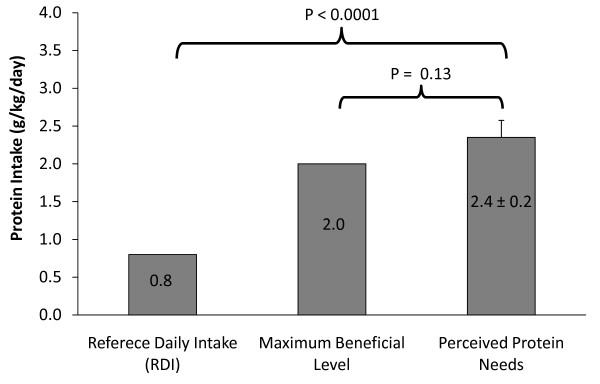
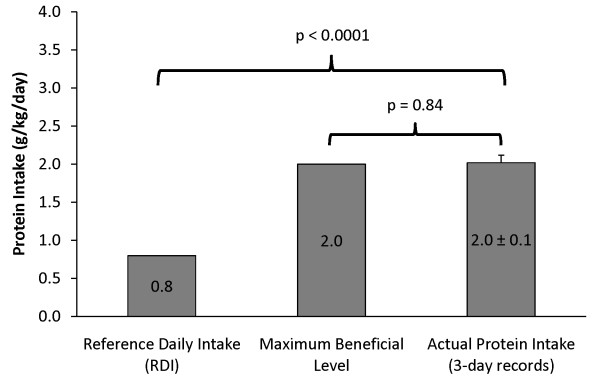
When asked to provide, in quantitative terms, protein needs for athletes, 67% of the athletes indicated "do not know." Of the remaining 33% of athletes, all gave values greater than 2.0 g/kg/d (mean 21.5 ± 11.2 g/kg/d, p = 0.14 vs. 2.0 g/kg/d). Based on the menu selection method for determining perceived protein needs, the athletes indicated that their protein needs were 2.4 ± 0.2 g/kg/d, which was greater than the RDI for protein (p < 0.0001) and tended to be greater than the maximally beneficial protein intake of 2.0 g/kg/d (p = 0.13). Measured protein intake was 2.0 ± 0.1 g/kg/d, which was greater than the RDI (p < 0.0001) but not different from the maximally beneficial protein intake of 2.0 g/kg/d (p = 0.84).
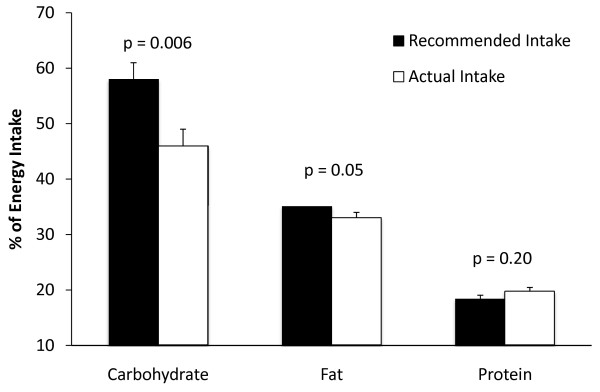
Male collegiate athletes recognize that their protein needs are higher than that of the general population and consume significantly more protein than recommended in the RDI. However, it also appears that athletes are not aware of objective recommendations for protein intake and may perceive their needs to be excessively high. This study highlights the need for nutrition education in collegiate athletes, in particular nutrition education on macronutrient distribution and protein needs.
运动员的蛋白质需求量可能高于一般人群。然而,运动员可能会认为自己的蛋白质需求量过高。本研究的目的是比较大学生运动员的蛋白质需求量和实际摄入量与健康成年人的推荐蛋白质摄入量(RDI,即 0.8 g/kg/d)以及力量训练运动员的最大有益摄入量(即 2.0 g/kg/d)。
通过问卷调查,量化 42 名力量型大学生男性运动员的蛋白质需求量,该问卷要求运动员以特定的定量术语(即 g/kg/d)来表达他们对蛋白质需求量的看法。运动员还可以从一组 5 种等能量的菜单中选择他们认为含有足够蛋白质的一天菜单,这些菜单的蛋白质含量不同,从而确定对蛋白质的感知需求。通过 3 天的食物记录和营养分析来量化实际蛋白质摄入量。使用单样本 t 检验比较蛋白质摄入量和感知蛋白质需求量与 0.8 g/kg/d 和 2.0 g/kg/d。
当被要求以定量术语提供运动员的蛋白质需求量时,67%的运动员表示“不知道”。在剩下的 33%的运动员中,所有人都给出了大于 2.0 g/kg/d 的值(平均值 21.5 ± 11.2 g/kg/d,p = 0.14 与 2.0 g/kg/d 相比)。基于确定感知蛋白质需求量的菜单选择方法,运动员表示他们的蛋白质需求量为 2.4 ± 0.2 g/kg/d,这高于蛋白质的 RDI(p < 0.0001),且倾向于大于 2.0 g/kg/d 的最大有益蛋白质摄入量(p = 0.13)。实际蛋白质摄入量为 2.0 ± 0.1 g/kg/d,这高于 RDI(p < 0.0001),但与 2.0 g/kg/d 的最大有益蛋白质摄入量无差异(p = 0.84)。
男性大学生运动员认识到他们的蛋白质需求量高于一般人群,并摄入远高于 RDI 推荐量的蛋白质。然而,运动员似乎也没有意识到客观的蛋白质摄入量建议,可能认为自己的需求量过高。本研究强调了对大学生运动员进行营养教育的必要性,特别是关于宏量营养素分布和蛋白质需求量的营养教育。