Department of Preventative Medicine, Kyungpook National University, Daegu, Korea.
Diabetes Care. 2011 Aug;34(8):1778-84. doi: 10.2337/dc10-2116. Epub 2011 Jun 23.
Persistent organic pollutants (POPs), lipophilic chemicals that accumulate mainly in adipose tissue, have recently been linked to type 2 diabetes. However, evidence from prospective studies is sparse. This study was performed to evaluate prospective associations of type 2 diabetes with selected POPs among the elderly.
Nineteen POPs (14 polychlorinated biphenyl [PCB] congeners, 3 organochlorine pesticides, 1 brominated diphenyl ether, and 1 dioxin) were measured in plasma collected at baseline in 725 participants, aged 70 years, of the Prospective Investigation of the Vasculature in Uppsala Seniors (PIVUS).
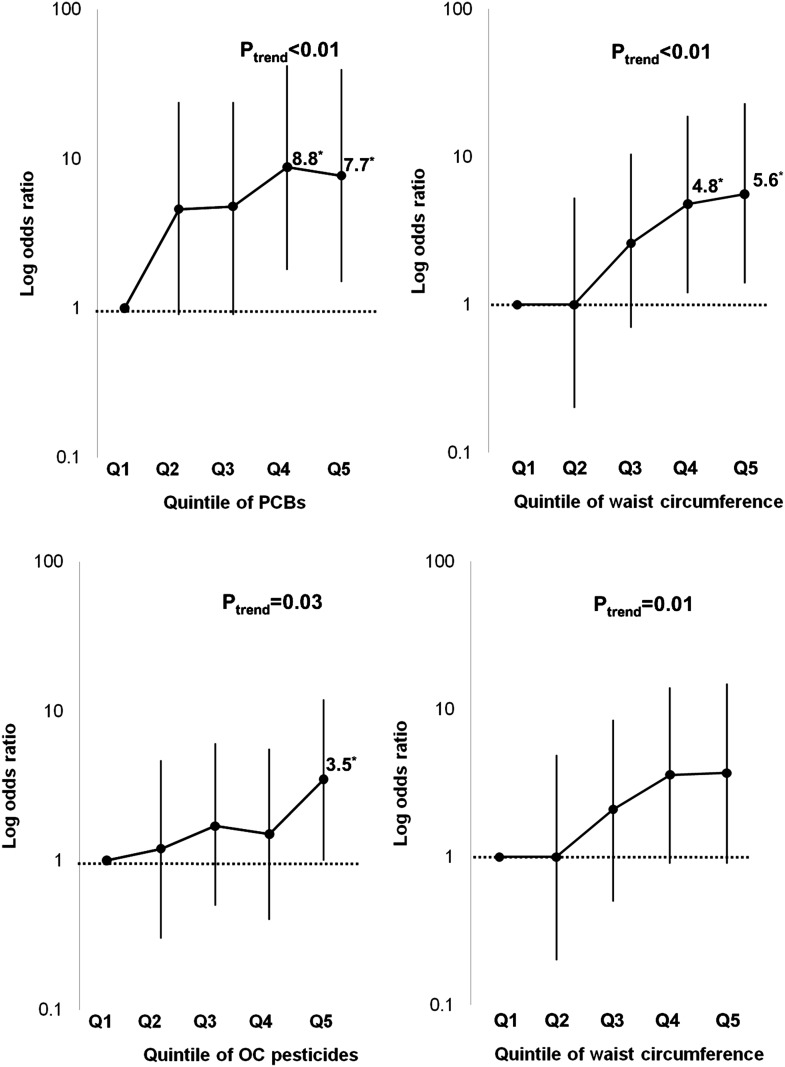
After adjusting for known type 2 diabetes risk factors, including obesity, odds ratios (ORs) (95% CIs) for type 2 diabetes at age 75 years (n = 36) according to the quintiles of a summary measure of concentrations of PCBs (vs. the lowest quintile) were 4.5, 5.1, 8.8 (1.8-42.7), and 7.5 (1.4-38.8) (P(trend) <0.01). Among organochlorine pesticides, adjusted ORs across concentrations of trans-nonachlor showed that P(trend) = 0.03. Adjusted ORs (95% CIs) across quintiles of the sum of three organochlorine pesticides were 1.1, 1.6, 1.5, and 3.4 (1.0-11.7) (P(trend) = 0.03). Neither brominated diphenyl ether 47 nor dioxin was significantly associated with incident diabetes. The sum of PCBs improved reclassification significantly when added to traditional risk factors for diabetes.
Despite the small number of incident cases, this study found that environmental exposure to some POPs substantially increased risk of future type 2 diabetes in an elderly population.
持久性有机污染物(POPs)是一种脂溶性化学物质,主要积聚在脂肪组织中,最近与 2 型糖尿病有关。然而,前瞻性研究的证据很少。本研究旨在评估老年人中 2 型糖尿病与某些 POPs 的前瞻性关联。
在 Prospective Investigation of the Vasculature in Uppsala Seniors(PIVUS)研究中,在基线时采集了 725 名年龄为 70 岁的参与者的血浆,共检测了 19 种 POP(14 种多氯联苯 [PCB] 同系物、3 种有机氯农药、1 种溴化二苯醚和 1 种二恶英)。
在调整了肥胖等已知的 2 型糖尿病危险因素后,根据 PCB 浓度综合指标的五分位数(与最低五分位数相比),75 岁时 2 型糖尿病的比值比(ORs)(95%CI)分别为 4.5、5.1、8.8(1.8-42.7)和 7.5(1.4-38.8)(P(趋势)<0.01)。在有机氯农药中,随着顺式-六氯的浓度增加,调整后的 OR 值显示 P(趋势)=0.03。三种有机氯农药总和的五分位数之间的调整 OR 分别为 1.1、1.6、1.5 和 3.4(1.0-11.7)(P(趋势)=0.03)。溴化二苯醚 47 和二恶英与糖尿病发病率均无显著相关性。当将 PCB 总和添加到糖尿病的传统危险因素中时,显著改善了再分类。
尽管病例数量较少,但本研究发现,老年人环境暴露于某些 POPs 会显著增加未来 2 型糖尿病的风险。