Park Jong Myoung, Kim Tae Yong, Lee Sang Yup
Metabolic and Biomolecular Engineering National Research Laboratory, Department of Chemical and Biomolecular Engineering (BK21 program), KAIST, 291 Daehak-ro, Yuseong-gu, Daejeon 305-701, Republic of Korea.
BMC Syst Biol. 2011 Jun 28;5:101. doi: 10.1186/1752-0509-5-101.
Ralstonia eutropha H16, found in both soil and water, is a Gram-negative lithoautotrophic bacterium that can utillize CO2 and H2 as its sources of carbon and energy in the absence of organic substrates. R. eutropha H16 can reach high cell densities either under lithoautotrophic or heterotrophic conditions, which makes it suitable for a number of biotechnological applications. It is the best known and most promising producer of polyhydroxyalkanoates (PHAs) from various carbon substrates and is an environmentally important bacterium that can degrade aromatic compounds. In order to make R. eutropha H16 a more efficient and robust biofactory, system-wide metabolic engineering to improve its metabolic performance is essential. Thus, it is necessary to analyze its metabolic characteristics systematically and optimize the entire metabolic network at systems level.
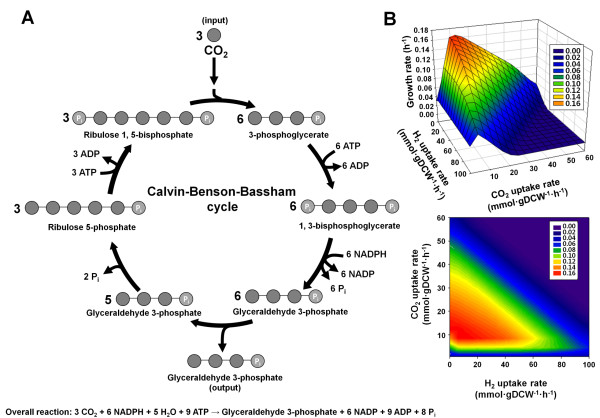
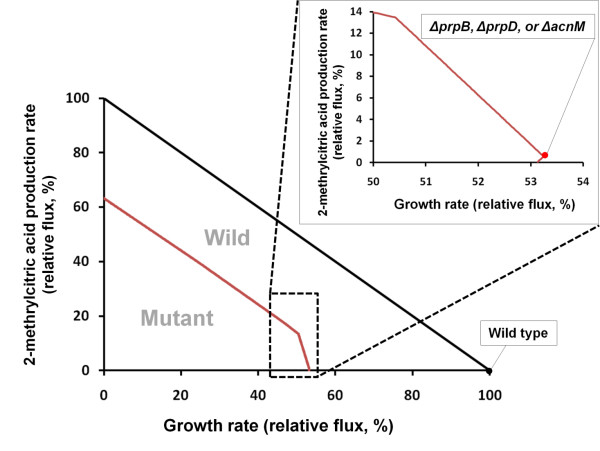
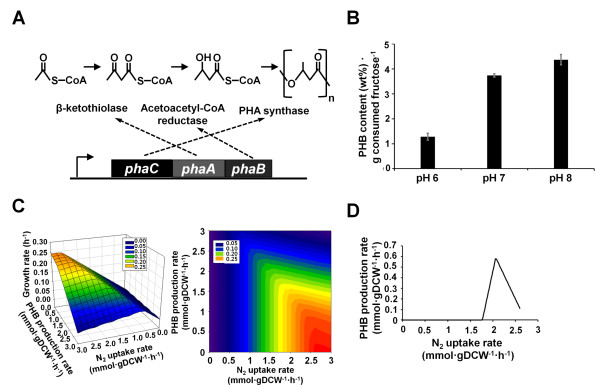
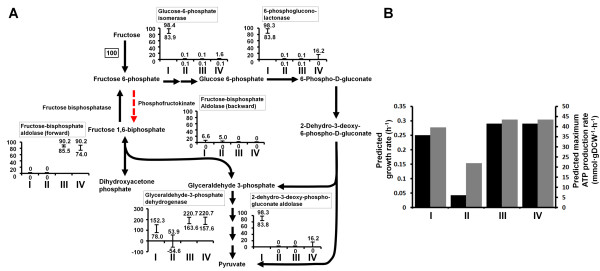
We present the lithoautotrophic genome-scale metabolic model of R. eutropha H16 based on the annotated genome with biochemical and physiological information. The stoichiometic model, RehMBEL1391, is composed of 1391 reactions including 229 transport reactions and 1171 metabolites. Constraints-based flux analyses were performed to refine and validate the genome-scale metabolic model under environmental and genetic perturbations. First, the lithoautotrophic growth characteristics of R. eutropha H16 were investigated under varying feeding ratios of gas mixture. Second, the genome-scale metabolic model was used to design the strategies for the production of poly[R-(-)-3hydroxybutyrate] (PHB) under different pH values and carbon/nitrogen source uptake ratios. It was also used to analyze the metabolic characteristics of R. eutropha when the phosphofructokinase gene was expressed. Finally, in silico gene knockout simulations were performed to identify targets for metabolic engineering essential for the production of 2-methylcitric acid in R. eutropha H16.
The genome-scale metabolic model, RehMBEL1391, successfully represented metabolic characteristics of R. eutropha H16 at systems level. The reconstructed genome-scale metabolic model can be employed as an useful tool for understanding its metabolic capabilities, predicting its physiological consequences in response to various environmental and genetic changes, and developing strategies for systems metabolic engineering to improve its metabolic performance.
嗜油假单胞菌H16存在于土壤和水中,是一种革兰氏阴性化能自养细菌,在没有有机底物的情况下,它可以利用二氧化碳和氢气作为碳源和能源。嗜油假单胞菌H16在化能自养或异养条件下都能达到较高的细胞密度,这使其适用于多种生物技术应用。它是从各种碳底物生产聚羟基脂肪酸酯(PHA)最知名且最有前景的菌株,也是一种能降解芳香族化合物的对环境重要的细菌。为了使嗜油假单胞菌H16成为更高效、更强大的生物工厂,进行全系统代谢工程以改善其代谢性能至关重要。因此,有必要系统地分析其代谢特性,并在系统水平上优化整个代谢网络。
我们基于带有生化和生理信息的注释基因组,提出了嗜油假单胞菌H16的化能自养基因组规模代谢模型。化学计量模型RehMBEL1391由1391个反应组成,包括229个转运反应和1171个代谢物。基于约束的通量分析用于在环境和遗传扰动下完善和验证基因组规模代谢模型。首先,研究了嗜油假单胞菌H16在不同气体混合物进料比下的化能自养生长特性。其次,基因组规模代谢模型用于设计在不同pH值和碳/氮源摄取比下生产聚[R-(-)-3-羟基丁酸酯](PHB)的策略。它还用于分析磷酸果糖激酶基因表达时嗜油假单胞菌的代谢特性。最后,进行了计算机基因敲除模拟,以确定嗜油假单胞菌H16中生产2-甲基柠檬酸所必需的代谢工程靶点。
基因组规模代谢模型RehMBEL1391成功地在系统水平上表征了嗜油假单胞菌H16的代谢特性。重建的基因组规模代谢模型可作为一个有用的工具,用于理解其代谢能力,预测其对各种环境和遗传变化的生理反应,并制定系统代谢工程策略以改善其代谢性能