Telkemeyer Silke, Rossi Sonja, Nierhaus Till, Steinbrink Jens, Obrig Hellmuth, Wartenburger Isabell
Languages of Emotion Cluster of Excellence, Freie Universität Berlin Berlin, Germany.
Front Psychol. 2011 Apr 9;1:62. doi: 10.3389/fpsyg.2011.00062. eCollection 2011.
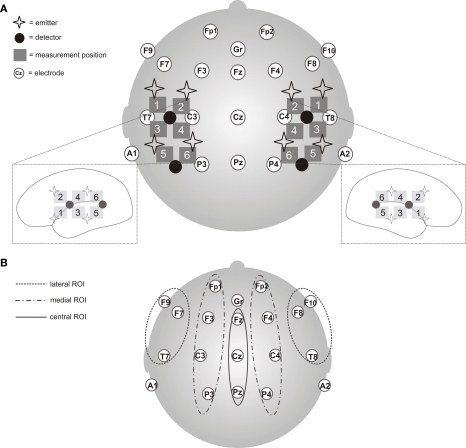
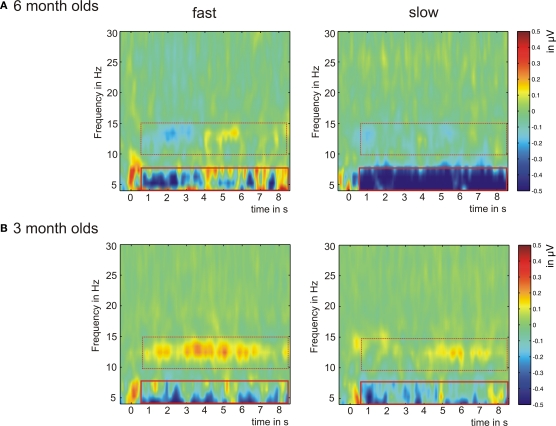
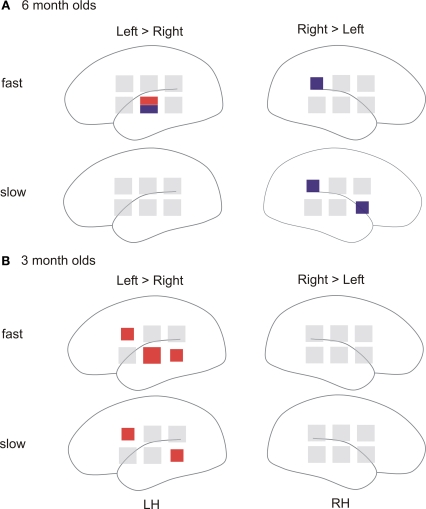
Speech perception requires rapid extraction of the linguistic content from the acoustic signal. The ability to efficiently process rapid changes in auditory information is important for decoding speech and thereby crucial during language acquisition. Investigating functional networks of speech perception in infancy might elucidate neuronal ensembles supporting perceptual abilities that gate language acquisition. Interhemispheric specializations for language have been demonstrated in infants. How these asymmetries are shaped by basic temporal acoustic properties is under debate. We recently provided evidence that newborns process non-linguistic sounds sharing temporal features with language in a differential and lateralized fashion. The present study used the same material while measuring brain responses of 6 and 3 month old infants using simultaneous recordings of electroencephalography (EEG) and near-infrared spectroscopy (NIRS). NIRS reveals that the lateralization observed in newborns remains constant over the first months of life. While fast acoustic modulations elicit bilateral neuronal activations, slow modulations lead to right-lateralized responses. Additionally, auditory-evoked potentials and oscillatory EEG responses show differential responses for fast and slow modulations indicating a sensitivity for temporal acoustic variations. Oscillatory responses reveal an effect of development, that is, 6 but not 3 month old infants show stronger theta-band desynchronization for slowly modulated sounds. Whether this developmental effect is due to increasing fine-grained perception for spectrotemporal sounds in general remains speculative. Our findings support the notion that a more general specialization for acoustic properties can be considered the basis for lateralization of speech perception. The results show that concurrent assessment of vascular based imaging and electrophysiological responses have great potential in the research on language acquisition.
言语感知需要从声学信号中快速提取语言内容。有效处理听觉信息快速变化的能力对于解码言语至关重要,因此在语言习得过程中起着关键作用。研究婴儿期言语感知的功能网络可能会阐明支持影响语言习得的感知能力的神经元集合。婴儿期语言的半球间特化已得到证实。这些不对称性如何由基本的时间声学特性塑造仍存在争议。我们最近提供的证据表明,新生儿以差异化和侧化的方式处理与语言共享时间特征的非语言声音。本研究使用相同的材料,同时通过脑电图(EEG)和近红外光谱(NIRS)同步记录来测量6个月和3个月大婴儿的脑反应。NIRS显示,新生儿中观察到的侧化在生命的头几个月保持不变。虽然快速声学调制会引发双侧神经元激活,但缓慢调制会导致右侧化反应。此外,听觉诱发电位和振荡性脑电图反应对快速和缓慢调制显示出不同的反应,表明对时间声学变化具有敏感性。振荡反应显示出一种发育效应,即6个月而非3个月大的婴儿对缓慢调制的声音表现出更强的θ波段去同步化。这种发育效应是否总体上归因于对频谱时间声音的更精细感知仍具有推测性。我们的研究结果支持这样一种观点,即对声学特性的更普遍特化可被视为言语感知侧化的基础。结果表明,基于血管的成像和电生理反应的同步评估在语言习得研究中具有巨大潜力。