Obrig Hellmuth, Rossi Sonja, Telkemeyer Silke, Wartenburger Isabell
Max-Planck-Institute for Cognitive and Brain Sciences Leipzig, Germany.
Front Neuroenergetics. 2010 Jun 23;2. doi: 10.3389/fnene.2010.00013. eCollection 2010.
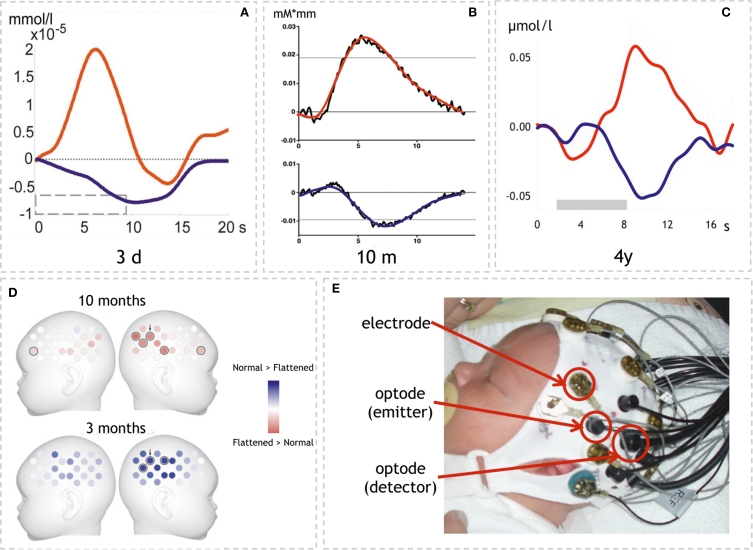
During language acquisition in infancy and when learning a foreign language, the segmentation of the auditory stream into words and phrases is a complex process. Intuitively, learners use "anchors" to segment the acoustic speech stream into meaningful units like words and phrases. Regularities on a segmental (e.g., phonological) or suprasegmental (e.g., prosodic) level can provide such anchors. Regarding the neuronal processing of these two kinds of linguistic cues a left-hemispheric dominance for segmental and a right-hemispheric bias for suprasegmental information has been reported in adults. Though lateralization is common in a number of higher cognitive functions, its prominence in language may also be a key to understanding the rapid emergence of the language network in infants and the ease at which we master our language in adulthood. One question here is whether the hemispheric lateralization is driven by linguistic input per se or whether non-linguistic, especially acoustic factors, "guide" the lateralization process. Methodologically, functional magnetic resonance imaging provides unsurpassed anatomical detail for such an enquiry. However, instrumental noise, experimental constraints and interference with EEG assessment limit its applicability, pointedly in infants and also when investigating the link between auditory and linguistic processing. Optical methods have the potential to fill this gap. Here we review a number of recent studies using optical imaging to investigate hemispheric differences during segmentation and basic auditory feature analysis in language development.
在婴儿期语言习得过程中以及学习外语时,将听觉流分割成单词和短语是一个复杂的过程。直观地说,学习者使用“锚点”将语音流分割成诸如单词和短语等有意义的单元。在音段(如音系学)或超音段(如韵律学)层面上的规律可以提供这样的锚点。关于这两种语言线索的神经处理,已有报道称成年人在音段处理上左半球占优势,在超音段信息处理上右半球有偏向。尽管大脑半球侧化在许多高级认知功能中很常见,但它在语言中的突出地位也可能是理解婴儿语言网络快速形成以及我们在成年后轻松掌握语言的关键。这里的一个问题是,大脑半球侧化是由语言输入本身驱动的,还是非语言因素,尤其是声学因素“引导”了侧化过程。从方法学上讲,功能磁共振成像为这样的探究提供了无与伦比的解剖学细节。然而,仪器噪声、实验限制以及对脑电图评估的干扰限制了其适用性,尤其是在婴儿身上,以及在研究听觉与语言处理之间的联系时。光学方法有潜力填补这一空白。在此,我们回顾一些最近使用光学成像来研究语言发展过程中分割和基本听觉特征分析期间大脑半球差异的研究。