Department of Neuroimaging, Centre for Neuroimaging Sciences, Institute of Psychiatry, King's College London, London, UK.
Neuroimage. 2011 Oct 1;58(3):793-804. doi: 10.1016/j.neuroimage.2011.06.042. Epub 2011 Jun 24.
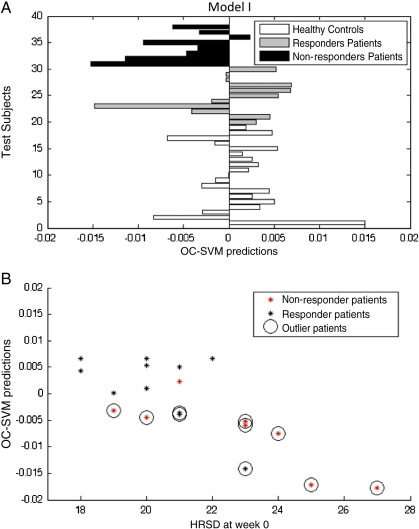
Pattern recognition approaches, such as the Support Vector Machine (SVM), have been successfully used to classify groups of individuals based on their patterns of brain activity or structure. However these approaches focus on finding group differences and are not applicable to situations where one is interested in accessing deviations from a specific class or population. In the present work we propose an application of the one-class SVM (OC-SVM) to investigate if patterns of fMRI response to sad facial expressions in depressed patients would be classified as outliers in relation to patterns of healthy control subjects. We defined features based on whole brain voxels and anatomical regions. In both cases we found a significant correlation between the OC-SVM predictions and the patients' Hamilton Rating Scale for Depression (HRSD), i.e. the more depressed the patients were the more of an outlier they were. In addition the OC-SVM split the patient groups into two subgroups whose membership was associated with future response to treatment. When applied to region-based features the OC-SVM classified 52% of patients as outliers. However among the patients classified as outliers 70% did not respond to treatment and among those classified as non-outliers 89% responded to treatment. In addition 89% of the healthy controls were classified as non-outliers.
模式识别方法,如支持向量机(SVM),已经成功地用于根据个体的大脑活动或结构模式对其进行分类。然而,这些方法侧重于寻找群体差异,不适用于人们对特定类别或群体的偏差感兴趣的情况。在本研究中,我们提出了一种应用单类支持向量机(OC-SVM)的方法,以研究抑郁患者对悲伤面部表情的 fMRI 反应模式是否可以被归类为异常值,与健康对照组的模式相比。我们基于全脑体素和解剖区域定义了特征。在这两种情况下,我们都发现 OC-SVM 预测与患者的汉密尔顿抑郁评定量表(HRSD)之间存在显著相关性,即患者越抑郁,他们就越像异常值。此外,OC-SVM 将患者群体分为两个亚组,其成员与未来的治疗反应相关。当应用于基于区域的特征时,OC-SVM 将 52%的患者归类为异常值。然而,在被归类为异常值的患者中,70%没有对治疗有反应,而在被归类为非异常值的患者中,89%对治疗有反应。此外,89%的健康对照者被归类为非异常值。