Institute on the Environment, University of Minnesota, St. Paul, Minnesota, USA.
Environ Health Perspect. 2011 Oct;119(10):1390-5. doi: 10.1289/ehp.1003371. Epub 2011 Jul 1.
Almost half of the world's population uses coal and biomass fuels for domestic energy. Limited evidence suggests that exposure to air pollutants from indoor biomass combustion may be associated with elevated blood pressure (BP).
Our aim was to assess the relationship between air pollution exposure from indoor biomass combustion and BP in women in rural China.
We measured 24-hr personal integrated gravimetric exposure to fine particles < 2.5 µm in aerodynamic diameter (PM2.5) and systolic BP (SBP) and diastolic BP (DBP) in the winter and summer among 280 women ≥ 25 years of age living in rural households using biomass fuels in Yunnan, China. We investigated the association between PM2.5 exposure and SBP and DBP using mixed-effects models with random intercepts to account for correlation among repeated measures.
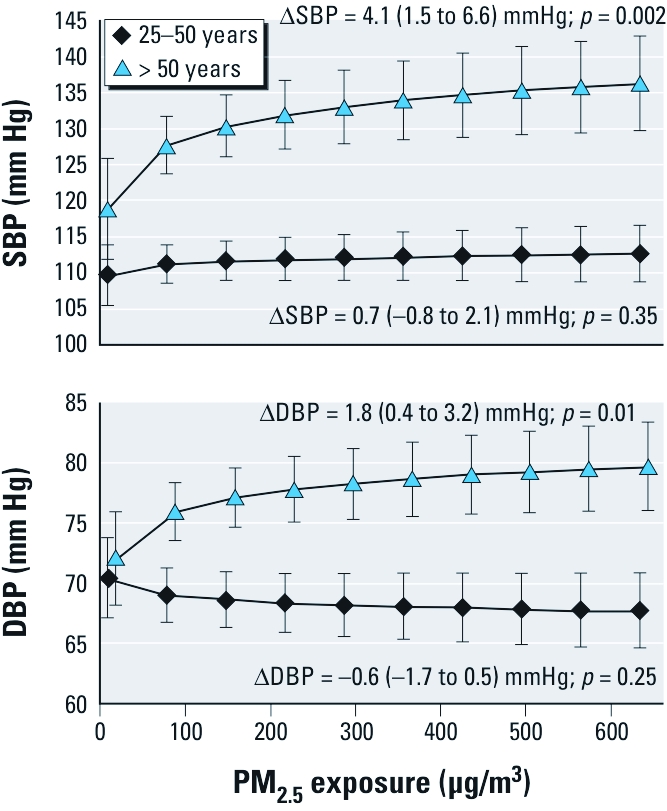
Personal average 24-hr exposure to PM2.5 ranged from 22 to 634 µg/m3 in winter and from 9 to 492 µg/m3 in summer. A 1-log-µg/m3 increase in PM2.5 exposure was associated with 2.2 mm Hg higher SBP [95% confidence interval (CI), 0.8 to 3.7; p = 0.003] and 0.5 mm Hg higher DBP (95% CI, -0.4 to 1.3; p = 0.31) among all women; estimated effects varied by age group. Among women > 50 years of age, a 1-log-µg/m3 increase in PM2.5 exposure was associated with 4.1 mm Hg higher SBP (95% CI, 1.5 to 6.6; p = 0.002) and 1.8 mm Hg higher DBP (95% CI, 0.4 to 3.2; p = 0.01). PM2.5 exposure was positively associated with SBP among younger women, but the association was not statistically significant.
PM2.5 exposure from biomass combustion may be a risk factor for elevated BP and hence for cardiovascular events. Our findings should be corroborated in longitudinal studies.
全球近一半的人口将煤和生物质燃料用于家庭能源。有限的证据表明,室内生物质燃烧产生的空气污染物暴露可能与血压升高有关。
我们旨在评估中国农村地区女性因室内生物质燃烧产生的空气污染暴露与血压之间的关系。
我们测量了 280 名年龄在 25 岁及以上、使用生物质燃料的农村家庭妇女在冬季和夏季 24 小时个人综合重力暴露于空气动力学直径<2.5µm 的细颗粒物(PM2.5)和收缩压(SBP)和舒张压(DBP)。我们使用混合效应模型,通过随机截距来评估 PM2.5 暴露与 SBP 和 DBP 之间的关联,以解释重复测量之间的相关性。
冬季个人平均 24 小时 PM2.5 暴露范围为 22 至 634µg/m3,夏季为 9 至 492µg/m3。PM2.5 暴露每增加 1-log-µg/m3,SBP 升高 2.2mmHg(95%置信区间[CI],0.8 至 3.7;p = 0.003),DBP 升高 0.5mmHg(95% CI,-0.4 至 1.3;p = 0.31);所有女性中估计的影响因年龄组而异。在>50 岁的女性中,PM2.5 暴露每增加 1-log-µg/m3,SBP 升高 4.1mmHg(95% CI,1.5 至 6.6;p = 0.002),DBP 升高 1.8mmHg(95% CI,0.4 至 3.2;p = 0.01)。PM2.5 暴露与年轻女性的 SBP 呈正相关,但相关性无统计学意义。
生物质燃烧产生的 PM2.5 暴露可能是血压升高的一个危险因素,进而也是心血管事件的一个危险因素。我们的发现应在纵向研究中得到证实。