The University of British Columbia, Vancouver, British Columbia, Canada.
BMC Public Health. 2011 Jul 5;11:532. doi: 10.1186/1471-2458-11-532.
Outdoor air pollution, given its demonstrated negative effects on the respiratory system, is a growing public health concern worldwide, particularly in urban cities. Human exposure to pollutants such as ozone, nitrogen oxides, combustion-related particulate matter and oxides of sulfur is responsible for significant cardiopulmonary morbidity and mortality in both adults and children. Several antioxidants have shown an ability to partially attenuate the negative physiological and functional impacts of air pollutants. This study systematically presents current data on the potential benefits of antioxidant supplementation on lung function outcomes associated with air pollutant exposures in intact humans.
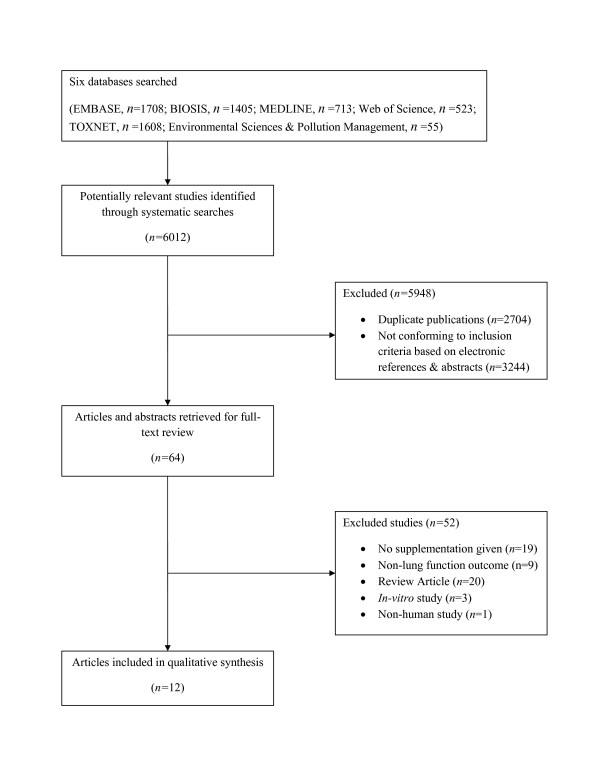
Electronic databases (MEDLINE, EMBASE, BIOSIS Previews, Web of Sciences, Environmental Sciences & Pollution Management and TOXNET) were systematically searched for all studies published up to April 2009. Search terms relating to the concepts of respiratory tract diseases, respiratory function tests, air pollution, and antioxidants were used. Data was systematically abstracted from original articles that satisfied selection criteria for inclusion. For inclusion, the studies needed to have evaluated human subjects, given supplemental antioxidants, under conditions of known levels of air pollutants with measured lung function before and after antioxidant administration and/or air pollution exposure. Selected studies were summarized and conclusions presented.
Eight studies investigated the role of antioxidant supplementation on measured lung function outcomes after subject exposure to air pollutants under controlled conditions; 5 of these studies concluded that pollutant-induced airway hyper-responsiveness and diminution in lung function measurements were attenuated by antioxidant supplementation. The remaining five studies took place under ambient (uncontrolled) exposures and unanimously concluded that antioxidant supplementations attenuate the negative effects of urban air pollution on lung function.
The data evaluating modification of changes in lung function associated with air pollutant exposure by antioxidant supplementation, in intact humans, is limited. Of 13 studies dedicated to this concern, ten demonstrated an attenuation of pollution-associated decrements. There is growing evidence for the benefit of anti-oxidant supplementation in moderating the effects of air pollution on lung function, but more research on human participants is needed to inform this topic.
户外空气污染对呼吸系统的负面影响已得到证实,这是一个在全球范围内日益受到关注的公共卫生问题,尤其是在城市地区。人类暴露于臭氧、氮氧化物、燃烧相关的颗粒物和硫氧化物等污染物中,会导致成人和儿童的心肺发病率和死亡率显著增加。一些抗氧化剂已被证明具有部分减轻空气污染物对生理和功能的负面影响的能力。本研究系统地介绍了目前关于抗氧化剂补充对完整人体暴露于空气污染物相关的肺功能结果的潜在益处的数据。
系统地检索了截至 2009 年 4 月发表的所有研究的电子数据库(MEDLINE、EMBASE、BIOSIS Previews、Web of Sciences、Environmental Sciences & Pollution Management 和 TOXNET)。使用了与呼吸道疾病、呼吸功能测试、空气污染和抗氧化剂概念相关的检索词。从符合纳入标准的原始文章中系统地提取数据。纳入的研究需要评估人类受试者,在已知水平的空气污染物存在下,给予补充抗氧化剂,并在抗氧化剂给药和/或空气污染物暴露前后测量肺功能。总结了选定的研究并提出了结论。
八项研究调查了在受控条件下暴露于空气污染物后补充抗氧化剂对测量的肺功能结果的作用;其中五项研究的结论认为,抗氧化剂补充剂减轻了污染物引起的气道高反应性和肺功能测量值的降低。其余五项研究是在环境(不受控制)暴露下进行的,一致认为抗氧化剂补充剂减轻了城市空气污染对肺功能的负面影响。
评估抗氧化剂补充剂对完整人体暴露于空气污染物相关的肺功能变化的影响的数据有限。在专门研究这一问题的 13 项研究中,有 10 项研究表明,空气污染相关的下降得到了缓解。越来越多的证据表明抗氧化剂补充剂在减轻空气污染对肺功能的影响方面有益,但需要更多的人类参与者研究来阐明这一问题。