Department of Paediatric Infectious Diseases, Medical University of Bialystok, University Children's Hospital, Waszyngtona 17, 15-274, Bialystok, Poland.
Eur J Clin Microbiol Infect Dis. 2012 Apr;31(4):417-22. doi: 10.1007/s10096-011-1321-z. Epub 2011 Jul 6.
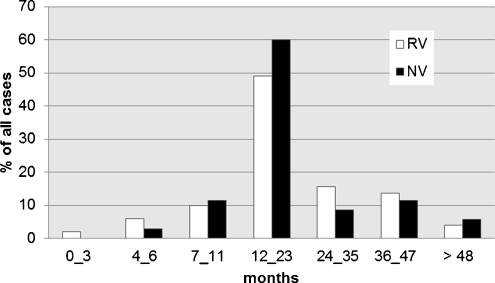
The primary aim of this study was to evaluate the frequency and seasonality of norovirus infection in hospitalized Polish children under 5 years of age, and a secondary aim was to compare the clinical severity of norovirus and rotavirus disease. The prospective surveillance study was carried out from July 2009 through June 2010. Stool samples from 242 children hospitalized due to acute viral gastroenteritis were tested for rotavirus group A and adenovirus with commercial immunochromatographic test and for norovirus with EIA assay. Single norovirus infection was found in 35/242 (14.5%) patients and in a further 5 (2.1%) children as co-infection with rotavirus. Overall, norovirus was detected in 16.5% of stool specimens. Norovirus infections tended to peak from October to November and again from February to March. In autumn months and in February, the proportion of norovirus gastroenteritis cases was equal or even surpassed those of rotavirus origin. Both norovirus and rotavirus infections most commonly affected children between 12 and 23 months of age. The low-grade or no fever was significantly more common in children infected with norovirus (94.3%) compared to rotavirus cases (52.9%). Overall, norovirus gastroenteritis was less severe than rotavirus disease with regard to 20-point severity scale (p < 0.05). Noroviruses have emerged as a relevant cause of acute gastroenteritis in Polish children. There is a great need for introducing routine norovirus testing of hospitalized children with gastroenteritis.
本研究的主要目的是评估波兰 5 岁以下住院儿童感染诺如病毒的频率和季节性,次要目的是比较诺如病毒和轮状病毒疾病的临床严重程度。这项前瞻性监测研究于 2009 年 7 月至 2010 年 6 月进行。对 242 名因急性病毒性肠胃炎住院的儿童的粪便样本进行轮状病毒 A 组和腺病毒的商业免疫层析试验检测以及诺如病毒的 EIA 检测。242 例患儿中,35 例(14.5%)和 5 例(2.1%)患儿分别为单纯诺如病毒感染和诺如病毒与轮状病毒混合感染。总的来说,16.5%的粪便标本检测到诺如病毒。诺如病毒感染呈 10 月至 11 月和 2 月至 3 月的双峰分布。在秋季和 2 月,诺如病毒肠胃炎的比例与轮状病毒相当或甚至超过轮状病毒。诺如病毒和轮状病毒感染最常见于 12 至 23 个月大的儿童。与轮状病毒感染患儿(52.9%)相比,诺如病毒感染患儿(94.3%)出现低热或无热的比例明显更高。整体而言,在 20 分严重程度评分上,诺如病毒肠胃炎的严重程度低于轮状病毒病(p < 0.05)。诺如病毒已成为波兰儿童急性肠胃炎的重要病因。迫切需要对患有肠胃炎的住院儿童进行常规诺如病毒检测。