Behavioural and Clinical Neuroscience Institute, Department of Experimental Psychology, University of Cambridge, UK.
Psychol Med. 2011 Dec;41(12):2625-35. doi: 10.1017/S003329171100095X. Epub 2011 Jun 29.
Pathological gambling (PG) is a form of behavioural addiction that has been associated with elevated impulsivity and also cognitive distortions in the processing of chance, probability and skill. We sought to assess the relationship between the level of cognitive distortions and state and trait measures of impulsivity in treatment-seeking pathological gamblers.
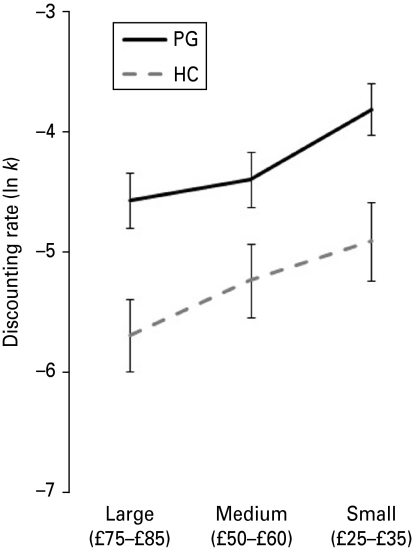
Thirty pathological gamblers attending the National Problem Gambling Clinic, the first National Health Service clinic for gambling problems in the UK, were compared with 30 healthy controls in a case-control design. Cognitive distortions were assessed using the Gambling-Related Cognitions Scale (GRCS). Trait impulsivity was assessed using the UPPS-P, which includes scales of urgency, the tendency to be impulsive in positive or negative mood states. Delay discounting rates were taken as a state measure of impulsive choice.
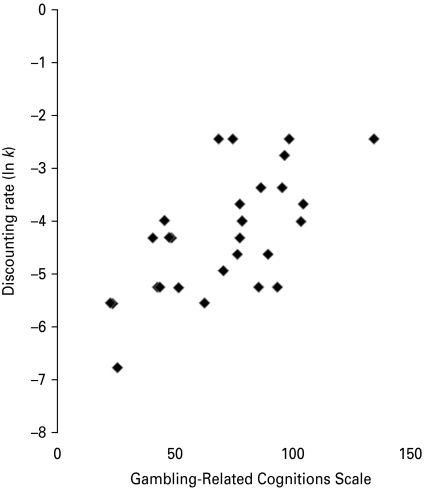
Pathological gamblers had elevated impulsivity on several UPPS-P subscales but effect sizes were largest (Cohen's d>1.4) for positive and negative urgency. The pathological gamblers also displayed higher levels of gambling distortions, and elevated preference for immediate rewards, compared to controls. Within the pathological gamblers, there was a strong relationship between the preference for immediate rewards and the level of cognitive distortions (R2=0.41).
Impulsive choice in the gamblers was correlated with the level of gambling distortions, and we hypothesize that an impulsive decision-making style may increase the acceptance of erroneous beliefs during gambling play.
病理性赌博(PG)是一种行为成瘾形式,与冲动性升高有关,也与对机会、概率和技能的处理中的认知扭曲有关。我们试图评估认知扭曲程度与寻求治疗的病理性赌博者的冲动状态和特质测量之间的关系。
30 名病理性赌博者参加了英国首家国家卫生服务赌博问题诊所——国家问题赌博诊所,与 30 名健康对照组进行病例对照设计比较。使用赌博相关认知量表(GRCS)评估认知扭曲。特质冲动性使用 UPPS-P 进行评估,其中包括冲动性在积极或消极情绪状态下的冲动性倾向的量表。延迟折扣率作为冲动选择的状态测量。
病理性赌博者在几个 UPPS-P 子量表上表现出冲动性升高,但效应大小(Cohen's d>1.4)最大的是积极和消极冲动性。与对照组相比,病理性赌博者也表现出更高水平的赌博扭曲和对即时奖励的偏好。在病理性赌博者中,对即时奖励的偏好与认知扭曲程度之间存在很强的关系(R2=0.41)。
赌博者的冲动选择与赌博扭曲程度相关,我们假设冲动决策风格可能会在赌博过程中增加对错误信念的接受。