National Institute on Aging, National Institutes of Health, Department of Health and Human Services, Baltimore, MD 21224, USA.
J Pers Soc Psychol. 2011 Sep;101(3):579-92. doi: 10.1037/a0024286.
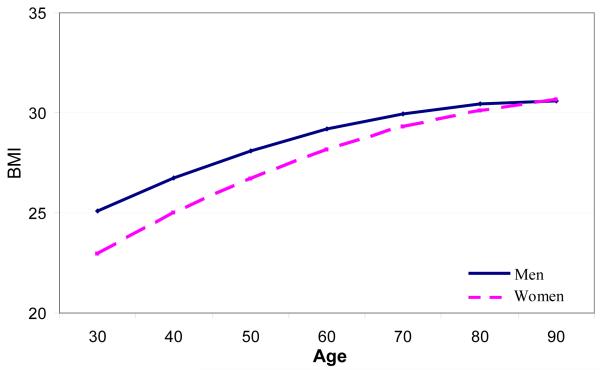
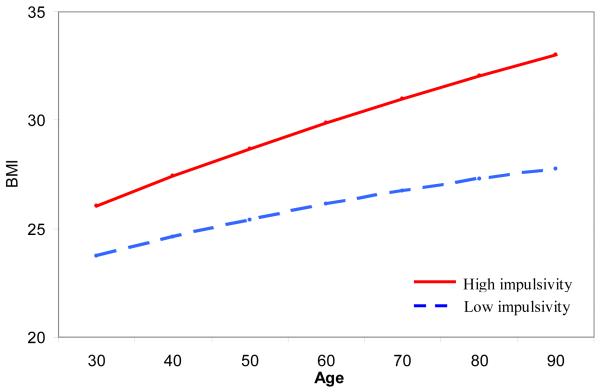
Personality traits contribute to health outcomes, in part through their association with major controllable risk factors, such as obesity. Body weight, in turn, reflects our behaviors and lifestyle and contributes to the way we perceive ourselves and others. In this study, the authors use data from a large (N = 1,988) longitudinal study that spanned more than 50 years to examine how personality traits are associated with multiple measures of adiposity and with fluctuations in body mass index (BMI). Using 14,531 anthropometric assessments, the authors modeled the trajectory of BMI across adulthood and tested whether personality predicted its rate of change. Measured concurrently, participants higher on Neuroticism or Extraversion or lower on Conscientiousness had higher BMI; these associations replicated across body fat, waist, and hip circumference. The strongest association was found for the impulsivity facet: Participants who scored in the top 10% of impulsivity weighed, on average, 11Kg more than those in the bottom 10%. Longitudinally, high Neuroticism and low Conscientiousness, and the facets of these traits related to difficulty with impulse control, were associated with weight fluctuations, measured as the variability in weight over time. Finally, low Agreeableness and impulsivity-related traits predicted a greater increase in BMI across the adult life span. BMI was mostly unrelated to change in personality traits. Personality traits are defined by cognitive, emotional, and behavioral patterns that likely contribute to unhealthy weight and difficulties with weight management. Such associations may elucidate the role of personality traits in disease progression and may help to design more effective interventions.
人格特质与健康结果有关,部分原因是它们与肥胖等主要可控风险因素有关。体重反过来又反映了我们的行为和生活方式,并影响我们对自己和他人的看法。在这项研究中,作者使用了一项大型(N=1988)纵向研究的数据,该研究跨越了 50 多年,以研究人格特质与多种肥胖指标以及身体质量指数(BMI)的波动之间的关系。通过 14531 项人体测量评估,作者模拟了 BMI 在成年期的轨迹,并测试了人格是否可以预测其变化率。在同期测量时,神经质或外向性得分较高或尽责性得分较低的参与者的 BMI 较高;这些关联在体脂肪、腰围和臀围中均得到了复制。冲动特质的关联最强:在冲动性方面得分最高的 10%的参与者的体重比得分最低的 10%的参与者平均重 11 公斤。从纵向来看,高神经质和低尽责性,以及与冲动控制困难相关的这些特质的特质,与体重波动有关,即随时间变化的体重变化。最后,低宜人性和与冲动性相关的特质预测了 BMI 在成年期的更大增长。BMI 与人格特质的变化几乎没有关系。人格特质由认知、情感和行为模式定义,这些模式可能导致不健康的体重和体重管理困难。这些关联可能阐明了人格特质在疾病进展中的作用,并可能有助于设计更有效的干预措施。