Das A, Prabhakar P, Narayanan P, Neilsen G, Wi T, Kumta S, Rao G, Gangakhedkar R, Risbud A
India Office, FHI, H 5 Green Park Extension, New Delhi 110016, India.
Infect Dis Obstet Gynecol. 2011;2011:494769. doi: 10.1155/2011/494769. Epub 2011 Jun 22.
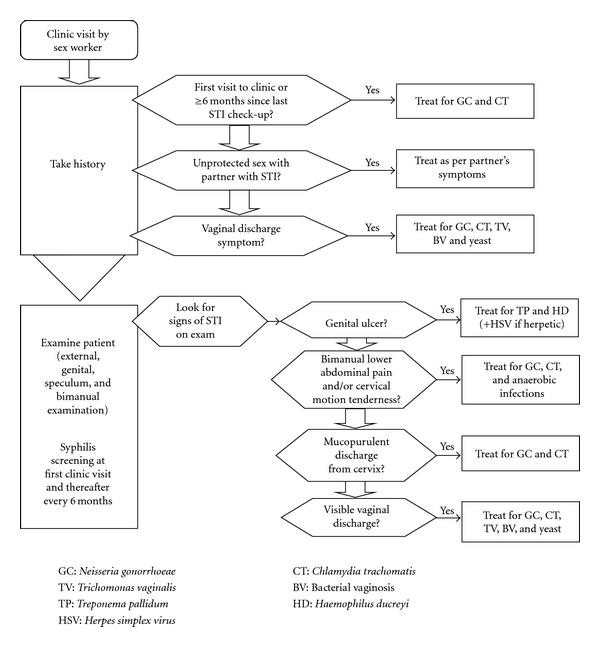
Control of sexually transmitted infections (STIs) among female sex workers (FSWs) is an important strategy to reduce HIV transmission. A study was conducted to determine the prevalence and assess the current clinical management of STIs in India.
FSWs attending three clinics for regular checkups or symptoms were screened for study eligibility. A behavioral questionnaire was administered, clinical examination performed, and laboratory samples collected.
417 study participants reported a mean number of 4.9 (SD 3.5) commercial clients in the last week. 14.6% reported anal sex in the last three months. Consistent condom use with commercial and regular partners was 70.1% and 17.5%, respectively. The prevalence of gonorrhea was 14.1%, chlamydia 16.1%, and trichomoniasis 31.1% with a third of all infections being asymptomatic. Syphilis seropositivity was 10.1%.
At study sites, presumptive treatment for gonorrhea, chlamydia, and syphilis screening should continue. Presumptive treatment for trichomoniasis should be considered. Consistent condom use and partner treatment need to be reemphasized.
控制女性性工作者(FSW)中的性传播感染(STI)是减少艾滋病毒传播的一项重要策略。开展了一项研究,以确定印度性传播感染的患病率并评估当前的临床管理情况。
对前往三家诊所进行定期检查或因出现症状就诊的女性性工作者进行研究资格筛查。发放行为调查问卷,进行临床检查并采集实验室样本。
417名研究参与者报告称,上周平均有4.9名(标准差3.5)商业客户。14.6%的人报告在过去三个月中有肛交行为。与商业伙伴和固定伴侣始终坚持使用避孕套的比例分别为70.1%和17.5%。淋病患病率为14.1%,衣原体感染率为16.1%,滴虫病感染率为31.1%,所有感染中有三分之一无症状。梅毒血清阳性率为10.1%。
在研究地点,应继续对淋病、衣原体感染进行推定治疗并开展梅毒筛查。应考虑对滴虫病进行推定治疗。需要再次强调始终坚持使用避孕套和对性伴侣进行治疗。