Ingolia Nicholas T, Ghaemmaghami Sina, Newman John R S, Weissman Jonathan S
Department of Cellular and Molecular Pharmacology, Howard Hughes Medical Institute, University of California, San Francisco, and California Institute for Quantitative Biosciences, San Francisco, CA 94158, USA.
Science. 2009 Apr 10;324(5924):218-23. doi: 10.1126/science.1168978. Epub 2009 Feb 12.
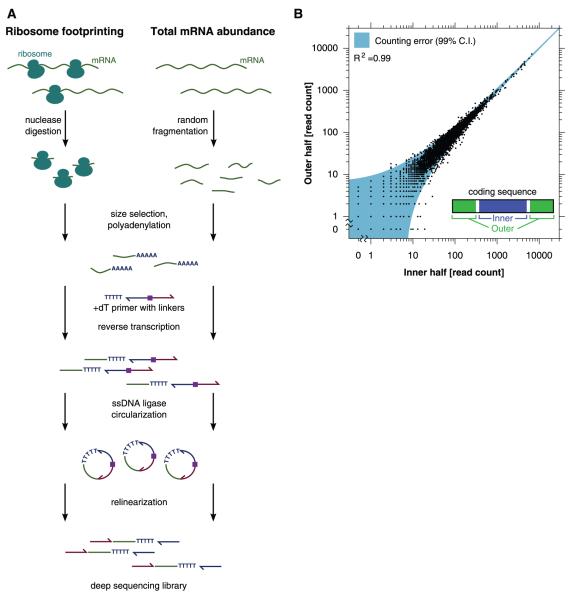
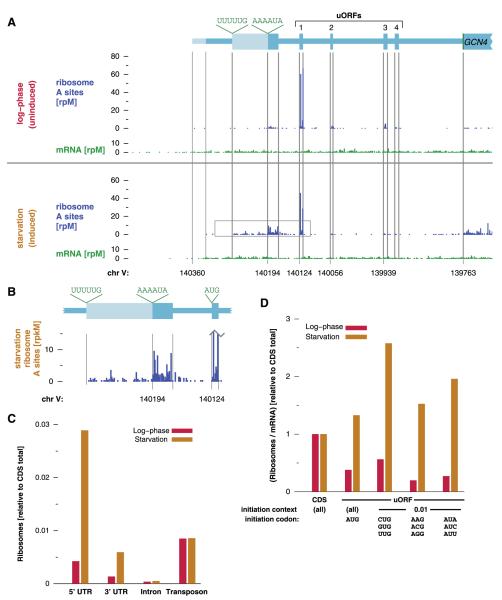
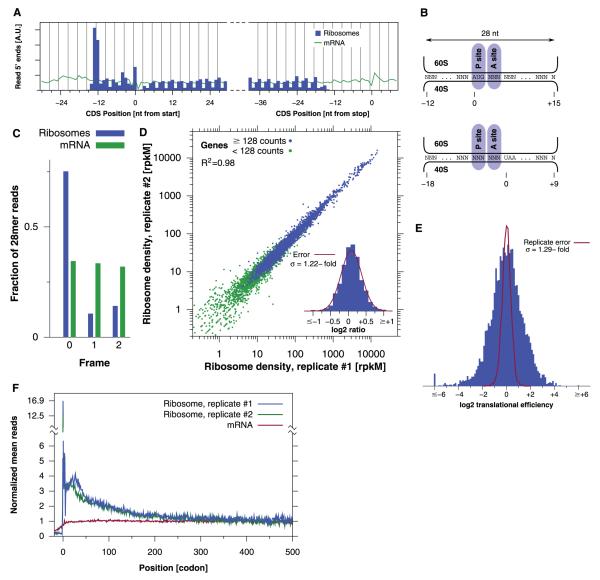
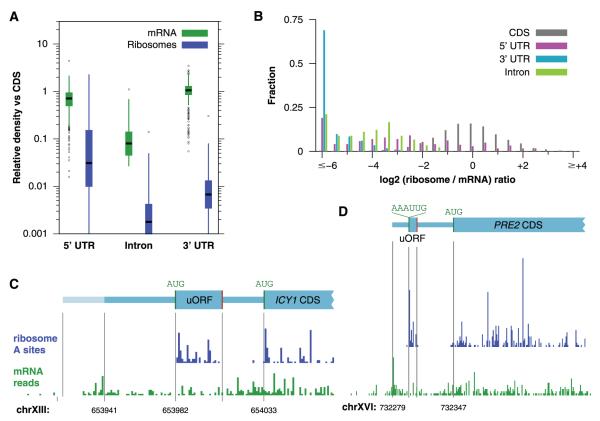
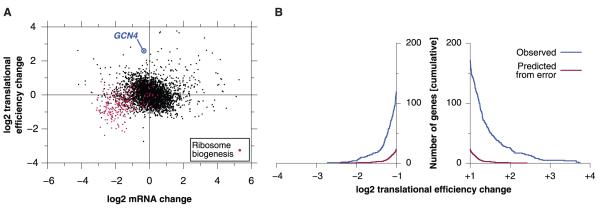
Techniques for systematically monitoring protein translation have lagged far behind methods for measuring messenger RNA (mRNA) levels. Here, we present a ribosome-profiling strategy that is based on the deep sequencing of ribosome-protected mRNA fragments and enables genome-wide investigation of translation with subcodon resolution. We used this technique to monitor translation in budding yeast under both rich and starvation conditions. These studies defined the protein sequences being translated and found extensive translational control in both determining absolute protein abundance and responding to environmental stress. We also observed distinct phases during translation that involve a large decrease in ribosome density going from early to late peptide elongation as well as widespread regulated initiation at non-adenine-uracil-guanine (AUG) codons. Ribosome profiling is readily adaptable to other organisms, making high-precision investigation of protein translation experimentally accessible.
系统监测蛋白质翻译的技术远远落后于测量信使核糖核酸(mRNA)水平的方法。在此,我们提出一种核糖体分析策略,该策略基于对核糖体保护的mRNA片段进行深度测序,能够以亚密码子分辨率对翻译进行全基因组研究。我们使用这项技术监测了出芽酵母在丰富营养和饥饿条件下的翻译情况。这些研究确定了正在被翻译的蛋白质序列,并发现了在决定绝对蛋白质丰度和应对环境压力方面广泛存在的翻译控制。我们还观察到翻译过程中的不同阶段,包括从肽链延伸早期到晚期核糖体密度大幅下降,以及在非腺嘌呤-尿嘧啶-鸟嘌呤(AUG)密码子处广泛存在的受调控起始。核糖体分析很容易应用于其他生物体,使得对蛋白质翻译进行高精度实验研究成为可能。