CNRS-EMBL-UJF, Unit of Virus Host Cell Interactions (UVHCI)-UMI 3265, Grenoble, France.
PLoS One. 2011;6(7):e21921. doi: 10.1371/journal.pone.0021921. Epub 2011 Jul 8.
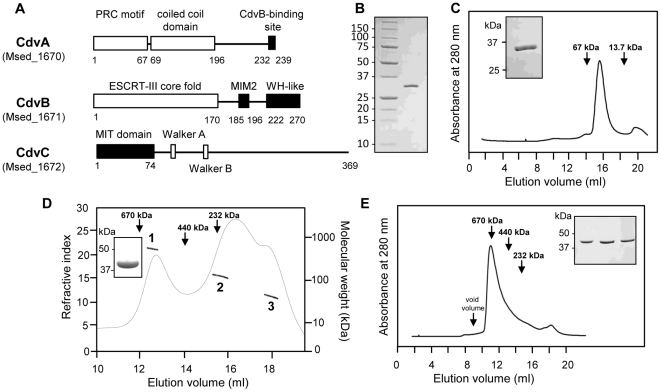
The phylum Crenarchaeota lacks the FtsZ cell division hallmark of bacteria and employs instead Cdv proteins. While CdvB and CdvC are homologues of the eukaryotic ESCRT-III and Vps4 proteins, implicated in membrane fission processes during multivesicular body biogenesis, cytokinesis and budding of some enveloped viruses, little is known about the structure and function of CdvA. Here, we report the biochemical and biophysical characterization of the three Cdv proteins from the hyperthermophilic archaeon Metallospherae sedula.
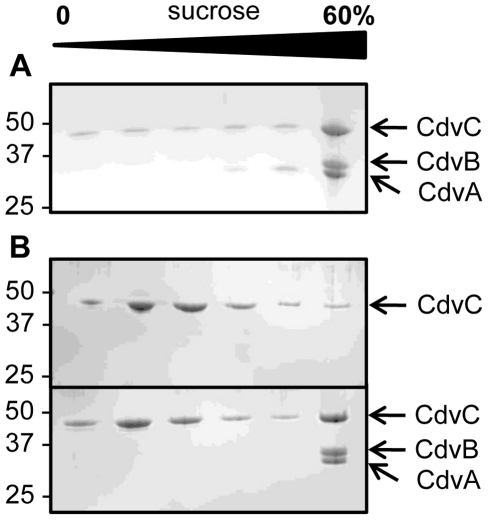
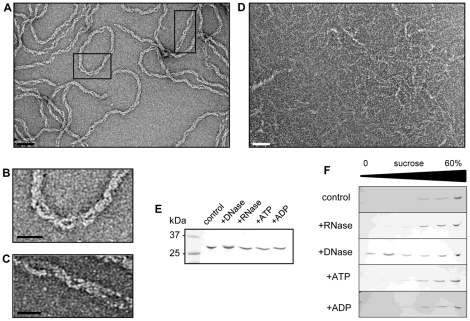
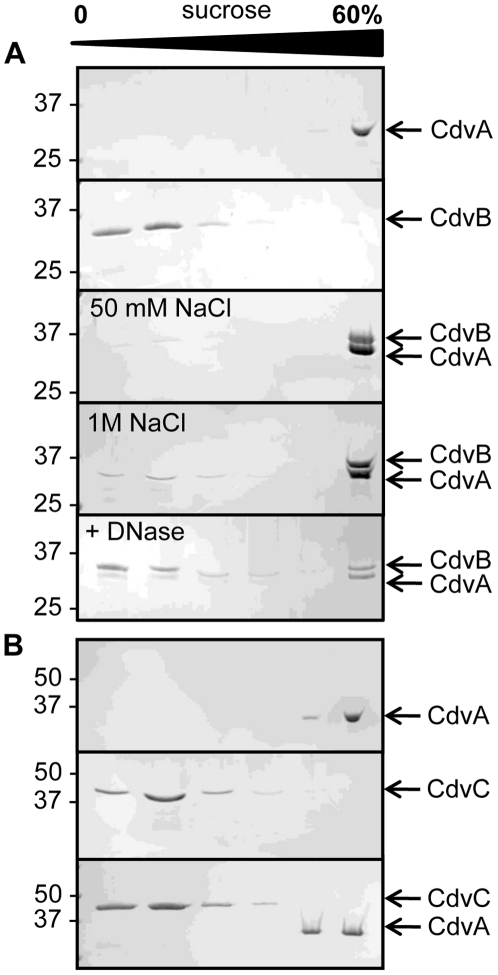
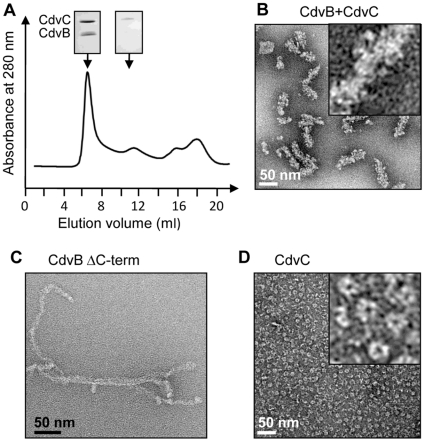
METHODOLOGY/PRINCIPAL FINDINGS: Using sucrose density gradient ultracentrifugation and negative staining electron microscopy, we evidenced for the first time that CdvA forms polymers in association with DNA, similar to known bacterial DNA partitioning proteins. We also observed that, in contrast to full-lengh CdvB that was purified as a monodisperse protein, the C-terminally deleted CdvB construct forms filamentous polymers, a phenomenon previously observed with eukaryotic ESCRT-III proteins. Based on size exclusion chromatography data combined with detection by multi-angle laser light scattering analysis, we demonstrated that CdvC assembles, in a nucleotide-independent way, as homopolymers resembling dodecamers and endowed with ATPase activity in vitro. The interactions between these putative cell division partners were further explored. Thus, besides confirming the previous observations that CdvB interacts with both CdvA and CdvC, our data demonstrate that CdvA/CdvB and CdvC/CdvB interactions are not mutually exclusive.
CONCLUSIONS/SIGNIFICANCE: Our data reinforce the concept that Cdv proteins are closely related to the eukaryotic ESCRT-III counterparts and suggest that the organization of the ESCRT-III machinery at the Crenarchaeal cell division septum is organized by CdvA an ancient cytoskeleton protein that might help to coordinate genome segregation.
Crenarchaeota 门缺乏细菌的 FtsZ 细胞分裂标志,而是使用 Cdv 蛋白。虽然 CdvB 和 CdvC 是真核 ESCRT-III 和 Vps4 蛋白的同源物,这些蛋白在多泡体生物发生、胞质分裂和一些包膜病毒出芽过程中涉及膜分裂过程,但对 CdvA 的结构和功能知之甚少。在这里,我们报告了来自嗜热古菌 Metallospherae sedula 的三种 Cdv 蛋白的生化和生物物理特性。
方法/主要发现:使用蔗糖密度梯度超速离心和负染色电子显微镜,我们首次证明 CdvA 与 DNA 形成聚合物,类似于已知的细菌 DNA 分配蛋白。我们还观察到,与全长 CdvB 不同,全长 CdvB 作为单分散蛋白纯化,截短 C 端的 CdvB 构建体形成丝状聚合物,这是以前在真核 ESCRT-III 蛋白中观察到的现象。基于大小排阻色谱数据结合多角度激光散射分析检测,我们证明 CdvC 以非核苷酸依赖的方式组装成类似于十二聚体的同源聚合物,并具有体外 ATPase 活性。进一步探讨了这些潜在细胞分裂伙伴之间的相互作用。因此,除了证实之前的观察结果,即 CdvB 与 CdvA 和 CdvC 相互作用外,我们的数据还表明 CdvA/CdvB 和 CdvC/CdvB 相互作用不是相互排斥的。
结论/意义:我们的数据加强了这样一种观点,即 Cdv 蛋白与真核 ESCRT-III 对应物密切相关,并表明 Crenarchaeota 细胞分裂隔膜处的 ESCRT-III 机制的组织由 CdvA 组成,CdvA 是一种古老的细胞骨架蛋白,可能有助于协调基因组分离。