From the Department of Family Medicine (AZ, DR, MZ, MM, MF), University of Wisconsin School of Medicine and Public Health, Madison, WI; Department of Psychology (CC), University of Wisconsin, Madison, WI; NewStart Alcohol & Drug Treatment Program (MM), Meriter Hospital, Madison, WI.
J Addict Med. 2008 Sep;2(3):165-73. doi: 10.1097/ADM.0b013e31816f8546.
: Meditation is a promising treatment for alcohol dependence. This 16-week prospective case series was designed to gather preliminary data about the efficacy of meditation for relapse prevention and to evaluate study methods feasibility.
: Nineteen adult alcohol-dependent graduates of an intensive outpatient program were enrolled. Fifteen subjects completed the 8-week meditation course supplemented by at-home meditation and "standard of care" therapy. Outcome measures included surveys and 2 stress-responsive biomarkers.
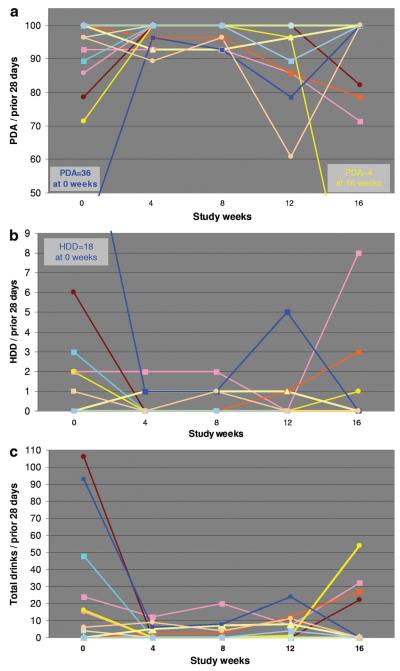
: Subjects (N = 19, 38.4 standard deviation [SD] = 8.6-year-old) were abstinent for 30.9 (SD = 22.2) days at enrollment. Completers (N = 15) attended 82% of meditation course sessions and meditated on average 4.6 (SD = 1.1) days per week; they were abstinent on 94.5% (SD = 7.4) of study days, with 47% reporting complete abstinence and 47% reporting 1 or more heavy drinking days. Their severity of depression, anxiety, stress (P < 0.05), and craving (P < 0.08), documented relapse triggers, decreased, and the degree of mindfulness increased (P < 0.05). The meditation course was rated as a "very important" (8.7/10, SD = 1.8) and "useful relapse prevention tool" (8.5/10, SD = 2.1); participants reported being "very likely" to continue meditating (9.0/10, SD = 1.5). "Gaining skills to reduce stress," "coping with craving," and "good group support" were the most common qualitative comments about the course value. Compared with baseline, at 16 weeks, interleukin-6 levels decreased (N = 12, P = 0.05); cortisol levels (N = 10) were reduced but not significantly. There were no adverse events or side effects.
: Meditation may be an effective adjunctive therapy for relapse prevention in alcohol dependence, worthy of investigation in a larger trial. The study methods are appropriate for such a trial.
冥想是治疗酒精依赖的一种有前途的方法。本前瞻性病例系列研究旨在收集关于冥想预防复发的疗效的初步数据,并评估研究方法的可行性。
19 名成年酒精依赖患者毕业于强化门诊项目,被纳入研究。15 名受试者完成了 8 周的冥想课程,辅以家庭冥想和“标准护理”治疗。结果评估包括问卷调查和 2 种应激反应生物标志物。
入组时,受试者(N = 19,38.4 标准差 [SD] = 8.6 岁)的禁欲天数为 30.9(SD = 22.2)天。完成者(N = 15)参加了 82%的冥想课程,平均每周冥想 4.6(SD = 1.1)天;他们在 94.5%(SD = 7.4)的研究日中保持禁欲,其中 47%报告完全禁欲,47%报告 1 或更多次重度饮酒日。他们的抑郁、焦虑、压力严重程度(P < 0.05)和渴望程度(P < 0.08)、记录的复发触发因素均降低,正念程度增加(P < 0.05)。冥想课程被评为“非常重要”(8.7/10,SD = 1.8)和“非常有用的预防复发工具”(8.5/10,SD = 2.1);参与者报告“非常有可能”继续冥想(9.0/10,SD = 1.5)。“获得减轻压力的技能”、“应对渴望”和“良好的小组支持”是课程价值的最常见的评价。与基线相比,16 周时白细胞介素-6 水平下降(N = 12,P = 0.05);皮质醇水平(N = 10)虽有所降低,但无统计学意义。没有不良事件或副作用。
冥想可能是酒精依赖预防复发的有效辅助治疗方法,值得更大规模的试验研究。该研究方法适合此类试验。