Salvador Aiala, Igartua Manoli, Hernández Rosa Maria, Pedraz José Luis
NanoBioCel Group, Laboratory of Pharmaceutics, School of Pharmacy, University of the Basque Country, 01006 Vitoria, Spain.
J Drug Deliv. 2011;2011:181646. doi: 10.1155/2011/181646. Epub 2011 Jun 15.
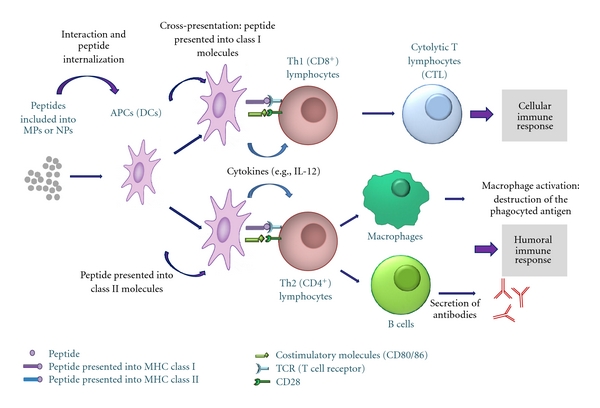
The development of synthetic peptide-based vaccines has many advantages in comparison with vaccines based on live attenuated organisms, inactivated or killed organism, or toxins. Peptide-based vaccines cannot revert to a virulent form, allow a better conservation, and are produced more easily and safely. However, they generate a weaker immune response than other vaccines, and the inclusion of adjuvants and/or the use of vaccine delivery systems is almost always needed. Among vaccine delivery systems, micro- and nanoparticulated ones are attractive, because their particulate nature can increase cross-presentation of the peptide. In addition, they can be passively or actively targeted to antigen presenting cells. Furthermore, particulate adjuvants are able to directly activate innate immune system in vivo. Here, we summarize micro- and nanoparticulated vaccine delivery systems used in the field of synthetic peptide-based vaccines as well as strategies to increase their immunogenicity.
与基于减毒活生物体、灭活或杀死的生物体或毒素的疫苗相比,合成肽基疫苗的开发具有许多优势。肽基疫苗不会恢复为有毒形式,保存性更好,生产更容易且更安全。然而,它们产生的免疫反应比其他疫苗弱,几乎总是需要添加佐剂和/或使用疫苗递送系统。在疫苗递送系统中,微颗粒和纳米颗粒递送系统很有吸引力,因为它们的颗粒性质可以增加肽的交叉呈递。此外,它们可以被动或主动靶向抗原呈递细胞。此外,颗粒佐剂能够在体内直接激活先天免疫系统。在此,我们总结了合成肽基疫苗领域中使用的微颗粒和纳米颗粒疫苗递送系统以及提高其免疫原性的策略。