Institute of Political Science and Governance, University of Tallinn, Narva mnt. 10-120, Tallinn, Estonia.
Int J Environ Res Public Health. 2011 Jun;8(6):1772-91. doi: 10.3390/ijerph8061772. Epub 2011 May 25.
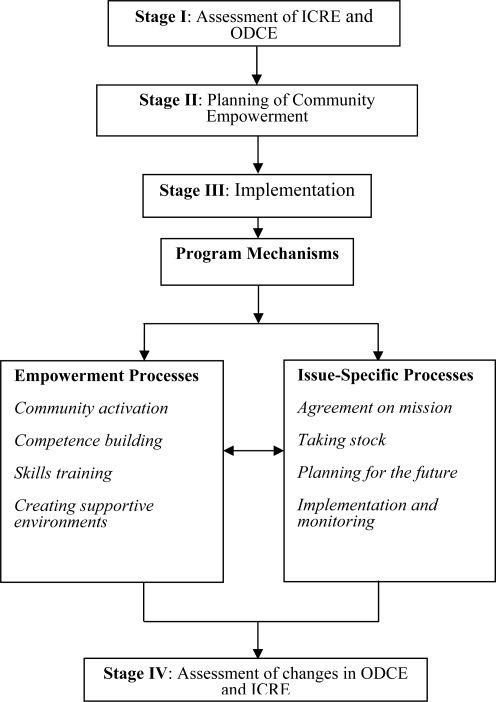
This study assessed changes in community members' ratings of the dimensions of individual community related empowerment (ICRE) before and two years after the implementation of an empowerment expansion framework in three community health promotion initiatives within the Estonian context. We employed a self-administered questionnaire, the adapted mobilisation scale-individual. As the first step, we investigated the multidimensional nature of the ICRE construct and explored the validity and reliability (internal consistency) of the ICRE scale. Two datasets were used. The first dataset comprised a cross-sectional random sample of 1,000 inhabitants of Rapla County selected in 2003 from the National Population Register, which was used to confirm the composition of the dimensions of the scale and to examine the reliability of the dimensions. The second dataset comprised two waves of data: 120 participants from three health promotion programs in 2003 (pre-test) and 115 participants in 2005 (post-test), and the dataset was used to compare participants' pre-test and post-test ratings of their levels of empowerment. The content validity ratio, determined using Lawshe's formula, was high (0.98). Five dimensions of ICRE, self-efficacy, intention, participation, motivation and critical awareness, emerged from the factor analysis. The internal consistency (α) of the total empowerment scale was 0.86 (subscales self-efficacy α=0.88, intention α=0.83, participation α=0.81 and motivation α=0.69; critical awareness comprised only one item). The levels of ICRE dimensions measured after the application of the empowerment expansion framework were significantly more favourable for the dimensions self-efficacy, participation, intention and motivation to participate. We conclude that for Rapla community workgroups and networks, their ICRE was rendered more favourable after the implementation of the empowerment expansion framework.
本研究评估了在爱沙尼亚背景下的三个社区健康促进计划中实施赋权扩展框架前后,社区成员对个体社区相关赋权(ICRE)维度的评价变化。我们采用了自我管理问卷,即改编后的动员量表-个体。作为第一步,我们调查了 ICRE 结构的多维性质,并探索了 ICRE 量表的有效性和可靠性(内部一致性)。使用了两个数据集。第一个数据集由 2003 年从国家人口登记册中随机选择的拉普拉县 1000 名居民的横断面随机样本组成,用于确认量表维度的组成,并检验维度的可靠性。第二个数据集由两个波次的数据组成:来自三个健康促进计划的 120 名参与者(前测)和 2005 年的 115 名参与者(后测),数据集用于比较参与者在前测和后测时对赋权水平的评价。使用 Lawshe 公式确定的内容有效性比很高(0.98)。通过因子分析得出了 ICRE 的五个维度,即自我效能、意图、参与、动机和批判意识。总赋权量表的内部一致性(α)为 0.86(子量表自我效能α=0.88,意图α=0.83,参与α=0.81,动机α=0.69;批判意识仅由一个项目组成)。应用赋权扩展框架后测量的 ICRE 维度水平对自我效能、参与、意图和参与动机更为有利。我们的结论是,对于拉普拉社区工作组和网络,在实施赋权扩展框架后,他们的 ICRE 变得更加有利。