Nath Nisa S, Bhattacharya Ishita, Tuck Andrew G, Schlipalius David I, Ebert Paul R
School of Biological Sciences, University of Queensland, St. Lucia, QLD 4072, Australia.
J Toxicol. 2011;2011:494168. doi: 10.1155/2011/494168. Epub 2011 Apr 28.
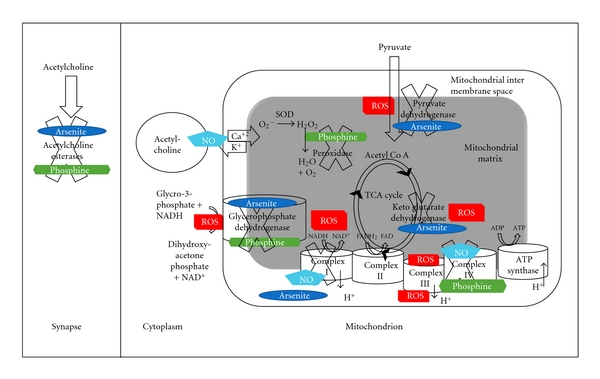
Fumigation with phosphine gas is by far the most widely used treatment for the protection of stored grain against insect pests. The development of high-level resistance in insects now threatens its continued use. As there is no suitable chemical to replace phosphine, it is essential to understand the mechanisms of phosphine toxicity to increase the effectiveness of resistance management. Because phosphine is such a simple molecule (PH(3)), the chemistry of phosphorus is central to its toxicity. The elements above and below phosphorus in the periodic table are nitrogen (N) and arsenic (As), which also produce toxic hydrides, namely, NH(3) and AsH(3). The three hydrides cause related symptoms and similar changes to cellular and organismal physiology, including disruption of the sympathetic nervous system, suppressed energy metabolism and toxic changes to the redox state of the cell. We propose that these three effects are interdependent contributors to phosphine toxicity.
用磷化氢气体熏蒸是目前保护储存谷物免受虫害最广泛使用的处理方法。昆虫中高水平抗性的发展现在威胁到其继续使用。由于没有合适的化学品来替代磷化氢,了解磷化氢毒性机制以提高抗性管理的有效性至关重要。因为磷化氢是如此简单的分子(PH₃),磷的化学性质是其毒性的核心。元素周期表中磷上方和下方的元素是氮(N)和砷(As),它们也产生有毒氢化物,即NH₃和AsH₃。这三种氢化物会导致相关症状以及细胞和机体生理的类似变化,包括交感神经系统紊乱、能量代谢受抑制以及细胞氧化还原状态的毒性变化。我们认为这三种效应是磷化氢毒性的相互依存的促成因素。