Weiss Thomas W, Rosenthal Susan L, Zimet Gregory D
Global Health Outcomes, Merck & Co., Inc., P.O. Box 4, WP97-A243, 770 Sumneytown Pike, West Point, PA 19486-0004, USA.
ISRN Obstet Gynecol. 2011;2011:670318. doi: 10.5402/2011/670318. Epub 2011 Apr 7.
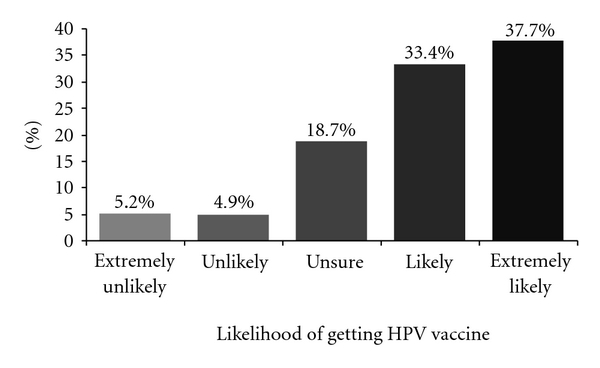
The purpose of this study was to identify attitudes toward HPV vaccination among US women 27 to 45 years of age. A survey was mailed to 2,750 insured US women to assess perceptions of relevance or irrelevance of the HPV vaccine, the underlying reasons, and, for those reporting relevance, the likelihood of vaccination if it became available. Among the 451 eligible respondents, 304 (67.4%) reported that the HPV vaccine was relevant to them, whereas 143 (31.7%) stated that it was not at all relevant. The most common reasons for relevance were protection from cervical cancer (62.8%), vaginal cancer (58.2%), precancerous cells (55.9%), HPV (55.6%), and genital warts (46.4%). Reasons for irrelevance were most commonly being married (54.0%) or in a monogamous relationship (39.6%). Most respondents reporting relevance of the HPV vaccine were likely (33.4%) or extremely likely (37.7%) to receive the vaccine if approved for their age group.
本研究的目的是确定27至45岁美国女性对人乳头瘤病毒(HPV)疫苗接种的态度。向2750名参加保险的美国女性邮寄了一份调查问卷,以评估她们对HPV疫苗相关性或不相关性的看法、潜在原因,以及对于那些报告认为疫苗相关的女性,如果疫苗可用她们接种的可能性。在451名符合条件的受访者中,304人(67.4%)报告称HPV疫苗与她们相关,而143人(31.7%)表示完全不相关。认为疫苗相关的最常见原因是预防宫颈癌(62.8%)、阴道癌(58.2%)、癌前细胞(55.9%)、HPV(55.6%)和尖锐湿疣(46.4%)。认为疫苗不相关的原因最常见的是已婚(54.0%)或处于一夫一妻制关系(39.6%)。大多数报告称HPV疫苗相关的受访者如果该疫苗被批准用于其年龄组,很可能(33.4%)或极有可能(37.7%)接种该疫苗。