Harris Peter R, Sillence Elizabeth, Briggs Pam
Department of Psychology, University of Sheffield, Sheffield, United Kingdom.
J Med Internet Res. 2011 Jul 27;13(3):e51. doi: 10.2196/jmir.1821.
How do people decide which sites to use when seeking health advice online? We can assume, from related work in e-commerce, that general design factors known to affect trust in the site are important, but in this paper we also address the impact of factors specific to the health domain.
The current study aimed to (1) assess the factorial structure of a general measure of Web trust, (2) model how the resultant factors predicted trust in, and readiness to act on, the advice found on health-related websites, and (3) test whether adding variables from social cognition models to capture elements of the response to threatening, online health-risk information enhanced the prediction of these outcomes.
Participants were asked to recall a site they had used to search for health-related information and to think of that site when answering an online questionnaire. The questionnaire consisted of a general Web trust questionnaire plus items assessing appraisals of the site, including threat appraisals, information checking, and corroboration. It was promoted on the hungersite.com website. The URL was distributed via Yahoo and local print media. We assessed the factorial structure of the measures using principal components analysis and modeled how well they predicted the outcome measures using structural equation modeling (SEM) with EQS software.
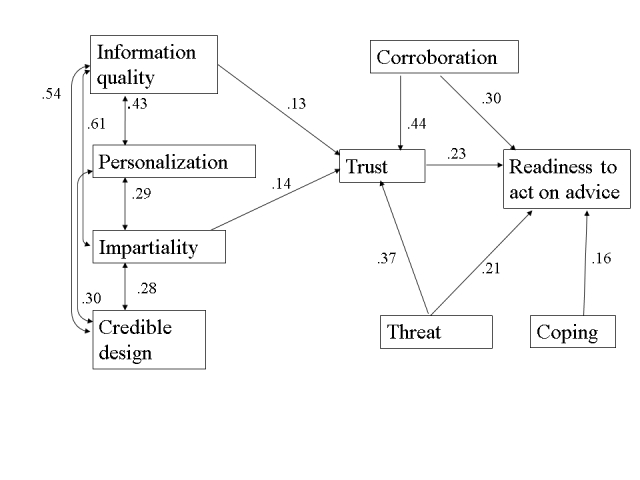
We report an analysis of the responses of participants who searched for health advice for themselves (N = 561). Analysis of the general Web trust questionnaire revealed 4 factors: information quality, personalization, impartiality, and credible design. In the final SEM model, information quality and impartiality were direct predictors of trust. However, variables specific to eHealth (perceived threat, coping, and corroboration) added substantially to the ability of the model to predict variance in trust and readiness to act on advice on the site. The final model achieved a satisfactory fit: χ(2) (5) = 10.8 (P = .21), comparative fit index = .99, root mean square error of approximation = .052. The model accounted for 66% of the variance in trust and 49% of the variance in readiness to act on the advice.
Adding variables specific to eHealth enhanced the ability of a model of trust to predict trust and readiness to act on advice.
人们在网上寻求健康建议时如何决定使用哪些网站?从电子商务的相关研究中我们可以假设,那些已知会影响对网站信任度的一般设计因素很重要,但在本文中,我们也探讨了健康领域特有的因素的影响。
当前研究旨在(1)评估网络信任度一般测量指标的因子结构;(2)建立模型,以研究由此产生的因子如何预测对健康相关网站上所获建议的信任度以及据此采取行动的意愿;(3)测试加入社会认知模型中的变量以捕捉对具有威胁性的在线健康风险信息的反应要素,是否能增强对这些结果的预测。
参与者被要求回忆他们曾用于搜索健康相关信息的一个网站,并在回答在线问卷时想着该网站。问卷包括一份一般网络信任问卷以及评估对该网站评价的项目,包括威胁评估、信息核实和确证。问卷在hungersite.com网站上进行推广。网址通过雅虎和当地平面媒体发布。我们使用主成分分析评估测量指标的因子结构,并使用EQS软件通过结构方程模型(SEM)建立模型,研究这些指标对结果指标的预测效果。
我们报告了对为自己搜索健康建议的参与者(N = 561)的回答的分析结果。对一般网络信任问卷的分析揭示了4个因子:信息质量、个性化、公正性和可信设计。在最终的结构方程模型中,信息质量和公正性是信任度的直接预测因子。然而,电子健康特有的变量(感知威胁、应对方式和确证)极大地增强了模型预测信任度变化以及据此采取行动意愿的能力。最终模型拟合良好:χ(2) (5) = 10.8(P = .21),比较拟合指数 = .99,近似均方根误差 = .052。该模型解释了66%的信任度变化和49%的据此采取行动意愿的变化。
加入电子健康特有的变量增强了信任模型预测信任度以及据此采取行动意愿的能力。