Department of Psychology and Institute of Neuroscience, University of Oregon, Eugene, Oregon, United States of America.
PLoS One. 2011;6(7):e20742. doi: 10.1371/journal.pone.0020742. Epub 2011 Jul 20.
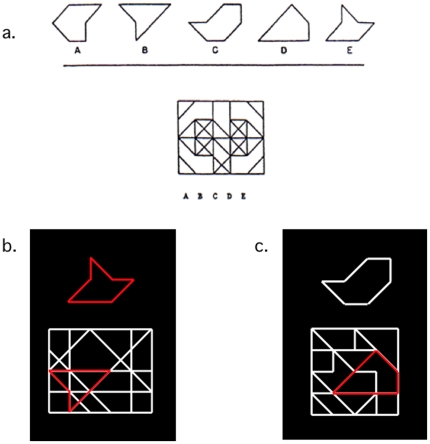
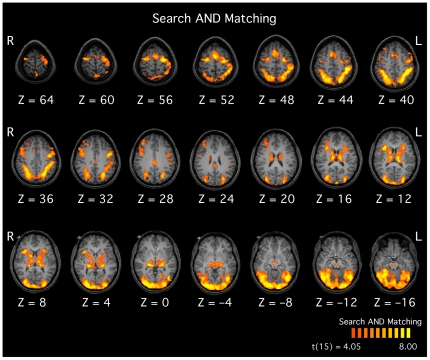
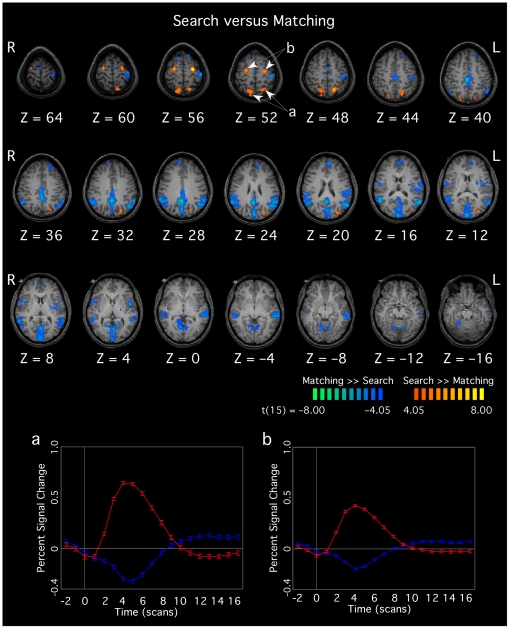
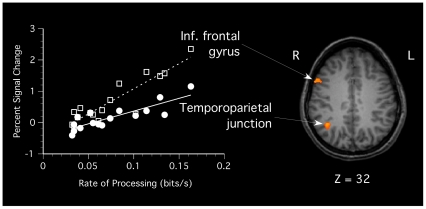
The Embedded Figures Test (EFT) requires observers to search for a simple geometric shape hidden inside a more complex figure. Surprisingly, performance in the EFT is negatively correlated with susceptibility to illusions of spatial orientation, such as the Roelofs effect. Using fMRI, we previously demonstrated that regions in parietal cortex are involved in the contextual processing associated with the Roelofs task. In the present study, we found that similar parietal regions (superior parietal cortex and precuneus) were more active during the EFT than during a simple matching task. Importantly, these parietal activations overlapped with regions found to be involved during contextual processing in the Roelofs illusion. Additional parietal and frontal areas, in the right hemisphere, showed strong correlations between brain activity and behavioral performance during the search task. We propose that the posterior parietal regions are necessary for processing contextual information across many different, but related visuospatial tasks, with additional parietal and frontal regions serving to coordinate this processing in participants proficient in the task.
嵌入式图形测试(EFT)要求观察者在更复杂的图形中寻找一个简单的几何形状。令人惊讶的是,EFT 的表现与对空间方向错觉的易感性呈负相关,例如罗尔夫斯效应。使用 fMRI,我们之前证明了顶叶皮层中的区域参与了与罗尔夫斯任务相关的上下文处理。在本研究中,我们发现,在 EFT 期间,与简单匹配任务相比,类似的顶叶区域(顶叶上回和楔前叶)更活跃。重要的是,这些顶叶激活与在罗尔夫斯错觉的上下文处理中发现的区域重叠。在搜索任务期间,右半球的额外顶叶和额叶区域显示出大脑活动与行为表现之间的强烈相关性。我们提出,后顶叶区域对于在许多不同但相关的视空间任务中处理上下文信息是必要的,额外的顶叶和额叶区域有助于协调任务熟练的参与者的这种处理。