Department of Pharmacology, Kurume University School of Medicine Kurume, Fukuoka, Japan.
Front Neuroanat. 2011 Jul 18;5:43. doi: 10.3389/fnana.2011.00043. eCollection 2011.
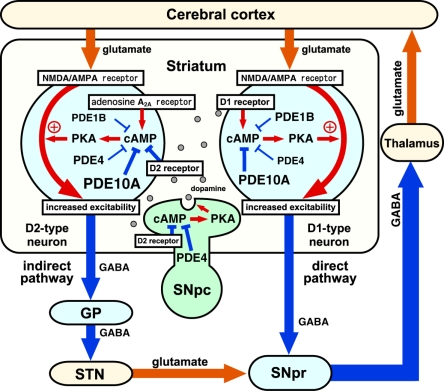
In the striatum, dopamine D(1) receptors are preferentially expressed in striatonigral neurons, and increase the neuronal excitability, leading to the increase in GABAergic inhibitory output to substantia nigra pars reticulata. Such roles of D(1) receptors are important for the control of motor functions. In addition, the roles of D(1) receptors are implicated in reward, cognition, and drug addiction. Therefore, elucidation of mechanisms for the regulation of dopamine D(1) receptor signaling is required to identify therapeutic targets for Parkinson's disease and drug addiction. D(1) receptors are coupled to G(s/olf)/adenylyl cyclase/PKA signaling, leading to the phosphorylation of PKA substrates including DARPP-32. Phosphorylated form of DARPP-32 at Thr34 has been shown to inhibit protein phosphatase-1, and thereby controls the phosphorylation states and activity of many downstream physiological effectors. Roles of DARPP-32 and its phosphorylation at Thr34 and other sites in D(1) receptor signaling are extensively studied. In addition, functional roles of the non-canonical D(1) receptor signaling cascades that coupled to G(q)/phospholipase C or Src family kinase become evident. We have recently shown that phosphodiesterases (PDEs), especially PDE10A, play a pivotal role in regulating the tone of D(1) receptor signaling relatively to that of D(2) receptor signaling. We review the current understanding of molecular mechanisms for the modulation of D(1) receptor signaling in the striatum.
在纹状体中,多巴胺 D1 受体优先表达于纹状体苍白球神经元,增加神经元兴奋性,导致 GABA 能抑制性输出增加到黑质网状部。D1 受体的这些作用对于运动功能的控制很重要。此外,D1 受体的作用还与奖赏、认知和药物成瘾有关。因此,阐明多巴胺 D1 受体信号转导调节的机制对于确定帕金森病和药物成瘾的治疗靶点非常重要。D1 受体与 Gs/olf/腺苷酸环化酶/PKA 信号转导偶联,导致 PKA 底物包括 DARPP-32 的磷酸化。已经表明 DARPP-32 在 Thr34 处的磷酸化形式可以抑制蛋白磷酸酶-1,从而控制许多下游生理效应器的磷酸化状态和活性。DARPP-32 及其在 Thr34 和 D1 受体信号转导其他位点的磷酸化在 D1 受体信号转导中的作用得到了广泛的研究。此外,与 Gq/磷脂酶 C 或 Src 家族激酶偶联的非典型 D1 受体信号级联的功能作用也变得明显。我们最近表明,磷酸二酯酶(PDEs),特别是 PDE10A,在调节 D1 受体信号相对于 D2 受体信号的张力方面发挥着关键作用。我们综述了目前对纹状体中 D1 受体信号转导调节的分子机制的理解。