Department of Prosthodontics and Dental Research Center, School of Dentistry, Seoul National University, Seoul, Korea.
J Adv Prosthodont. 2011 Jun;3(2):81-4. doi: 10.4047/jap.2011.3.2.81. Epub 2011 Jun 30.
The aim of this in vitro study was to investigate the adhesion of initial colonizer, Streptococcus sanguis, on resin, titanium and zirconia under the same surface polishing condition.
Specimens were prepared from Z-250, cp-Ti and 3Y-TZP and polished with 1 µm diamond paste. After coating with saliva, each specimen was incubated with Streptococcus sanguis. Scanning electron microscope, crystal violet staining and measurement of fluorescence intensity resulting from resazurin reduction were performed for quantifying the bacterial adhesion.
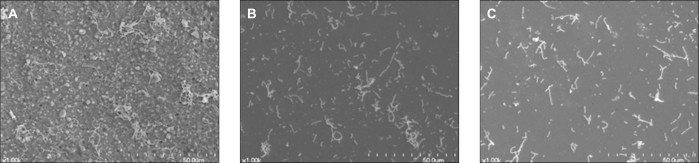
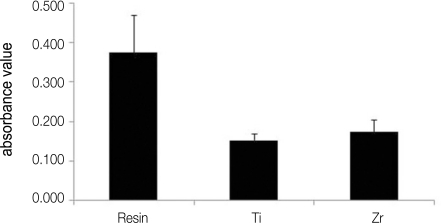
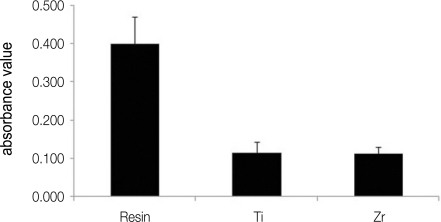
Surface of resin composite was significantly rougher than that of titanium and zirconia, although all tested specimens are classified as smooth. The resin specimens showed lower value of contact angle compared with titanium and zirconia specimens, and had hydrophilic surfaces. The result of scanning electron microscopy demonstrated that bound bacteria were more abundant on resin in comparison with titanium and zirconia. When total biofilm mass determined by crystal violet, absorbance value of resin was significantly higher than that of titanium or zirconia. The result of relative fluorescence intensities also demonstrated that the highest fluorescence intensity was found on the surface of resin. Absorbance value and fluorescence intensity on titanium was not significantly different from those on zirconia.
Resin specimens showed the roughest surface and have a significantly higher susceptibility to adhere Streptococcus sanguis than titanium and zirconia when surfaces of each specimen were polished under same condition. There was no significant difference in bacteria adhesion between titanium and zirconia in vitro.
本体外研究旨在探讨在相同表面抛光条件下,初始定植菌——血链球菌在树脂、钛和氧化锆上的黏附情况。
从 Z-250、cp-Ti 和 3Y-TZP 制备试件,并使用 1 µm 金刚石膏抛光。在涂覆唾液后,将每个试件与血链球菌孵育。通过使用结晶紫染色和还原-resazurin 测量荧光强度来对细菌黏附进行定量分析。
尽管所有测试的试件都被归类为光滑表面,但树脂复合材料的表面明显比钛和氧化锆粗糙。树脂试件的接触角值低于钛和氧化锆试件,具有亲水表面。扫描电子显微镜的结果表明,与钛和氧化锆相比,树脂上的结合细菌更为丰富。当通过结晶紫测定总生物膜质量时,树脂的吸光度值明显高于钛或氧化锆。相对荧光强度的结果也表明,树脂表面的荧光强度最高。钛上的吸光度值和荧光强度与氧化锆上的无显著差异。
在相同条件下对每个试件表面进行抛光时,树脂试件的表面最粗糙,对黏附血链球菌的敏感性明显高于钛和氧化锆。体外钛和氧化锆的细菌黏附无显著差异。