IDEA Lab, Department of Radiology and BRIC, University of North Carolina, Chapel Hill, North Carolina, United States of America.
PLoS One. 2011;6(7):e21935. doi: 10.1371/journal.pone.0021935. Epub 2011 Jul 19.
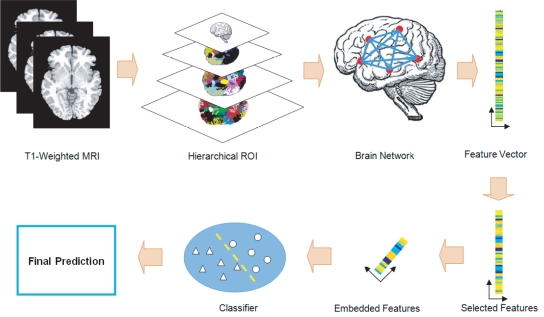
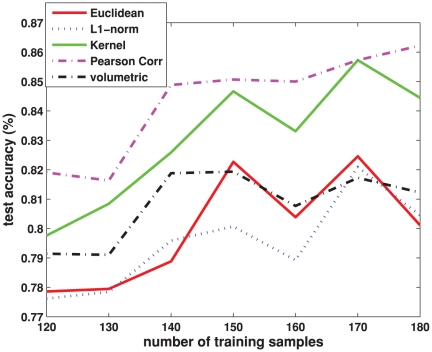
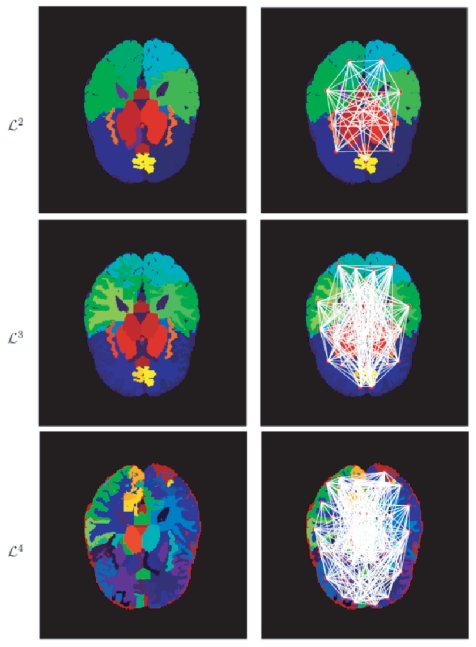
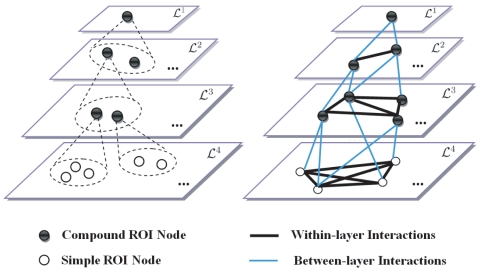
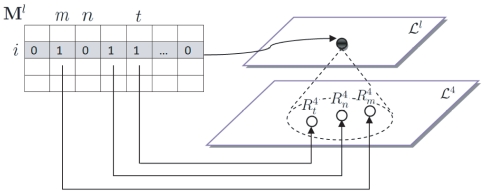
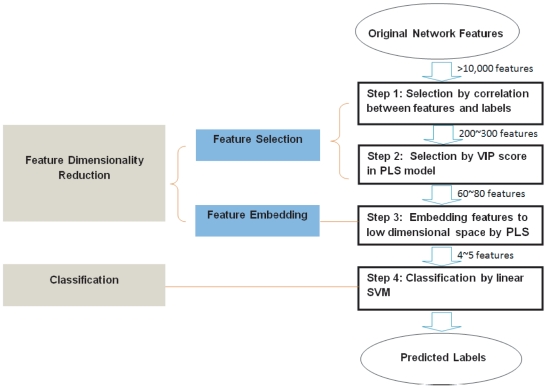
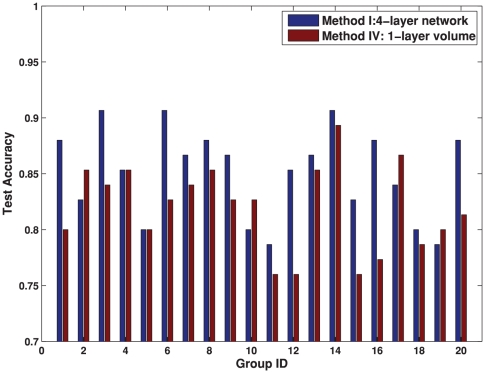
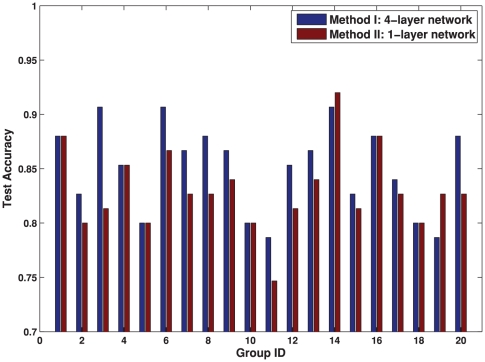
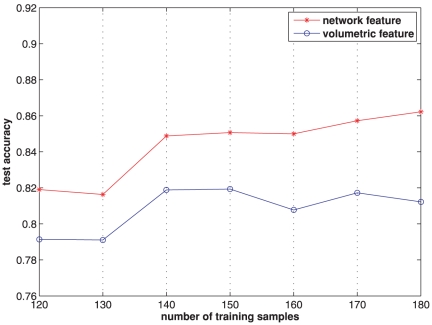
Owning to its clinical accessibility, T1-weighted MRI (Magnetic Resonance Imaging) has been extensively studied in the past decades for prediction of Alzheimer's disease (AD) and mild cognitive impairment (MCI). The volumes of gray matter (GM), white matter (WM) and cerebrospinal fluid (CSF) are the most commonly used measurements, resulting in many successful applications. It has been widely observed that disease-induced structural changes may not occur at isolated spots, but in several inter-related regions. Therefore, for better characterization of brain pathology, we propose in this paper a means to extract inter-regional correlation based features from local volumetric measurements. Specifically, our approach involves constructing an anatomical brain network for each subject, with each node representing a Region of Interest (ROI) and each edge representing Pearson correlation of tissue volumetric measurements between ROI pairs. As second order volumetric measurements, network features are more descriptive but also more sensitive to noise. To overcome this limitation, a hierarchy of ROIs is used to suppress noise at different scales. Pairwise interactions are considered not only for ROIs with the same scale in the same layer of the hierarchy, but also for ROIs across different scales in different layers. To address the high dimensionality problem resulting from the large number of network features, a supervised dimensionality reduction method is further employed to embed a selected subset of features into a low dimensional feature space, while at the same time preserving discriminative information. We demonstrate with experimental results the efficacy of this embedding strategy in comparison with some other commonly used approaches. In addition, although the proposed method can be easily generalized to incorporate other metrics of regional similarities, the benefits of using Pearson correlation in our application are reinforced by the experimental results. Without requiring new sources of information, our proposed approach improves the accuracy of MCI prediction from 80.83% (of conventional volumetric features) to 84.35% (of hierarchical network features), evaluated using data sets randomly drawn from the ADNI (Alzheimer's Disease Neuroimaging Initiative) dataset.
由于其临床可及性,T1 加权磁共振成像(Magnetic Resonance Imaging)在过去几十年中被广泛研究,用于预测阿尔茨海默病(AD)和轻度认知障碍(MCI)。灰质(GM)、白质(WM)和脑脊液(CSF)的体积是最常用的测量方法,已取得许多成功的应用。广泛观察到,疾病引起的结构变化可能不会发生在孤立的部位,而是发生在几个相互关联的区域。因此,为了更好地描述大脑病理,我们提出了一种从局部体积测量中提取区域间相关性特征的方法。具体来说,我们的方法涉及为每个受试者构建一个解剖学大脑网络,每个节点代表一个感兴趣区域(ROI),每条边代表 ROI 之间组织体积测量的皮尔逊相关性。作为二阶体积测量,网络特征更具描述性,但也对噪声更敏感。为了克服这个限制,使用层次结构的 ROI 来抑制不同尺度的噪声。不仅考虑了同一层层次结构中具有相同尺度的 ROI 之间的成对相互作用,还考虑了不同层中不同尺度的 ROI 之间的成对相互作用。为了解决由于网络特征数量众多而导致的高维问题,进一步采用有监督降维方法将选定的特征子集嵌入到低维特征空间中,同时保留判别信息。通过实验结果,我们证明了与其他一些常用方法相比,这种嵌入策略的有效性。此外,尽管所提出的方法可以很容易地推广到包含区域相似性的其他度量,但实验结果加强了在我们的应用中使用皮尔逊相关性的好处。无需新的信息来源,我们提出的方法将基于常规体积特征的 MCI 预测准确性从 80.83%提高到 84.35%(基于分层网络特征),使用从 ADNI(阿尔茨海默病神经影像学倡议)数据集随机抽取的数据进行评估。