Department of Child and Adolescent Psychiatry, AP-HP, Groupe Hospitalier Pitié-Salpêtrière, Université Pierre et Marie Curie, Paris, France.
PLoS One. 2011;6(7):e22393. doi: 10.1371/journal.pone.0022393. Epub 2011 Jul 27.
To assess whether taking into account interaction synchrony would help to better differentiate autism (AD) from intellectual disability (ID) and typical development (TD) in family home movies of infants aged less than 18 months, we used computational methods.
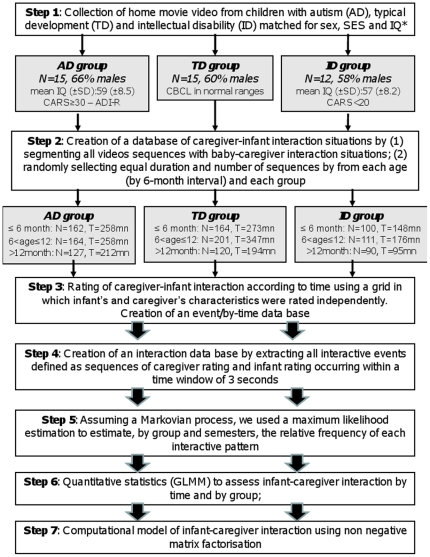
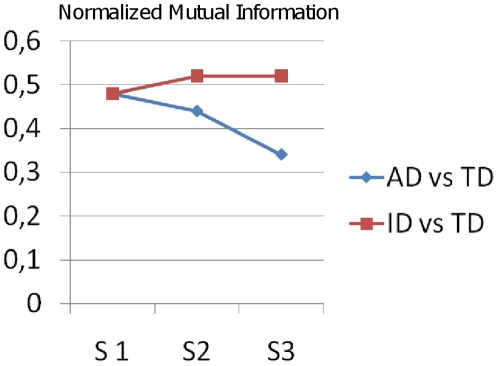
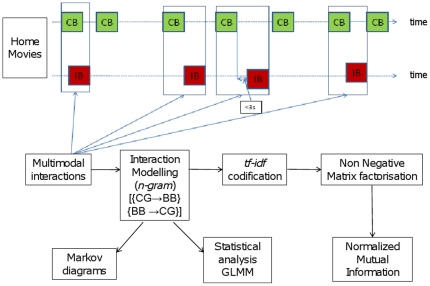
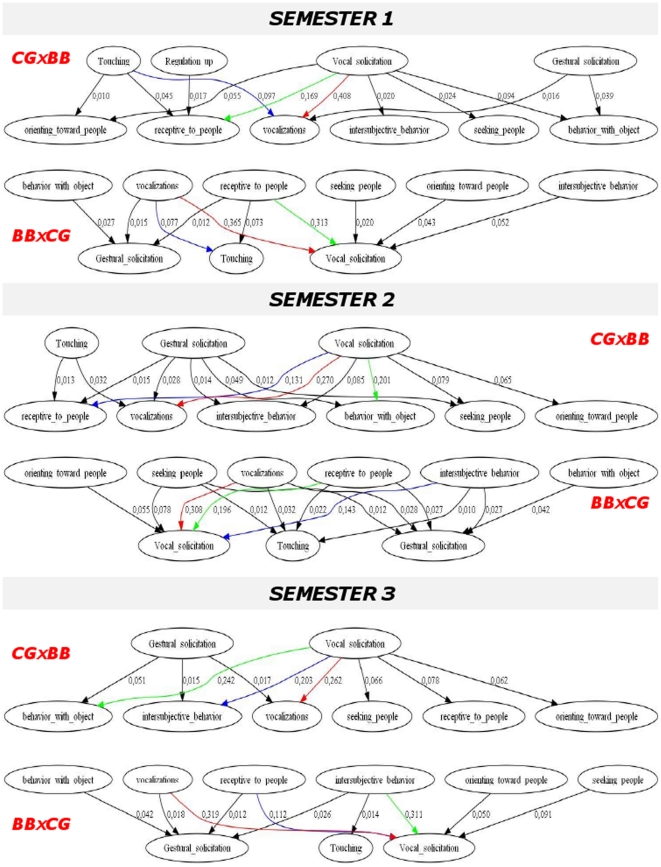
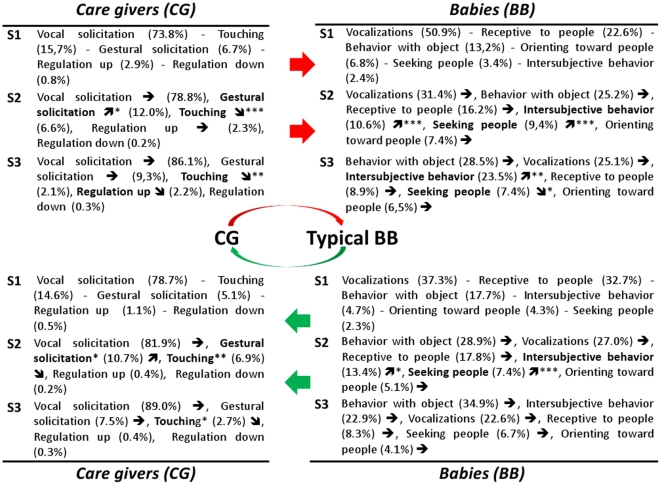
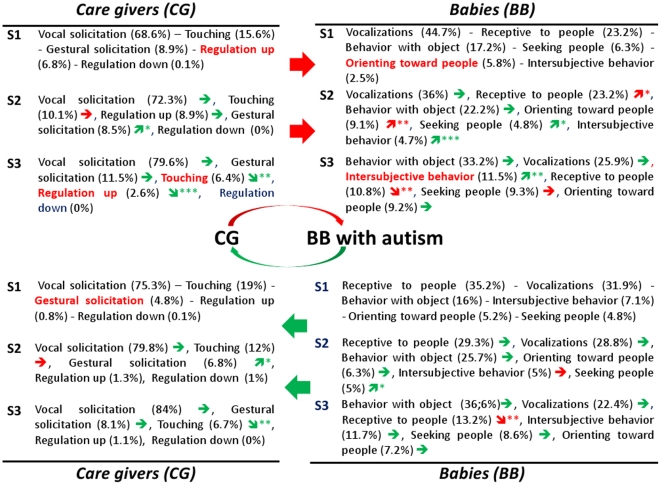
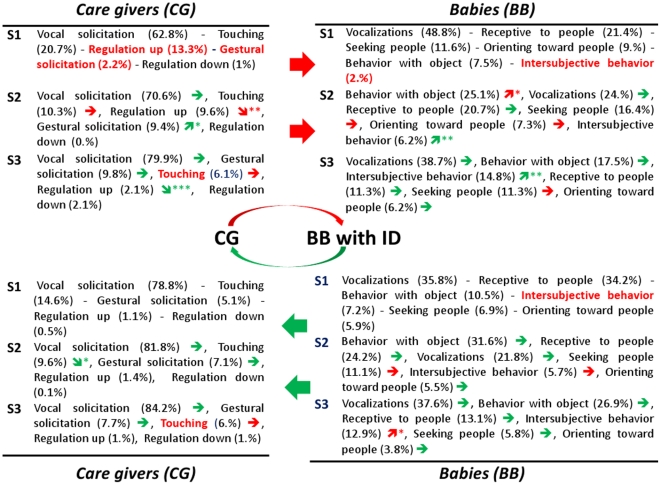
First, we analyzed interactive sequences extracted from home movies of children with AD (N = 15), ID (N = 12), or TD (N = 15) through the Infant and Caregiver Behavior Scale (ICBS). Second, discrete behaviors between baby (BB) and Care Giver (CG) co-occurring in less than 3 seconds were selected as single interactive patterns (or dyadic events) for analysis of the two directions of interaction (CG→BB and BB→CG) by group and semester. To do so, we used a Markov assumption, a Generalized Linear Mixed Model, and non negative matrix factorization. Compared to TD children, BBs with AD exhibit a growing deviant development of interactive patterns whereas those with ID rather show an initial delay of development. Parents of AD and ID do not differ very much from parents of TD when responding to their child. However, when initiating interaction, parents use more touching and regulation up behaviors as early as the first semester.
When studying interactive patterns, deviant autistic behaviors appear before 18 months. Parents seem to feel the lack of interactive initiative and responsiveness of their babies and try to increasingly supply soliciting behaviors. Thus we stress that credence should be given to parents' intuition as they recognize, long before diagnosis, the pathological process through the interactive pattern with their child.
为了评估在小于 18 个月大的婴儿的家庭录像中考虑互动同步性是否有助于更好地区分自闭症(AD)、智力障碍(ID)和典型发育(TD),我们使用了计算方法。
首先,我们通过婴儿和照顾者行为量表(ICBS)分析了来自 AD(N=15)、ID(N=12)或 TD(N=15)儿童家庭录像中的互动序列。其次,选择婴儿(BB)和照顾者(CG)在 3 秒内共同发生的离散行为作为单一互动模式(或双事件),以分析两个方向的互动(CG→BB 和 BB→CG),并按组和学期进行分析。为此,我们使用了马尔可夫假设、广义线性混合模型和非负矩阵分解。与 TD 儿童相比,AD 患儿的互动模式表现出越来越大的异常发育,而 ID 患儿则表现出最初的发育延迟。AD 和 ID 患儿的父母在回应孩子时与 TD 患儿的父母没有太大区别。然而,当发起互动时,父母最早在第一学期就使用更多的触摸和调节行为。
在研究互动模式时,异常的自闭症行为在 18 个月之前就出现了。父母似乎感觉到他们的婴儿缺乏互动主动性和响应性,并试图越来越多地提供请求行为。因此,我们强调应该相信父母的直觉,因为他们通过与孩子的互动模式在诊断之前很早就认识到了病理过程。