Dipartimento di Biologia Evoluzionistica Sperimentale and Centro Interdipartimentale di Ricerca per le Scienze Ambientali in Ravenna, Università di Bologna, Ravenna, Italy.
PLoS One. 2011;6(8):e22985. doi: 10.1371/journal.pone.0022985. Epub 2011 Aug 3.
Coastal landscapes are being transformed as a consequence of the increasing demand for infrastructures to sustain residential, commercial and tourist activities. Thus, intertidal and shallow marine habitats are largely being replaced by a variety of artificial substrata (e.g. breakwaters, seawalls, jetties). Understanding the ecological functioning of these artificial habitats is key to planning their design and management, in order to minimise their impacts and to improve their potential to contribute to marine biodiversity and ecosystem functioning. Nonetheless, little effort has been made to assess the role of human disturbances in shaping the structure of assemblages on marine artificial infrastructures. We tested the hypothesis that some negative impacts associated with the expansion of opportunistic and invasive species on urban infrastructures can be related to the severe human disturbances that are typical of these environments, such as those from maintenance and renovation works.
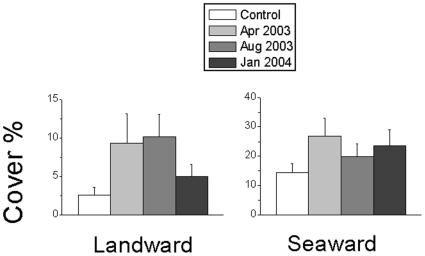
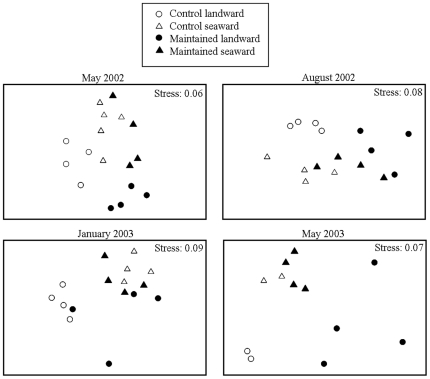
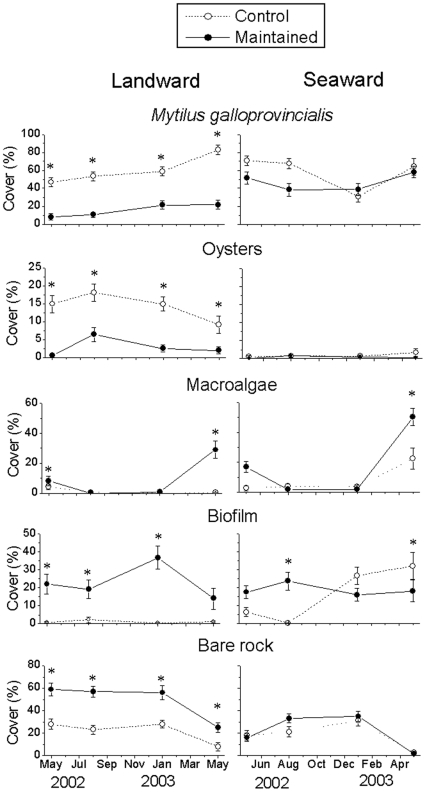
METHODOLOGY/PRINCIPAL FINDINGS: Maintenance caused a marked decrease in the cover of dominant space occupiers, such as mussels and oysters, and a significant enhancement of opportunistic and invasive forms, such as biofilm and macroalgae. These effects were particularly pronounced on sheltered substrata compared to exposed substrata. Experimental application of the disturbance in winter reduced the magnitude of the impacts compared to application in spring or summer. We use these results to identify possible management strategies to inform the improvement of the ecological value of artificial marine infrastructures.
CONCLUSIONS/SIGNIFICANCE: We demonstrate that some of the impacts of globally expanding marine urban infrastructures, such as those related to the spread of opportunistic, and invasive species could be mitigated through ecologically-driven planning and management of long-term maintenance of these structures. Impact mitigation is a possible outcome of policies that consider the ecological features of built infrastructures and the fundamental value of controlling biodiversity in marine urban systems.
由于满足住宅、商业和旅游活动需求的基础设施不断增加,沿海景观正在发生变化。因此,潮间带和浅海生境在很大程度上被各种人工基质(如防波堤、海堤、突堤)所取代。了解这些人工栖息地的生态功能是规划其设计和管理的关键,以尽量减少其影响,并提高其对海洋生物多样性和生态系统功能的潜在贡献。尽管如此,人们很少努力评估人类干扰在塑造海洋人工基础设施上生物组合结构方面的作用。我们检验了这样一个假设,即与城市基础设施上机会主义和入侵物种扩张相关的一些负面影响可能与这些环境中典型的严重人为干扰有关,例如维护和翻新工作带来的干扰。
方法/主要发现:维护工作导致优势空间占据者(如贻贝和牡蛎)的覆盖范围明显减少,而机会主义和入侵形式(如生物膜和大型藻类)显著增加。与暴露基质相比,这种影响在遮蔽基质上更为明显。冬季进行的干扰实验应用与春季或夏季相比,其影响程度显著降低。我们利用这些结果来确定可能的管理策略,为提高人工海洋基础设施的生态价值提供信息。
结论/意义:我们证明,一些全球性扩展的海洋城市基础设施的影响,如与机会主义和入侵物种传播相关的影响,可以通过对这些结构进行长期维护的生态驱动规划和管理来减轻。影响缓解是考虑到建筑基础设施的生态特征和控制海洋城市系统生物多样性的基本价值的政策的可能结果。