Faculty of Physical Therapy, Mahidol University, Thailand.
Nutr J. 2011 Aug 9;10:82. doi: 10.1186/1475-2891-10-82.
It has been known that hypertension is an independent risk factor for cardiovascular disease (CVD). CVD is the major cause of morbidity and mortality in developed and developing countries. Elevation of blood pressure (BP) increases the adverse effect for cardiovascular outcomes. Prevention of increased BP plays a crucial role in a reduction of those outcomes, leading to a decrease in mortality. Therefore, the purpose of this study was to investigate the effects of dietary black sesame meal on BP and oxidative stress in individuals with prehypertension.
Twenty-two women and eight men (aged 49.8 ± 6.6 years) with prehypertension were randomly divided into two groups, 15 subjects per group. They ingested 2.52 g black sesame meal capsules or placebo capsules each day for 4 weeks. Blood samples were obtained after overnight fasting for measurement of plasma lipid, malondialdehyde (MDA) and vitamin E levels. Anthropometry, body composition and BP were measured before and after 4-week administration of black sesame meal or a placebo.
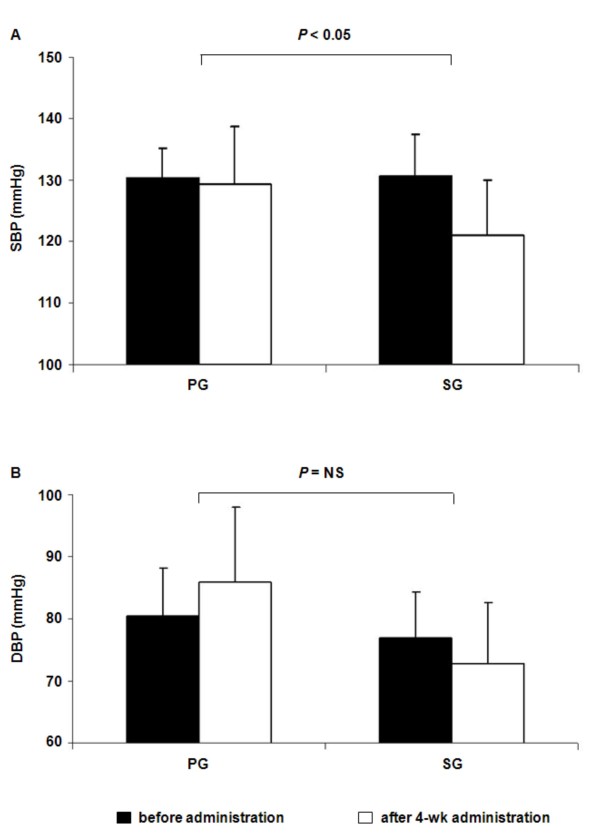
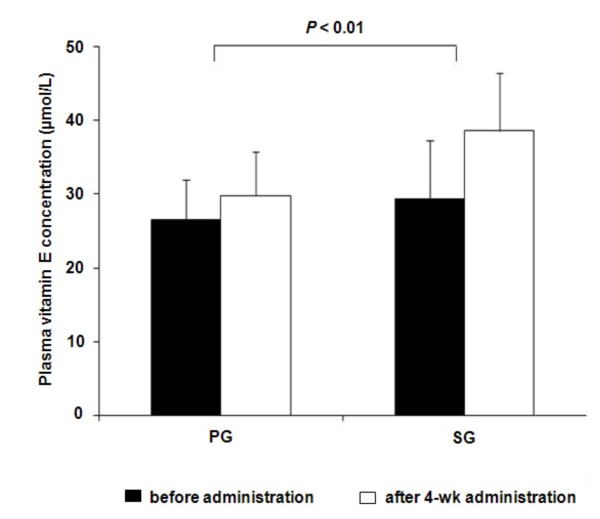
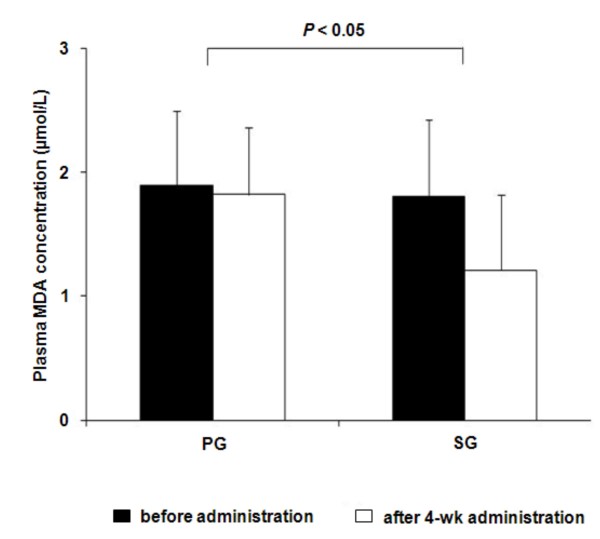
The results showed that 4-week administration of black sesame meal significantly decreased systolic BP (129.3 ± 6.8 vs. 121.0 ± 9.0 mmHg, P < 0.05) and MDA level (1.8 ± 0.6 vs. 1.2 ± 0.6 μmol/L, P < 0.05), and increased vitamin E level (29.4 ± 6.0 vs. 38.2 ± 7.8 μmol/L, P < 0.01). In the black sesame meal group, the change in SBP tended to be positively related to the change in MDA (R = 0.50, P = 0.05), while the change in DBP was negatively related to the change in vitamin E (R = -0.55, P < 0.05). There were no correlations between changes in BP and oxidative stress in the control group.
These results suggest the possible antihypertensive effects of black sesame meal on improving antioxidant status and decreasing oxidant stress. These data may imply a beneficial effect of black sesame meal on prevention of CVD.
高血压是心血管疾病(CVD)的独立危险因素。CVD 是发达国家和发展中国家发病率和死亡率的主要原因。血压升高会增加心血管不良后果的风险。预防血压升高对于降低这些后果、降低死亡率至关重要。因此,本研究旨在探讨食用黑芝麻对高血压前期患者血压和氧化应激的影响。
将 22 名女性和 8 名男性(年龄 49.8 ± 6.6 岁)高血压前期患者随机分为两组,每组 15 名患者。他们每天摄入 2.52 克黑芝麻粉胶囊或安慰剂胶囊,持续 4 周。在禁食过夜后采集血样,以测量血浆脂质、丙二醛(MDA)和维生素 E 水平。在服用黑芝麻或安慰剂 4 周前后测量人体测量学、身体成分和血压。
结果显示,4 周的黑芝麻粉干预可显著降低收缩压(129.3 ± 6.8 与 121.0 ± 9.0mmHg,P<0.05)和 MDA 水平(1.8 ± 0.6 与 1.2 ± 0.6μmol/L,P<0.05),并增加维生素 E 水平(29.4 ± 6.0 与 38.2 ± 7.8μmol/L,P<0.01)。在黑芝麻组中,SBP 的变化与 MDA 的变化呈正相关(R=0.50,P=0.05),而 DBP 的变化与维生素 E 的变化呈负相关(R=-0.55,P<0.05)。在对照组中,BP 和氧化应激的变化之间没有相关性。
这些结果表明,黑芝麻粉可能具有降血压作用,改善抗氧化状态,减少氧化应激。这些数据可能意味着黑芝麻粉对预防 CVD 有益。