Department of Biochemistry, Yong Loo Lin School of Medicine, National University Health System, National University of Singapore, Singapore, Singapore.
PLoS One. 2011;6(8):e22839. doi: 10.1371/journal.pone.0022839. Epub 2011 Aug 1.
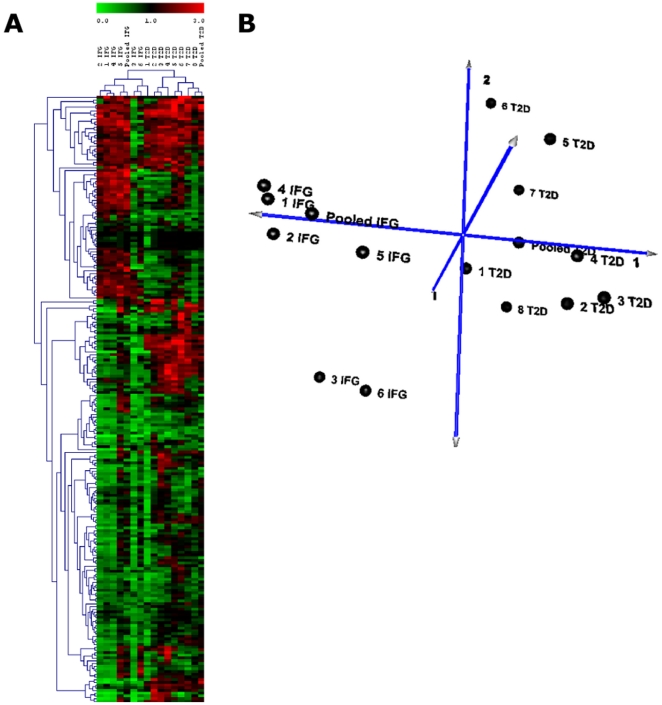
Dysregulation of microRNA (miRNA) expression in various tissues and body fluids has been demonstrated to be associated with several diseases, including Type 2 Diabetes mellitus (T2D). Here, we compare miRNA expression profiles in different tissues (pancreas, liver, adipose and skeletal muscle) as well as in blood samples from T2D rat model and highlight the potential of circulating miRNAs as biomarkers of T2D. In parallel, we have examined the expression profiles of miRNAs in blood samples from Impaired Fasting Glucose (IFG) and T2D male patients.
METHODOLOGY/PRINCIPAL FINDINGS: Employing miRNA microarray and stem-loop real-time RT-PCR, we identify four novel miRNAs, miR-144, miR-146a, miR-150 and miR-182 in addition to four previously reported diabetes-related miRNAs, miR-192, miR-29a, miR-30d and miR-320a, as potential signature miRNAs that distinguished IFG and T2D. Of these microRNAs, miR-144 that promotes erythropoiesis has been found to be highly up-regulated. Increased circulating level of miR-144 has been found to correlate with down-regulation of its predicted target, insulin receptor substrate 1 (IRS1) at both mRNA and protein levels. We could also experimentally demonstrate that IRS1 is indeed the target of miR-144.
We demonstrate that peripheral blood microRNAs can be developed as unique biomarkers that are reflective and predictive of metabolic health and disorder. We have also identified signature miRNAs which could possibly explain the pathogenesis of T2D and the significance of miR-144 in insulin signaling.
在各种组织和体液中,miRNA(微 RNA)表达的失调已被证明与多种疾病相关,包括 2 型糖尿病(T2D)。在这里,我们比较了 T2D 大鼠模型不同组织(胰腺、肝脏、脂肪组织和骨骼肌)以及血液样本中的 miRNA 表达谱,并强调了循环 miRNA 作为 T2D 生物标志物的潜力。同时,我们还检查了空腹血糖受损(IFG)和 T2D 男性患者血液样本中的 miRNA 表达谱。
方法/主要发现:我们采用 miRNA 微阵列和茎环实时 RT-PCR,鉴定出四个新的 miRNA(miR-144、miR-146a、miR-150 和 miR-182),以及四个先前报道的与糖尿病相关的 miRNA(miR-192、miR-29a、miR-30d 和 miR-320a),作为区分 IFG 和 T2D 的潜在特征 miRNA。在这些 microRNAs 中,促进红细胞生成的 miR-144 被发现高度上调。发现循环 miR-144 水平升高与预测靶基因胰岛素受体底物 1(IRS1)的 mRNA 和蛋白水平下调相关。我们还可以通过实验证明 IRS1 确实是 miR-144 的靶基因。
我们证明外周血 microRNAs 可以作为独特的生物标志物开发,反映和预测代谢健康和紊乱。我们还确定了特征性 miRNA,这些 miRNA 可能解释 T2D 的发病机制以及 miR-144 在胰岛素信号传导中的意义。