National Institute of Diabetes and Digestive and Kidney Diseases, National Institutes of Health, Bethesda, Maryland, USA.
Diabetes. 2011 Oct;60(10):2578-87. doi: 10.2337/db11-0058. Epub 2011 Aug 10.
The role of adenosine (ADO) in the regulation of glucose homeostasis is not clear. In the current study, we used A1-ADO receptor (A1AR)-deficient mice to investigate the role of ADO/A1AR signaling for glucose homeostasis.
After weaning, A1AR(-/-) and wild-type mice received either a standard diet (12 kcal% fat) or high-fat diet (HFD; 45 kcal% fat). Body weight, fasting plasma glucose, plasma insulin, and intraperitoneal glucose tolerance tests were performed in 8-week-old mice and again after 12-20 weeks of subsequent observation. Body composition was quantified by magnetic resonance imaging and epididymal fat-pad weights. Glucose metabolism was investigated by hyperinsulinemic-euglycemic clamp studies. To describe pathophysiological mechanisms, adipokines and Akt phosphorylation were measured.
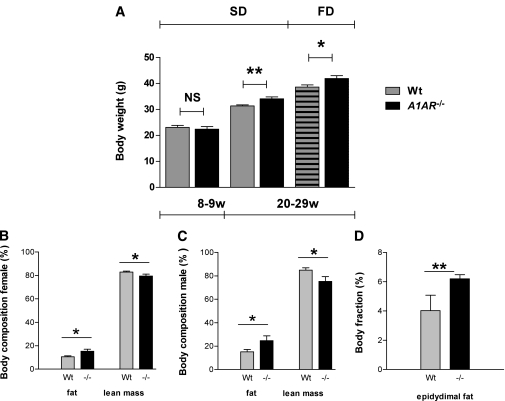
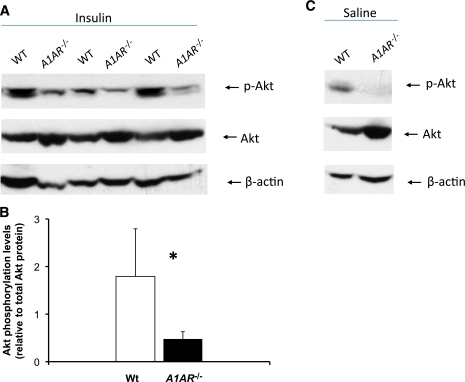
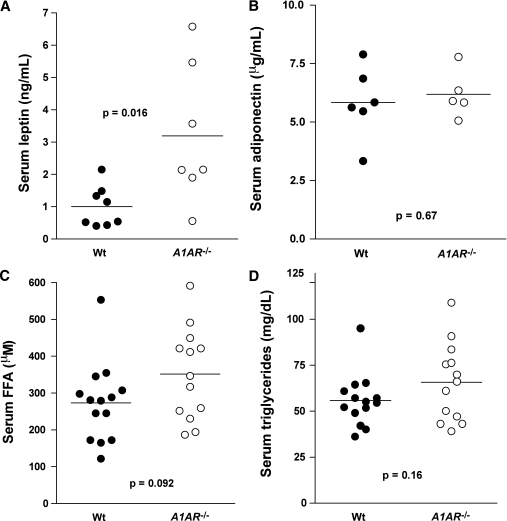
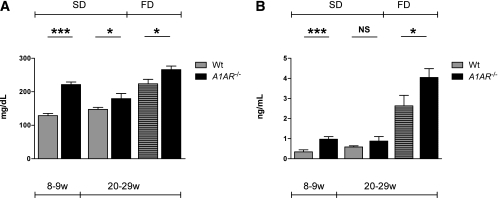
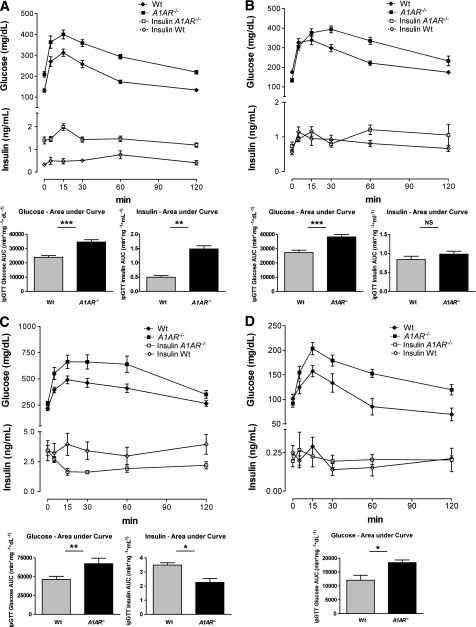
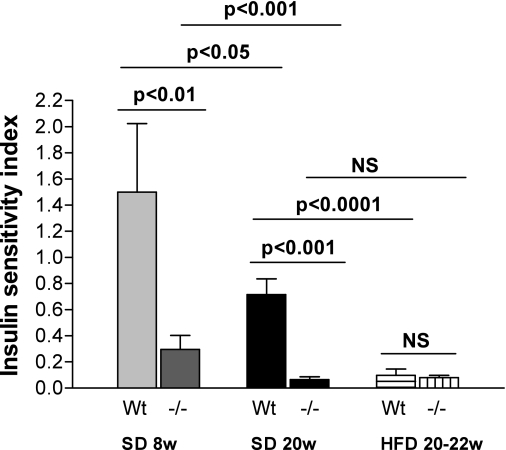
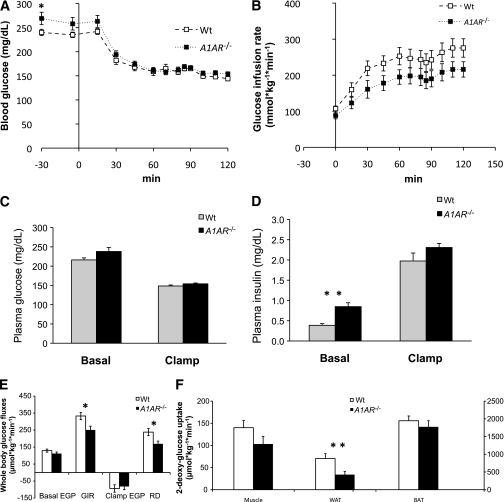
A1AR(-/-) mice were significantly heavier than wild-type mice because of an increased fat mass. Fasting plasma glucose and insulin were significantly higher in A1AR(-/-) mice after weaning and remained higher in adulthood. An intraperitoneal glucose challenge disclosed a significantly slower glucose clearance in A1AR(-/-) mice. An HFD enhanced this phenotype in A1AR(-/-) mice and unmasked a dysfunctional insulin secretory mechanism. Insulin sensitivity was significantly impaired in A1AR(-/-) mice on the standard diet shortly after weaning. Clamp studies detected a significant decrease of net glucose uptake in A1AR(-/-) mice and a reduced glucose uptake in muscle and white adipose tissue. Effects were not triggered by leptin deficiency but involved a decreased Akt phosphorylation.
ADO/A1AR signaling contributes importantly to insulin-controlled glucose homeostasis and insulin sensitivity in C57BL/6 mice and is involved in the metabolic regulation of adipose tissue.
腺苷(ADO)在调节葡萄糖稳态中的作用尚不清楚。在本研究中,我们使用 A1-ADO 受体(A1AR)缺陷小鼠来研究 ADO/A1AR 信号对葡萄糖稳态的作用。
在断奶后,A1AR(-/-)和野生型小鼠分别接受标准饮食(12 kcal%脂肪)或高脂肪饮食(HFD;45 kcal%脂肪)。在 8 周龄的小鼠中进行体重、空腹血糖、血浆胰岛素和腹腔内葡萄糖耐量试验,并在随后观察的 12-20 周后再次进行。通过磁共振成像和附睾脂肪垫重量定量身体成分。通过高胰岛素-正常血糖钳夹研究来研究葡萄糖代谢。为了描述病理生理机制,测量了脂肪因子和 Akt 磷酸化。
A1AR(-/-)小鼠比野生型小鼠明显更重,因为脂肪量增加。断奶后,A1AR(-/-)小鼠的空腹血糖和胰岛素水平明显升高,成年后仍保持较高水平。腹腔内葡萄糖挑战显示 A1AR(-/-)小鼠的葡萄糖清除速度明显较慢。HFD 增强了 A1AR(-/-)小鼠的这种表型,并揭示了胰岛素分泌功能障碍的机制。A1AR(-/-)小鼠在断奶后不久接受标准饮食时,胰岛素敏感性明显受损。钳夹研究检测到 A1AR(-/-)小鼠的净葡萄糖摄取量显著减少,肌肉和白色脂肪组织的葡萄糖摄取量减少。这些作用不是由瘦素缺乏引起的,而是涉及 Akt 磷酸化减少。
ADO/A1AR 信号对 C57BL/6 小鼠的胰岛素控制的葡萄糖稳态和胰岛素敏感性有重要贡献,并参与脂肪组织的代谢调节。