Health Outcomes & Behavior Program, Moffitt Cancer Center, 12902 Magnolia Drive, MRC-CANCONT, Tampa, FL 33612-9416, USA.
J Health Econ. 2011 Sep;30(5):1057-63. doi: 10.1016/j.jhealeco.2011.07.009. Epub 2011 Jul 21.
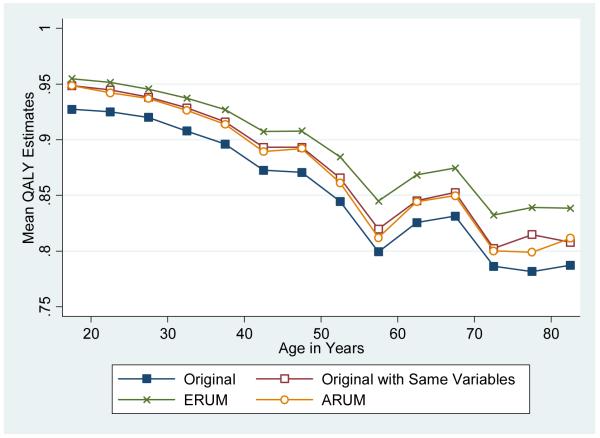
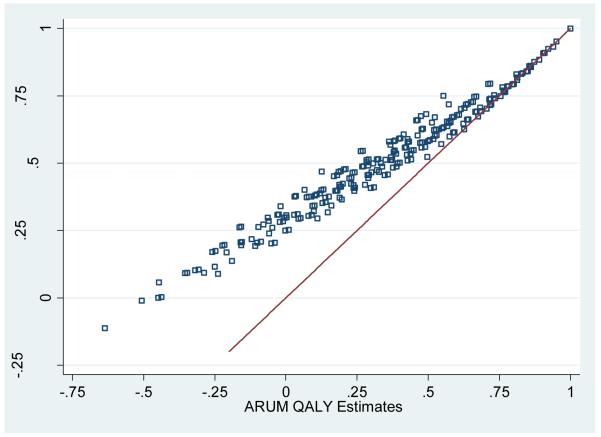
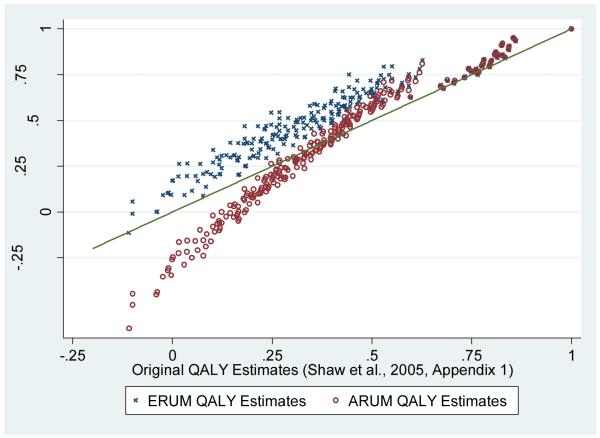
In the original US valuation study of EQ-5D states, all worse-than-dead time trade-off responses (26% of the sample) were divided by 39 to increase the QALY estimates. This transformation has no theoretical justification and motivates this re-examination. Using the publically available dataset, we compared three alternative random utility models: instant (IRUM), angular (ARUM), and episodic (ERUM) models. Each leads to a distinct econometric estimator: mean ratio, ratio of means, and coefficient, respectively. IRUM suggests that 203 of the 243 EQ-5D states are worse-than-dead, which has little face validity compared to ARUM and ERUM (42 and 3 WTD states). ARUM and ERUM estimates are proportionally related such that losses in QALYs are approximately 37% larger under ARUM than ERUM. Compared to ERUM, economic evaluations using ARUM estimates emphasize quality of life, and this difference may influence policy decisions. Either ERUM or ARUM values sets are recommended over the original, transformed set.
在最初的 EQ-5D 状态的美国估值研究中,所有比死亡还差的时间权衡反应(样本的 26%)都被除以 39,以增加 QALY 估计值。这种转换没有理论依据,这促使了重新检验。我们使用公开可用的数据集,比较了三种替代的随机效用模型:即时(IRUM)、角(ARUM)和 episodic(ERUM)模型。每种模型都导致了一个独特的计量经济学估计器:均值比、均值比和系数。IRUM 表明,在 243 个 EQ-5D 状态中,有 203 个比死亡还差,与 ARUM 和 ERUM(42 和 3 WTD 状态)相比,这几乎没有表面效度。ARUM 和 ERUM 的估计值是成比例相关的,因此在 ARUM 下,QALY 的损失比 ERUM 大约大 37%。与 ERUM 相比,使用 ARUM 估计值进行的经济评估更强调生活质量,这种差异可能会影响政策决策。建议使用 ERUM 或 ARUM 值集替代原始的、转换后的集。